Bernabe Towing & Recovery
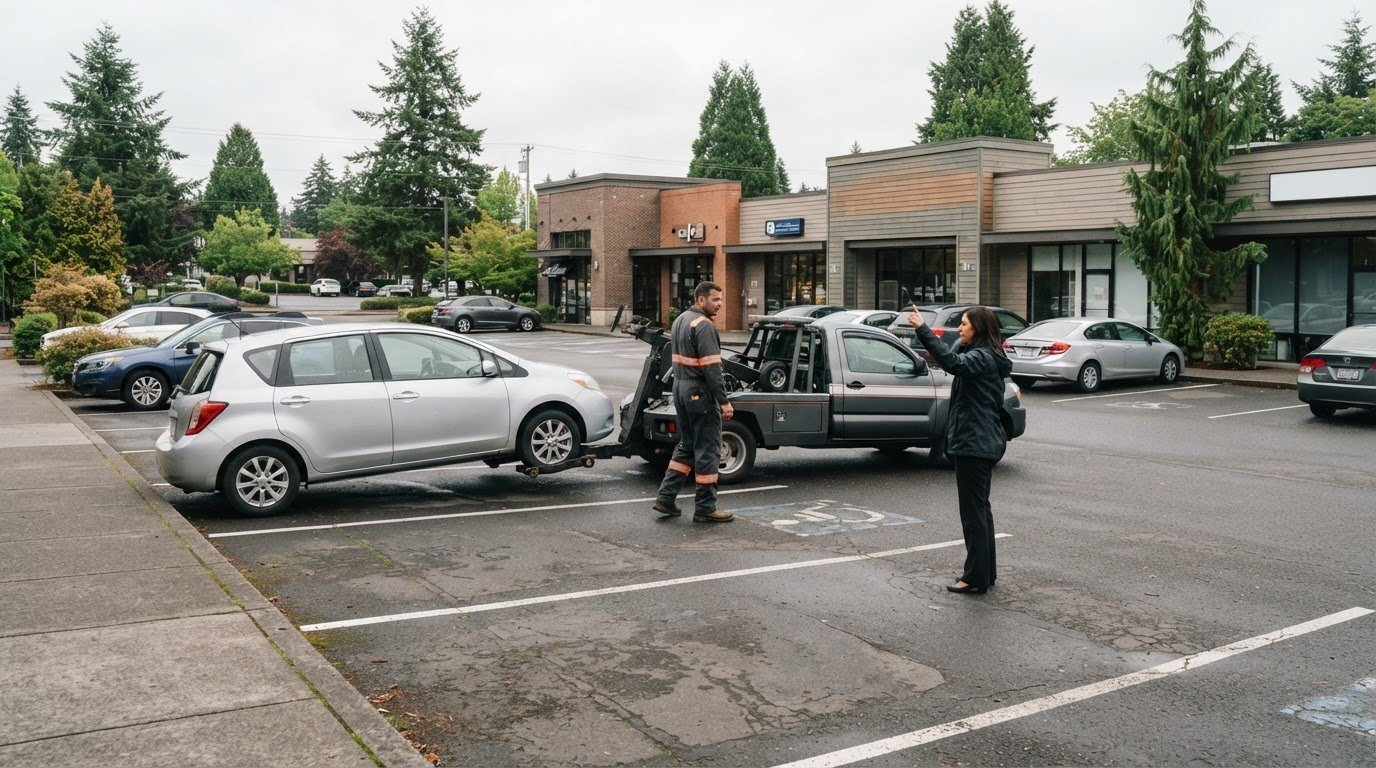
For commercial property parking enforcement and private property towing in Lake Oswego, Oregon, property managers can request scheduled or random patrols after reviewing site rules, authorized contacts, and towing notices. Written rules should explain permits, guest parking, assigned spaces, customer areas, and overnight parking. Vehicle removal depends on proper authorization, notice, and applicable legal requirements.
Clear rules and visible notices help drivers understand where they may park and give managers a consistent way to address recurring issues. This guide covers preparing a property for patrols, enforcing assigned spaces, and arranging a private-property tow when appropriate. It also explains which property details and access information make service setup more straightforward.
Key Takeaways
- Prepare a clear service setup with the property address, written parking rules, towing notices, and current authorized contacts.
- Plan patrols around the property’s access points and problem areas, including gates, garage clearance, and fire lanes.
- Make retail and office parking expectations easy to understand by defining customer spaces, reserved areas, and overnight parking rules.
- For an assigned-space violation, removal depends on proper authorization, notice, and applicable legal conditions.
- Share access details and parking-zone information to help organize private-property impound service across the site.
Private property impound services
Private-property towing in Lake Oswego depends on the site’s rules, proper authorization, towing notices, and applicable legal requirements. A property’s procedures should specify who can approve a tow and how drivers can find the appropriate contact afterward.
Permit or registration requirements for private-property towing depend on applicable Oregon and local rules. Owning a parking lot alone does not authorize every tow. The vehicle’s circumstances, property procedures, notice, and legal requirements all matter.
Vehicle Retrieval Rights
Drivers looking for a towed vehicle should read the towing notice at the property and contact the listed representative. Ask where the vehicle was taken and what steps are required to retrieve it. Have the vehicle details and the location where it was parked ready when making the inquiry.
If a tow is disputed, record the property location, parking space, and circumstances. These details help the property representative review whether the vehicle was in a restricted area and whether the removal followed the site’s procedures.
Towing Fees and Penalties
Applicable laws and regulations govern maximum towing and storage charges, so do not assume a specific amount without checking those requirements. In standard private-property arrangements, towing and storage charges are generally assessed to the responsible vehicle owner in accordance with governing rules.
Consequences for illegal or unauthorized towing depend on the applicable requirements and the circumstances of the removal. Authorization, notice, and the vehicle’s situation are key considerations. Property managers can reduce disputes by keeping written rules, current approvals, and towing notices aligned with site procedures.
Finding a Towed Vehicle
Start at the parking area. Read the posted towing notices, then contact the property manager or the representative named on the notice. Share the vehicle’s make, model, color, and license plate, along with the parking area and approximate time it was left there. These details can help identify the correct removal record.
If a property has several entrances or separate parking zones, identify the specific building, lot, or entrance where the vehicle was parked. A Lake Oswego site may have distinct customer, assigned, and overnight parking areas, so precise location details help narrow the search. Keep the notice and any written response for reference.
Before arranging a tow, property representatives should make the site’s process clear and repeatable:
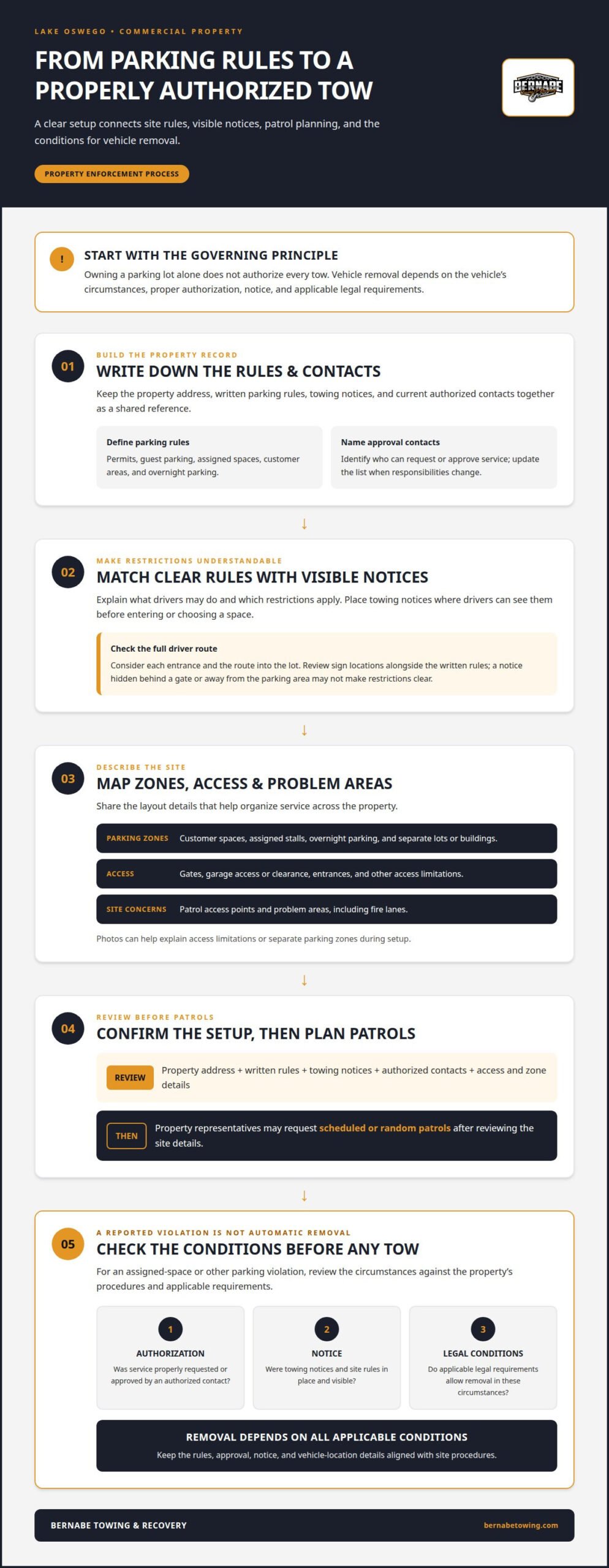
- Keep written rules for permits, guests, assigned spaces, customer parking, and overnight parking.
- Maintain an updated list of people authorized to request or approve service.
- Review towing notices and place them where drivers can see them before entering or choosing a space.
- Describe gates, garage access, and separate parking zones during service setup.
Photos can help explain access limitations or separate parking zones during setup. Removal of an abandoned or apparently abandoned vehicle also depends on its circumstances and applicable legal requirements. A clear record of the rules, authorization, and vehicle location supports an orderly decision.
Written parking rules and authorized contacts
A clear Lake Oswego parking plan starts with written rules, visible towing notices, and current approval contacts. These details help connect a reported violation to the property’s actual parking conditions.
Written Parking Rules
Write clear rules for permits, guests, assigned spaces, customer areas, and overnight parking. Define each area by its use, such as a customer lot beside an office entrance or a reserved stall behind an apartment building. State what drivers may do and which restrictions apply. Clear wording helps distinguish a permitted visitor from a vehicle using a restricted space.
Required Towing Signs
At Lake Oswego properties, place towing notices where drivers can see them before entering or choosing a space. Consider each entrance and the route drivers take to the lot. A notice hidden behind a gate or away from the parking area may not make the restrictions clear. Review sign locations alongside the written rules.
Authorized Property Contacts
Keep an up-to-date list of people authorized to request or approve service. Identify each contact by role, such as the property manager or community manager, and remove former representatives when responsibilities change. During setup, share the property address, rules, and towing notices with the appropriate contacts. This gives everyone a consistent basis for handling a reported violation.
Keep the rules and approval process together in one property record. Include current parking instructions, notice locations, the address, and authorized contacts. Describe each zone separately when a property has multiple areas. For example, identify customer spaces, assigned stalls, and overnight parking by location or building. Photos can clarify a complex layout or access limits during setup.
- Record which spaces require permits and how guest parking works.
- Identify assigned stalls and customer-only areas in the written rules.
- Explain overnight restrictions and any garage or gate access details.
- Keep contact names and approval responsibilities current.
Before patrols begin, property representatives may request a review of the address, rules, notices, and authorized contacts. They may then request scheduled or random patrols after those details have been reviewed. A consistent setup gives the property and its service team a shared reference when a parking concern arises. A review of parking rules and towing notices can help organize that setup.
Lake Oswego property parking enforcement may involve apartment permits, HOA parking rules, customer-only spaces, reserved stalls, garages, and abandoned-vehicle concerns. Keeping these categories in the property record helps authorized contacts connect a report with the relevant parking instructions. The record can distinguish permit questions, use of reserved or customer-only spaces, garage concerns, and reports involving abandoned vehicles while preserving the property’s established approval process.
Lake Oswego property managers should keep an up-to-date list of people authorized to request or approve service. An apartment manager may request vehicle removal when applicable Oregon law, local requirements, and the property’s authorization procedures are satisfied. Follow the documented approval process, with relevant property rules and contact details available to those responsible. Keeping this information current clarifies the manager’s role when considering a removal request.
Commercial parking lot enforcement
Commercial property parking enforcement and private property towing in Lake Oswego, Oregon, depend on site rules, driver notice, authorization, and the vehicle’s location. Parking patrols can identify violations, while a tow is appropriate only when authorization and applicable legal requirements support removal.
Parking Enforcement and Towing Options
Parking enforcement and towing serve different purposes. Patrols help identify vehicles that conflict with a commercial property’s rules. A tow removes a vehicle only when authorization, notice, and applicable legal requirements support removal. Managers can request scheduled or random patrols after reviewing the property rules, contacts, and towing notices.
Choose an approach based on the problem area. For example, a customer lot with recurring unauthorized parking may need patrols focused on customer spaces. A blocked fire lane presents a separate access concern. Site setup can review entrances, gates, garage clearance, fire lanes, and locations where violations occur frequently. These details help define patrol priorities.
A practical enforcement plan links each parking area to a specific rule and response:
- Identify customer spaces, assigned stalls, and restricted zones.
- Mark entrances and gates that affect patrol access.
- Note garage clearance and fire-lane locations.
- Record frequent violation areas for patrol planning.
This approach helps property representatives address recurring parking issues without treating every violation as an automatic tow. A patrol can identify a concern, but removal requires proper authorization and applicable legal conditions.
Rules for Nonconsensual Commercial Towing
Oregon laws governing nonconsensual towing from commercial lots apply alongside local requirements and the property’s authorization procedures. A removal decision should account for the vehicle’s circumstances, required notice, and approval by an authorized representative. The specific facts matter, including where the vehicle was parked and which written rule applies.
At Lake Oswego sites, place towing notices where drivers can see them before entering or choosing a space. This connects the posted notice with the parking rules drivers encounter. A notice at a remote building entrance may not reach drivers using a separate lot entrance, so review every route into the parking area.
For commercial property parking enforcement and private property towing in Lake Oswego, Oregon, organize the key details before requesting patrols or a tow:
- Identify the exact lot, entrance, and parking zone.
- Describe the restriction that applies to that space.
- Provide the current notice and the authorized contact.
- Explain access details, including gates and garage clearance.
Reviewing these details helps distinguish routine enforcement from a removal request. Lake Oswego property representatives can request patrols after reviewing the rules, contacts, and towing signs. The vehicle’s circumstances and applicable requirements still determine whether a nonconsensual tow is appropriate.
Reserved and assigned parking spaces
Reserved and assigned spaces need clear identification before managers can address unauthorized parking. In a Lake Oswego office lot, for example, a tenant’s assigned stall should be distinguishable from customer parking. A visible space label and matching written rule clarify which restriction applies. Property records should also identify who is authorized to manage each assigned area.
Map assigned stalls to their buildings, tenants, or other intended users. Keep the map consistent with the labels drivers see onsite. If a stall changes from employee parking to customer use, update the written rule and site information together. This reduces confusion between a permitted general space and a restricted stall.
A vehicle in a reserved space should be removed only when authorization, notice, and legal requirements are satisfied. Before requesting action, a manager should connect the vehicle to the specific stall and its posted restriction. For example, assess a vehicle in a labeled tenant space under that space’s rule, not a separate customer-parking restriction.
Useful records make that assessment specific. A report can identify:
- The building, lot, and assigned stall where the vehicle is parked.
- The restriction that applies to that exact space.
- The towing notice visible to drivers entering or choosing a space.
- The property representative authorized to approve service.
These details also help distinguish a one-time parking error from a recurring issue. If a vehicle repeatedly occupies an assigned stall, note the location and relevant dates in the property record. Keep the record factual: identify the space, posted rule, and observed vehicle. Avoid vague descriptions such as “wrong parking,” which do not show which assignment was affected.
Property layout matters too. Numbered stalls beside an office entrance may be easy to describe, while a large site may have separate assigned zones behind different buildings. During setup, note gates, garage access, and hard-to-reach areas. Photos can help explain a complex layout or separate parking zones.
Before requesting patrols, align the assigned-space map, written restrictions, notices, and authorized contacts. Patrols can then focus on locations where parking conflicts occur. Any removal still depends on the specific vehicle, proper authorization, notice, and applicable legal requirements. Clear records help representatives explain the issue without treating every occupied stall as an automatic tow.
Retail and office parking rules
Retail and office lots often serve different drivers within the same Lake Oswego property. A clear plan separates customer parking from employee stalls, reserved spaces, and areas intended for other uses. For example, a sign at a shop entrance can identify customer parking, while an office building’s written rules explain assigned spaces. Distinct rules help representatives assess a report against the correct area.
Describe each parking zone and its intended users. A retail property might identify customer spaces near storefronts and mark reserved stalls separately. An office property might distinguish employee parking from visitor spaces. If both uses share a lot, define the boundary between them in the property rules. Avoid broad labels that leave drivers unsure whether they may use a space.
Explain how permits and guest parking work in each area. For instance, state which spaces require a permit and where visitors may park. Define customer-only areas plainly, then describe any overnight restrictions. Written instructions should match the signs drivers see before entering or choosing a space. If a zone’s purpose changes, update the rules and relevant notices together.
Retail and office managers can use a simple zone record to organize these details:
- Identify the lot and the building or entrance it serves.
- Describe customer, employee, visitor, and assigned parking areas.
- Record permit, guest, and overnight rules for each zone.
- Note where drivers can see the notice before choosing a space.
- Keep the appropriate property representative’s approval details current.
Patrol planning can focus on the issues a property actually faces. A retail manager may want attention on customer spaces occupied by vehicles unrelated to the property. An office manager may need to address repeated use of assigned stalls. Property representatives can request scheduled or random patrols after reviewing the rules, authorized contacts, and towing notices.
For either property type, a reported violation does not automatically justify removal. The vehicle’s location, applicable restriction, proper authorization, notice, and legal requirements all matter. Assess a vehicle in a visitor space under that space’s rule, not a customer-only restriction elsewhere. Clear zone descriptions help representatives explain the issue and make consistent decisions.
To organize retail or office parking zones, request a commercial parking enforcement review.
When managing retail and office parking, representatives can keep contact information accessible. Bernabe Towing & Recovery lists its office and tow yard at 9117 SW Burnham St, Tigard, OR 97223.
Bernabe Towing & Recovery
Bernabe Towing & Recovery can help with vehicle emergencies at a Lake Oswego property. If a driver’s vehicle is disabled after an incident, Emergency Towing or Accident Recovery can address the immediate roadside need. Lockout Assistance and Jump Start Service can help with other common vehicle problems.
Parking rules and tow authorization remain central to property decisions. For managers, clear site rules identify restricted spaces and authorized contacts. For drivers facing a breakdown, collision, lockout, or dead battery, roadside assistance addresses the vehicle problem separately from a parking dispute.
Contact Bernabe Towing & Recovery to discuss help with a vehicle emergency.
Set the next step for your property
Turn your parking plan into a working site record. Keep current rules, space designations, notices, and approval contacts together so representatives can apply them consistently. For commercial property parking enforcement and private property towing in Lake Oswego, Oregon, this preparation gives each reported concern a clear starting point and helps managers distinguish parking issues from vehicle emergencies.
Drivers dealing with a disabled vehicle, collision, or lockout have a different immediate need. Bernabe Towing & Recovery offers Emergency Towing, Accident Recovery, and Lockout Assistance for these situations. Property managers and drivers can take the next step based on the issue at hand, without treating every parking concern as an automatic tow.
Contact Bernabe Towing & Recovery to discuss assistance with a vehicle emergency. Clear decisions and a defined next step help keep Lake Oswego properties moving smoothly.
Frequently Asked Questions
Can a property manager request parking patrols in Lake Oswego?
Yes. A Lake Oswego property representative can request scheduled or random patrols after the site’s parking rules, towing notices, and authorized contacts have been reviewed. For a property with several lots, provide a site map or photos showing separate zones, entrances, gates, and garage access. This gives patrol planning useful context, especially when customer spaces and assigned stalls are in different areas.
Does Bernabe Towing provide private property impound in Lake Oswego?
Yes. Bernabe Towing & Recovery provides private-property towing in Lake Oswego. For an impound request, the property’s authorization procedures and the vehicle’s circumstances matter. A manager can identify the site, specific parking area, and reason for the request. Removal depends on proper authorization, notice, and applicable legal requirements; a parking complaint alone does not make every tow appropriate.
What are Lake Oswego’s rules for parking enforcement on private commercial property?
Enforcement should follow the property’s written rules, visible towing notices, authorized contacts, and applicable legal requirements. The rules should distinguish areas such as customer parking, assigned stalls, permits, guest spaces, and overnight parking. For example, a vehicle in an office’s reserved stall should be assessed against that stall’s restriction, not a rule for a separate retail lot. Removal requires appropriate authorization and notice.
How must a commercial property owner authorize and document a private-property tow?
Follow the property’s established authorization process and keep a clear record of each request. Document the property address, vehicle location, relevant restriction, and representative approving service. Include the applicable parking notice and access details, such as a gate or separate parking zone. These records explain why the request was made and connect it to the correct space and rule.