Bernabe Towing & Recovery
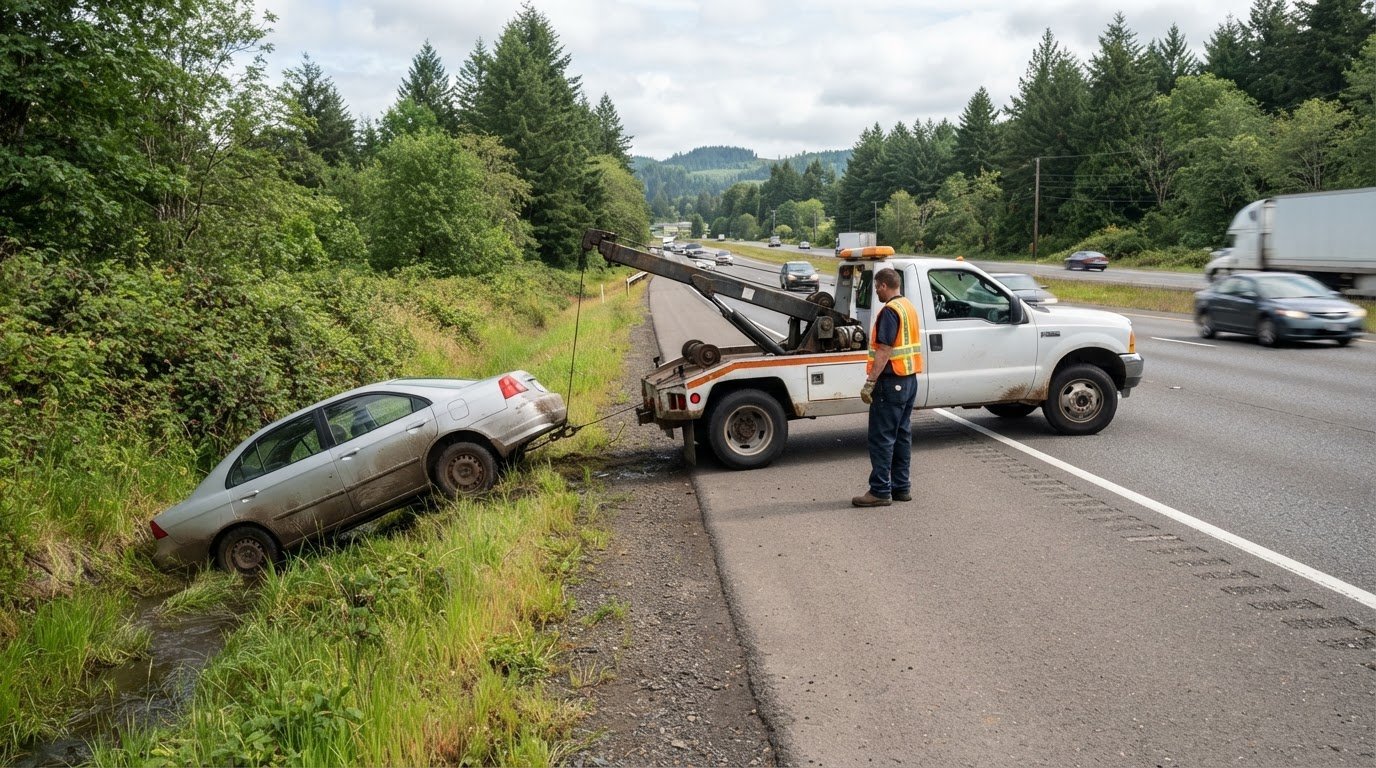
A breakdown on Highway 26 calls for clear, practical help. Emergency tow truck services near Highway 26 in Hillsboro, Oregon can include emergency towing and accident recovery, plus roadside help for lockouts, dead batteries, flat tires, and vehicles stuck off the roadway. The right response depends on what happened and where the vehicle is stopped.
It’s understandable to want to know what help is available and how long dispatch may take before making a call. Move as far from traffic as you safely can, switch on your hazard lights, and remain inside if your vehicle is safely away from traffic. A mile marker and last exit number can help pinpoint your location. Share whether the vehicle is blocking a lane, on a shoulder, or unable to move so the situation is clear. This guide explains which towing and roadside services are available, what can affect dispatch timing, what details to provide, and how to pull over safely.
Key Takeaways
- Identify the right type of help, from towing and accident recovery to roadside assistance for a lockout, dead battery, flat tire, or stuck vehicle.
- Understand which conditions can affect dispatch timing, including your precise location and the situation on the road.
- Share a nearby mile marker and last exit number to help pinpoint your location on Highway 26.
- Learn practical ways to make a disabled vehicle more visible and reduce risk while waiting in a safe place.
- See how service coverage around Hillsboro and Washington County relates to your vehicle’s location and needs.
What towing services are available in Hillsboro?
Hillsboro drivers can request towing or roadside assistance when a vehicle cannot continue safely. The right service depends on the problem, vehicle, and exact location.
Roadside Assistance Options
Roadside assistance can address a lockout, dead battery, flat tire, or vehicle stuck off the roadway. A tow may be needed when the vehicle cannot be moved safely or the problem prevents it from continuing. Fuel delivery is another roadside service drivers may encounter. For AAA roadside assistance in Oregon or Idaho, use the request channel tied to your membership and provide your location and vehicle problem.
If a trailer is involved or a load has shifted, tell dispatch and describe what has moved or become unstable. This helps clarify the situation before a response is arranged. Don’t try to shift a heavy load beside traffic. The vehicle, trailer, and recovery needed all affect the appropriate assistance.
Breakdown and Crash Guidance
After a breakdown on Highway 26, move onto the far-right shoulder if you can leave the road safely, and switch on your hazard lights. If your vehicle is safely away from traffic, stay inside while waiting. Don’t push the vehicle or stand directly in front of or behind it.
After a crash, prioritize getting away from moving traffic when it’s safe to do so, then share the incident location and vehicle condition. Oregon towing, storage, and fee arrangements depend on the circumstances and the tow requested. Fees depend on factors such as service type, distance, vehicle condition, and recovery needs; request a quote before service when circumstances allow.
Near Hillsboro, access or incident response may involve coordination with Oregon DOT or Oregon State Police. Give dispatch your direction of travel, nearest exit, mile marker, and whether the vehicle is blocking a lane. Report any crash, trailer, or shifted load so responders understand the scene. Follow instructions from officers or roadside personnel at the location.
Online roadside requests can convey the same practical details: a callback number, vehicle description, location, and the problem. Include a mile marker and last exit number when available. For an immediate hazard or a vehicle blocking traffic, use a direct call rather than relying on an online form alone.
Insurance or roadside-assistance membership may affect how a driver pays, but coverage depends on the specific policy or plan. Don’t assume a membership covers every tow or recovery. Hillsboro towing accepts cash, credit cards, and debit cards. State the service needed and payment method when arranging help.
Dispatch and estimated response times
Response times near Hillsboro depend on the truck’s location, traffic, route, and work required. A clear location and accurate description help dispatch assess the situation and provide a useful estimate.
Comparing Availability and Arrival Times
Compare the estimated arrival time for your exact location, not a general Portland or Portland metro estimate. Tell dispatch your direction of travel, nearest exit, mile marker, and whether your vehicle is safely off the road. Ask whether the estimate reflects current traffic and the type of assistance needed.
Customer reviews describe different response examples: one reports arrival within 30 minutes for a late-evening tow from southeast Portland to Tigard, while another describes a 20-25-minute arrival after a car stopped at 3 a.m. These are individual experiences, not a timetable for every Highway 26 call.
Reviews can offer insight into communication and reported outcomes, but compare details carefully. A city-street tow may differ from a shoulder recovery near Hillsboro. Look for a similar situation, time of day, and vehicle problem. Prioritize a current estimate and clear dispatch communication over an arrival time reported for a different call.
24/7 Contact and Response Times
Phone numbers are specific to each towing provider or roadside assistance plan. Use the direct dispatch number for the service you select, or the assistance number connected to your plan. A 24-hour contact listing concerns when calls can be received; it does not establish how soon a truck will reach Highway 26.
When you speak with dispatch, give your location first, then explain the vehicle issue and any immediate traffic hazard. Ask for the current estimated arrival time and what could affect it, such as congestion, road access, or a more complex recovery. If the situation changes, update dispatch so the estimate reflects the new details.
For example, a vehicle on a wide shoulder may need a different response from one blocking a lane or stuck beyond the pavement. A dead battery, flat tire, and collision recovery also require different work. Clear details help dispatch determine which service fits and whether the vehicle can be handled safely where it is.
Keep your phone available and stay where you can communicate safely. If traffic conditions make the original stopping place unsafe, move only if you can do so without increasing danger, then tell dispatch your updated position. For help arranging a response, request towing assistance.
Service coverage across Hillsboro and Washington County
Coverage around Hillsboro and Washington County depends on the vehicle’s exact location and the assistance needed. Highway 26 calls can involve a shoulder, an exit, or a nearby local road, and each pickup point affects truck access. Give the direction of travel and nearest exit when describing your location. For a vehicle that breaks down beyond the highway, name the road or nearby landmark instead.
A clear destination helps define the job, too. For example, a driver stranded on Highway 26 may need a tow to a nearby address or another destination within the Portland metro area. Share both the pickup location and where you want the vehicle taken. Dispatch can then assess the route, vehicle condition, and type of towing required before arranging the response.
Hillsboro has varied road settings, from busy highway lanes to local streets and parking areas. Access matters: a vehicle in a lot may be easier to reach than one behind a barrier or beside fast-moving traffic. Explain whether the vehicle is on pavement, on a shoulder, or off the roadway. These details help identify the right equipment and approach for the location.
The problem also shapes the service needed in Washington County. A flat tire on an accessible road may call for roadside assistance, while a vehicle that cannot move may need towing. A dead battery differs from a car stuck on soft ground. Describe the symptom and the vehicle’s position, rather than reporting only that it has stopped.
Nearby place names can make a location easier to pinpoint, but they should support, not replace, road details. On Highway 26, provide the route direction, last exit, and mile marker if visible. On a local Hillsboro street, give the street name, nearest intersection, and a recognizable landmark. If the vehicle is in a business parking area, identify the entrance or lot section.
If your trip begins in Hillsboro and ends elsewhere in the Portland metro, give dispatch the destination. The route, distance, vehicle condition, and access at both locations can affect how the tow is arranged. If a flat tire can be changed roadside, a tow may not be needed. If damage makes moving the vehicle unsafe, towing may be appropriate.
Washington County drivers can make coverage assessment more efficient by sending one accurate location update. If the vehicle moves or is relocated, share the new position promptly. Include the direction of travel on Highway 26, whether the vehicle blocks traffic, and whether it is a car or light-duty truck. This practical detail helps match the response to the location and situation.

Information needed to request service
Give dispatch a precise pickup location, the vehicle’s condition, and the help needed. On Highway 26 near Hillsboro, a mile marker and last exit number can narrow down where the truck should go. Add the direction of travel and a nearby landmark, such as an exit or intersection. If you’re on a local road, name the street and closest cross street.
Describe the problem in plain terms. Say whether the vehicle has a flat tire, a dead battery, collision damage, or is stuck off the pavement. Explain whether it can move under its own power or is blocking traffic. These details help dispatch distinguish roadside assistance from towing or recovery.
Include vehicle details relevant to the tow, such as make, model, approximate size, and whether it’s a car or light-duty truck. Mention a trailer, visible damage, or a wheel that won’t turn. If you think a flatbed may be needed, explain why, such as damage that makes moving the vehicle difficult. Naming equipment alone doesn’t explain the vehicle’s condition.
Share the destination as well as the pickup point. A request to move a vehicle from Highway 26 to an address in Hillsboro differs from transport toward Beaverton or another Washington County location. Give the destination clearly, and note any access issue at either end, such as a narrow driveway or a vehicle parked inside a structure.
- Location: Highway direction, mile marker, last exit, or street and cross street.
- Vehicle: Make, model, size, and whether it has a trailer.
- Problem: Flat tire, battery issue, crash damage, or stuck vehicle.
- Access: Whether it blocks traffic or sits off the roadway.
- Destination: The address or area for the requested transport.
If submitting an online request, enter the same details you would give by phone and include a callback number. Keep the message focused: “eastbound Highway 26 near the last exit, sedan with a flat tire, on the shoulder” is more useful than “car trouble near Hillsboro.” Add a safe place to meet if the vehicle’s position makes it hard to locate.
Before sending your request, review the location and callback number for errors. If the vehicle moves or the situation changes, update dispatch with its new position. Clear information helps match the response to the vehicle and work required, whether roadside assistance or towing.
What are the 24/7 phone numbers and response times for tow trucks near Highway 26 in Hillsboro?
Use the towing provider’s published contact number to reach dispatch, and give your exact Highway 26 location. A listed phone number alone doesn’t establish service hours or an arrival time. Check the provider’s stated contact availability, then ask dispatch for a current estimate based on your situation.
Response time depends on factors such as the truck’s location, traffic, road access, and work required. A car safely parked on a shoulder may need a different response from a vehicle blocking a lane. Collision recovery or a vehicle stuck off the pavement may also require more assessment than a routine tow.
Customer reviews can offer examples, but they describe individual calls rather than a schedule. Reviews in the Portland area have reported arrivals within 30 minutes and within 20-25 minutes in separate situations. Those accounts don’t establish the current estimate for a Highway 26 pickup near Hillsboro. Ask dispatch for an estimate tied to your location and vehicle problem.
Before calling, note the direction of travel, mile marker, last exit, and a nearby landmark. Then describe the vehicle, its condition, and whether it blocks traffic. For example, “westbound near the last exit, sedan on the shoulder, unable to move” gives dispatch clearer information than “car trouble on Highway 26.”
If you’re using a roadside assistance plan, use its designated contact number and have membership details ready. For a direct towing request, use the provider’s published number instead. Don’t assume a plan’s contact line and a local dispatch number handle the same request or provide identical arrival estimates.
Ask dispatch to repeat the estimated arrival time and confirm the pickup location. If congestion, a missed exit, or a vehicle relocation changes the situation, call back with updated details. Keep your phone available and remain in a safe position while waiting. A change in location can affect the route and response estimate.
Reviews are most useful when they describe a similar vehicle, road, and service need. A late-evening city tow may not reflect a Highway 26 shoulder recovery. Compare the reported communication and estimate with the current details dispatch gives you, rather than relying on one review as a promise of arrival.
For a Highway 26 breakdown near Hillsboro, request emergency towing assistance with your location and vehicle details ready.
A mile marker and last exit number can help distinguish nearby points along the route, giving dispatch a clearer reference for locating the vehicle and assessing the pickup.
Bernabe Towing & Recovery: Emergency Towing
Bernabe Towing & Recovery helps Hillsboro-area drivers who need towing or roadside assistance after a breakdown or collision. Turn to the team when a car or light-duty truck can’t continue safely, or when the situation calls for accident recovery.
For a vehicle that won’t start, Jump Start Service can help with a dead battery. Lockout Assistance is available when keys are locked inside. Share your location, vehicle type, and what happened so the requested help matches the situation. If a crash has left the vehicle unable to move, describe its position and condition when requesting assistance.
For emergency towing or roadside help near Highway 26, contact Bernabe Towing & Recovery to request service.
Take the Next Step Toward a Safer Trip
A roadside problem can disrupt your plans, but the next step is simple: choose help that matches what happened. First, reach a safe position, then explain the situation clearly. A precise request gives dispatch a useful starting point and keeps the response focused on your immediate need.
If you need emergency tow truck services near Highway 26 in Hillsboro, Oregon, Bernabe Towing & Recovery offers emergency towing, accident recovery, and lockout assistance. Whether a collision has left your vehicle unable to continue or your keys are locked inside, describe the problem and where the vehicle is located. Clear details help the response fit the situation.
For help with your roadside situation, Contact Bernabe Towing & Recovery. You can share what happened and discuss the assistance you need. Take the next step when you’re ready, and keep your attention on staying safe while help is arranged.
Frequently Asked Questions
Do you offer 24 hour towing in Hillsboro?
Yes, Bernabe Towing & Recovery provides 24/7 emergency towing in Hillsboro. Call (971-205-7677) and describe what happened. If you’re on Highway 26, give the direction of travel and a nearby exit or mile marker. Mention whether your vehicle can move, as that helps the team understand the type of assistance your situation calls for.
Do you provide roadside assistance on Highway 26?
Yes, roadside assistance is available on Highway 26 for issues such as a dead battery, flat tire, or locked-in keys. For example, a driver whose car won’t start can request a jump start. Share your location and the specific problem when requesting help. If you need emergency tow truck services near Highway 26 in Hillsboro, Oregon, explain whether the vehicle can move safely.
How quickly can you reach me in Hillsboro?
Arrival timing depends on your location, traffic, road access, and the assistance required. A pickup on a Highway 26 shoulder can involve different access conditions than a vehicle parked on a Hillsboro side street. Give the team your nearest exit or cross street and explain the problem. Those details help determine an estimate for your particular request.
Need a tow truck in Hillsboro?
Call Bernabe Towing & Recovery at (971-205-7677) to request towing in Hillsboro. Share the vehicle’s make and model, its location, and your requested destination. If you need emergency tow truck services near Highway 26 in Hillsboro, Oregon, include the highway direction and nearest exit. Mention any damage that affects the vehicle’s ability to move.
Which emergency tow truck services operate near Highway 26 in Hillsboro, Oregon?
Bernabe Towing & Recovery serves Hillsboro and the Portland metropolitan area with emergency towing and roadside assistance. Services include accident recovery, lockout assistance, jump starts, tire changes, and winch-outs. If your vehicle is stuck off the roadway, describe its location and condition so the team understands what assistance is needed.
Which towing companies near Highway 26 offer flatbed, heavy-duty, motorcycle, or accident recovery services?
Bernabe Towing & Recovery offers flatbed towing and accident recovery for cars, SUVs, pickup trucks, vans, motorcycles, and light-duty commercial vehicles. Describe the vehicle and any visible damage when arranging a tow. If it’s a motorcycle, identify it as such so the team understands the vehicle type and transport request.