Bernabe Towing & Recovery
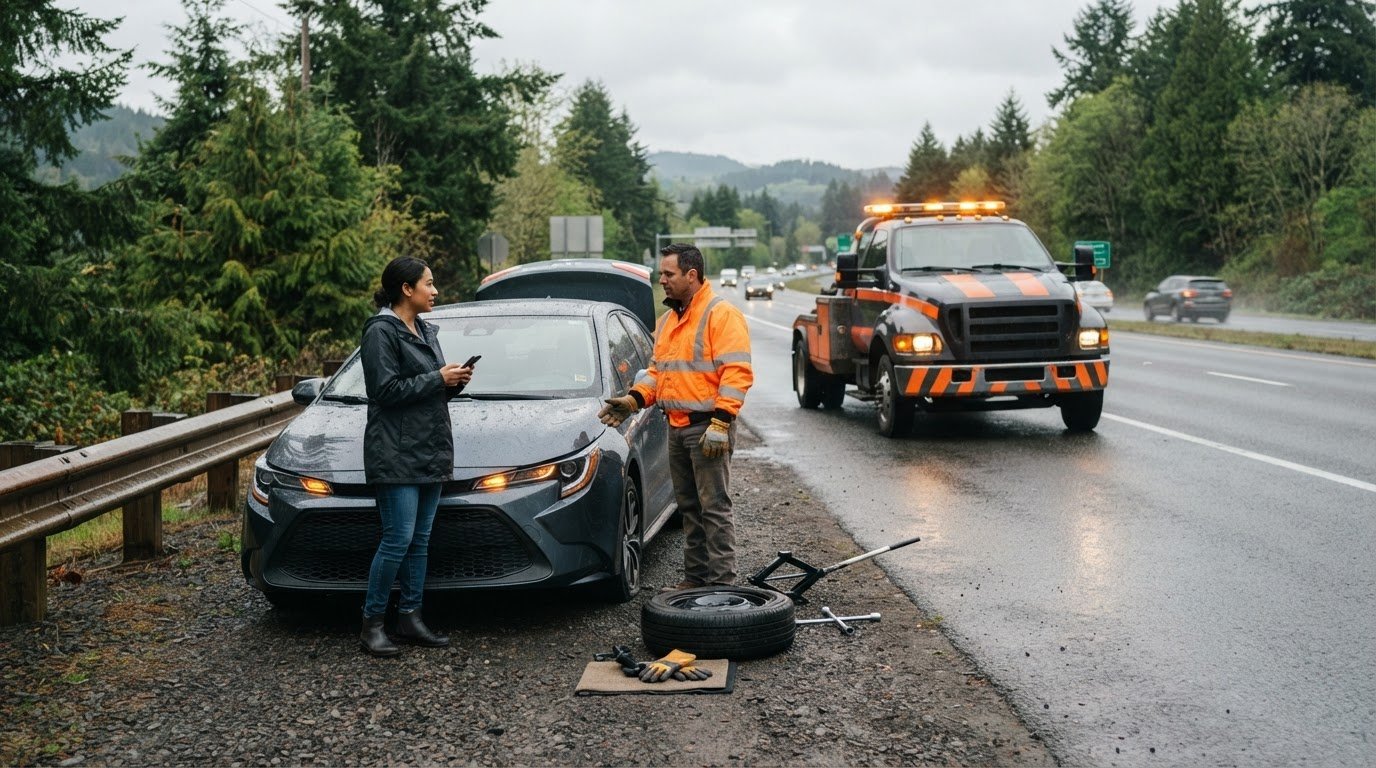
A flat tire on a busy road can leave you wondering whether to stay in the vehicle, try to change the tire, or call for a tow. First, focus on reaching a safe place away from traffic if you can do so safely. Once stopped, turn on your hazard lights and assess your surroundings. Roadside help for flat tire trouble starts with a safe location and a clear description of what happened.
It’s stressful to make decisions while cars are passing and you’re unsure what your vehicle needs. This checklist covers immediate safety, the details to share when you request assistance, and how to think through a tire change versus a tow. You’ll find what to report about your location, vehicle, tire, and spare.
A roadside tire change may get you moving when the vehicle and spare allow it. If there’s no usable spare, the vehicle can’t be driven safely, or a tire change won’t resolve the problem, towing may be the better next step. Bernabe Towing & Recovery provides roadside tire changes and towing for cars and light-duty trucks across the Portland metropolitan area.
Key Takeaways
- Check your surroundings and prioritize a safer place away from traffic before deciding what to do next.
- When requesting roadside help for flat tire trouble, share your precise location, vehicle details, and what you know about the tire.
- Whether you have a usable spare and the condition of the tire can help determine if a roadside tire change or a tow makes sense.
- Keep key information at hand while you wait, and stay in a safer place when conditions allow.
- Bernabe Towing & Recovery provides roadside tire changes and towing across Portland and nearby communities, including Tigard, Beaverton, and Lake Oswego.
Flat Tire Roadside Help: Recognize the Problem and Put Safety First
Pause before reacting. Check traffic, visibility, the shoulder, and how the vehicle is handling. A sudden change can be alarming, but inspecting or changing a tire beside moving traffic can put you at risk. Use this sequence to decide what to do:
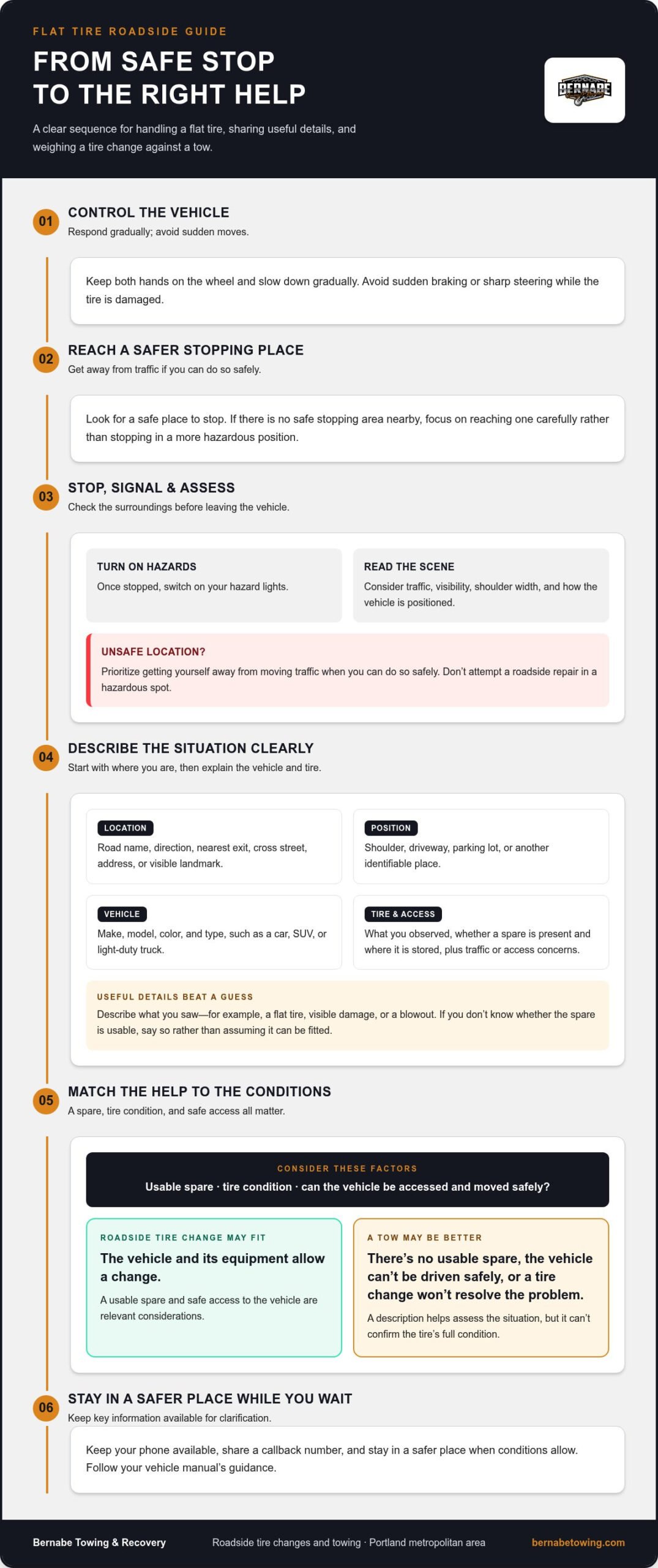
- Keep both hands on the wheel and slow down gradually.
- Look for a safe place to stop, away from traffic if possible.
- Once stopped, turn on your hazard lights and assess your surroundings before leaving the vehicle.
- If the location feels unsafe, prioritize getting yourself away from moving traffic when you can do so safely. Don’t attempt a roadside repair in a hazardous spot.
A gradual loss of pressure may make a tire feel soft or unstable. A blowout can cause a sudden change in handling or a loud report. These clues can help you describe what happened, but they don’t show the tire’s full condition. This overview of flat tires describes common causes and possible solutions. At the roadside, focus on your safety and report what you observed.
A flat tire is a reason to reassess whether it’s safe to keep driving. The vehicle’s handling, your distance from traffic, and how visible your stopped vehicle is all matter. A narrow shoulder, poor visibility, or heavy traffic can make inspecting or changing a tire unsafe, even if you have a spare.
What should you do immediately after noticing a flat tire?
Slow gradually and steer toward a safe stopping place when possible. Avoid sudden braking or sharp steering, which can make a vehicle with a damaged tire harder to control. Once stopped, use your hazard lights and follow your vehicle manual’s guidance. Don’t rush into the roadway to inspect the tire or begin a repair. Wait until you can do so without exposing yourself to traffic.
When should you stop driving and request help?
Stop as soon as it’s safe if you see obvious tire damage, the vehicle pulls or handles very differently, or continuing could put you or others at risk. Don’t assume a tire can support the vehicle just because it still holds some air. If there’s no safe stopping area nearby, focus on reaching one carefully rather than stopping in a more hazardous position. Once stopped, roadside help for flat tire trouble can help you decide whether a tire change or tow is appropriate.
Roadside Help for a Flat Tire: What Information to Share When You Call
A clear description helps the person arranging roadside help understand where you are and what the vehicle may need. If you’re stressed, note a few details or use the checklist below. Start with your location, identify the vehicle, describe the tire, and mention anything that could affect safe access.
Clear location and vehicle details help roadside professionals understand your request. Specific information can distinguish your vehicle from others nearby and clarify whether you’re stopped on a shoulder, in a parking lot, or somewhere else.
Which location and vehicle details should you prepare?
Give the most precise location you can, then add a nearby reference point. On a highway, the road name, direction of travel, and nearest exit can help. On a local road, share the cross street, address, or visible landmark. A nearby street or landmark is useful if there’s no clear address.
- Location: road name, direction, exit, cross street, landmark, or address.
- Position: shoulder, driveway, parking lot, or another identifiable place.
- Vehicle: make, model, color, and type, such as a car, SUV, or light-duty truck.
- Recognition details: a distinctive feature or where the vehicle is parked, if useful and safe to describe.
For example, “I’m on the shoulder of the road, heading north, just past the exit, in a blue SUV” is more useful than “I’m by the highway.” If you’re in a lot, name the business or entrance you’re near.
What should you tell roadside assistance about the tire?
Describe what you observed instead of trying to diagnose the cause. Say whether the tire appears flat or visibly damaged, or whether the problem began with a blowout. Mention if you have a spare and whether you know where it is stored. If you’re unsure whether it’s usable, say so rather than assuming it can be fitted.
Also explain any access or traffic concerns, such as a narrow shoulder, limited visibility, nearby traffic, or a vehicle position that makes reaching the tire difficult. These details help determine whether a roadside tire change is appropriate or towing may be needed. For general background on tire condition and maintenance, the NHTSA Tire Safety Guidelines discuss topics such as inflation and tread depth.
A concise call summary could sound like this: “I’m in a gray sedan in the parking lot beside the north entrance. The front tire is flat, and I have a spare in the vehicle. There’s room to access the car away from traffic.” Keep your phone available in case the service provider needs clarification, and share a callback number.
For a tire change or towing for a car or light-duty truck in the Portland metro area, Bernabe Towing & Recovery provides roadside tire-change and towing help.
Tire Change or Tow: Which Flat-Tire Help Fits the Situation?
The choice depends on whether you have a usable spare, what you can see about the damaged tire, and whether the vehicle can be accessed and moved safely. A roadside tire change may be appropriate when the vehicle and its equipment allow it. If changing the tire won’t make the vehicle safe to drive, towing may be the better next step. A description alone can’t confirm the full condition of the tire or vehicle.
Spare available: A suitable spare is present and accessible.
Tire condition: The flat appears limited to the tire, with no other obvious damage noticed.
Vehicle safety: The vehicle is in a place where roadside work can be done safely, and a tire change may allow it to move safely afterward.
Likely option: A roadside tire change may fit, depending on the vehicle and situation.
Spare unavailable or unsuitable: There’s no spare, or you don’t know whether it can be used.
Tire or vehicle condition: The tire has visible damage, or you notice other damage or unusual handling.
Vehicle safety: The vehicle remains unsafe to drive, or its location makes roadside work hazardous.
Likely option: A tow may be appropriate if a tire change can’t resolve the problem or the vehicle can’t be driven safely.
When can a roadside tire change be a practical option?
A tire change may be practical when a suitable spare is available, the vehicle can be accessed safely, and the situation appears limited to replacing the flat with that spare. Equipment and procedures vary by vehicle, so don’t assume every car has a spare or uses the same setup. Follow the owner’s manual, and don’t attempt work beside traffic or in another unsafe location.
Even with a spare, a change isn’t automatically the right choice. If the vehicle is unstable, the tire area is difficult to reach, or you’re unsure about the equipment, explain that when requesting roadside help for flat tire trouble. These details help determine whether a roadside tire change is reasonable or towing is safer.
When might towing be the safer next step?
A tow may be appropriate if there’s no usable spare, a tire change can’t address what you observe, or the vehicle remains unsafe to drive. Visible damage elsewhere on the vehicle is another reason not to assume a spare will make it safe to travel. Don’t try to diagnose the cause yourself or continue driving simply because the tire has been changed.
Bernabe Towing & Recovery provides roadside tire changes and towing for cars and light-duty trucks across the Portland metropolitan area. Share what you know about the spare, the tire, and the vehicle’s condition so the right kind of help can be considered.
Flat-Tire Roadside Assistance Checklist: Prepare Before Help Arrives
After requesting roadside help, keep the next steps simple: stay in a safer place away from traffic when conditions allow, keep your phone accessible, and be ready to clarify the situation. Don’t begin a roadside repair just to pass the time. Your safety and clear communication matter more than gathering equipment or inspecting the tire.
Use this waiting checklist to keep key details close at hand:
- Keep your phone with you and make sure you can notice an incoming call.
- Have the vehicle make, model, color, and location details you shared available.
- Note whether a spare is present and where it is stored, if you know.
- Keep passengers and personal belongings in a safer place, away from moving traffic when conditions allow.
- Be prepared to describe changes, such as moving the vehicle or noticing a new safety concern.
These steps can make roadside help for flat tire trouble easier to coordinate without asking you to diagnose or repair the vehicle. For an overview of what drivers can expect from professional tire-change support, see this professional tire change help guide.
What should you have ready for the service provider?
Keep the vehicle and location information you gave during the request nearby so you can repeat or clarify it if needed. If a spare is present, tell the service provider where it is stored. Don’t enter a traffic lane or another unsafe area to retrieve it. Keep children, other passengers, and personal belongings away from roadside hazards, and choose a safer waiting place based on the conditions around you.
If you’re unsure whether the spare is accessible, simply say so. A concise update is more useful than taking risks to check. If the vehicle is in a parking lot or driveway rather than on a road shoulder, make that clear so the service provider understands the setting.
How can commuters reduce confusion during a roadside stop?
Busy routes and unfamiliar areas can make a location difficult to describe. Use a road name, direction of travel, nearby exit, cross street, or visible landmark to add context. If you move to a safer spot, share the new location as soon as you can. The original directions may no longer lead to you after you relocate.
Keep updates brief and specific: “I’ve moved from the shoulder to the lot beside the service station” gives a clearer picture than “I’m nearby.” For broader preparation for unexpected vehicle problems during a commute, consult this commuter roadside assistance guide.
For roadside tire-change service or towing for a car or light-duty truck in the Portland metro area, contact Bernabe Towing & Recovery for roadside help.
Local Flat-Tire Roadside Help in the Portland Metro Area
For drivers dealing with a flat in the Portland area, local support can mean a roadside tire change when the vehicle and available spare make a change suitable, or towing when the vehicle needs to be moved. Bernabe Towing & Recovery provides roadside tire changes and towing for cars and light-duty trucks across the Portland metropolitan area.
Service is available in Portland, Tigard, Beaverton, Tualatin, Sherwood, Hillsboro, Wilsonville, King City, and Lake Oswego. Whether you’re on a neighborhood street, in a business parking lot, or near a busy route, share the clearest location details you can when requesting roadside help for flat tire trouble.
What roadside tire-change support can help with
A roadside tire change can help when a suitable spare is available and the vehicle can be accessed safely. The right option depends on the vehicle and circumstances, so describe what you know about the tire and spare rather than assuming a change will resolve every problem. If the vehicle can’t be driven safely or a tire change won’t address the situation, towing may be the appropriate next step.
Bernabe Towing & Recovery provides both roadside tire changes and towing for cars and light-duty trucks. Keep the distinction in mind: a tire change addresses a tire-related need at the vehicle, while towing moves the vehicle when roadside help isn’t enough. A visible tire issue may not tell the whole story, so mention any other damage or handling concerns you’ve noticed.
For broader guidance on what to consider after a flat, the tire change service guide explains practical next steps.
What to do next if you are stranded locally
Before requesting help, keep yourself and passengers in a safer place away from traffic when conditions allow. Then share details that help identify your location and vehicle: the road or nearby address, direction of travel if relevant, a cross street or landmark, and the vehicle’s make, model, color, and type. Mention whether you have a spare and whether the vehicle is on a shoulder, in a lot, or parked elsewhere.
If your position changes, provide the updated location so the request reflects where the vehicle is now. Clear details help connect the situation to the right kind of assistance without requiring you to diagnose the tire yourself.
Drivers who need local roadside tire-change help or towing can contact Bernabe Towing & Recovery for support in the Portland metro area. Share the details you have so the next step can account for the vehicle, spare, and conditions at the scene.
Take the Next Safe Step
A flat tire can disrupt your plans, but you don’t have to solve every detail before asking for help. Focus on your safety and share what you know about the vehicle and situation. If you’re unsure whether a tire change will be enough, explain that when you request roadside help for flat tire trouble.
Bernabe Towing & Recovery provides roadside tire-change service for cars and light-duty trucks, with towing when the vehicle needs to be transported. If you’re stranded in Portland, Tigard, Beaverton, Tualatin, Sherwood, Hillsboro, Wilsonville, King City, or Lake Oswego, request roadside help from Bernabe Towing & Recovery.
Share your location, vehicle details, and what you know about the tire, then make safety your priority.
Frequently Asked Questions
Can I drive a short distance with a flat tire?
Usually, no. Driving on a flat can make the vehicle harder to control and may damage the wheel, even over a short distance. Ease off the accelerator, avoid sudden steering or braking, and stop at the nearest place you can reach safely. Don’t continue just to reach a repair shop. Arrange help, and follow your owner’s manual if it gives specific guidance for your tires.
What information should I give roadside assistance for a flat tire?
Give a callback number, your location, and a clear description of the vehicle and tire problem. Include the road and direction of travel, a nearby landmark or cross street, and whether you’re in a lot, driveway, or shoulder. Say if you have a spare and mention anything that could make the vehicle difficult to reach. If your phone battery is low, share that during the call.
Can roadside assistance change a tire if I do not have a spare?
A standard roadside tire change generally uses a spare carried with the vehicle. If you don’t have a usable spare, a tire change may not be possible, so towing may be needed to move the vehicle. Tell the service provider that no spare is available rather than expecting the flat to be repaired or replaced on the spot. This helps clarify what assistance may be needed.
How do I know whether I need a tire change or a tow?
A tire change may be suitable if there’s an appropriate spare and the vehicle can be accessed safely. A tow may make more sense if you have no usable spare, the vehicle still can’t be driven safely, or you notice other damage. You don’t need to identify the cause yourself. Describe what you can see and how the vehicle is behaving so the situation can be assessed.
Is it safe to change a tire on the side of the road?
Not necessarily. A narrow shoulder, fast-moving traffic, poor visibility, or an unstable stopping place can make roadside work unsafe, even if you have the right equipment. Don’t start a change if you’d need to stand close to traffic or can’t follow your vehicle’s instructions safely. Wait in a safer place when conditions allow and request roadside help instead of taking unnecessary risks.
Does roadside assistance help with flat tires in the Portland area?
Yes. Bernabe Towing & Recovery provides roadside tire changes and towing for cars and light-duty trucks in Portland and nearby communities, including Tigard, Beaverton, Tualatin, Sherwood, Hillsboro, Wilsonville, King City, and Lake Oswego. Roadside help for flat tire trouble may mean a tire change when the vehicle and spare allow it, or towing when the vehicle needs transport.
What should I do if my tire goes flat on a busy road?
Stay focused on controlling the vehicle, slow gradually, and aim for a safe stopping place away from traffic if you can reach one. Turn on your hazard lights once stopped. Don’t step into a traffic lane to inspect the tire or retrieve equipment. If you need roadside assistance, explain the road, direction of travel, and a nearby exit or landmark so your position is easier to identify.