Bernabe Towing & Recovery
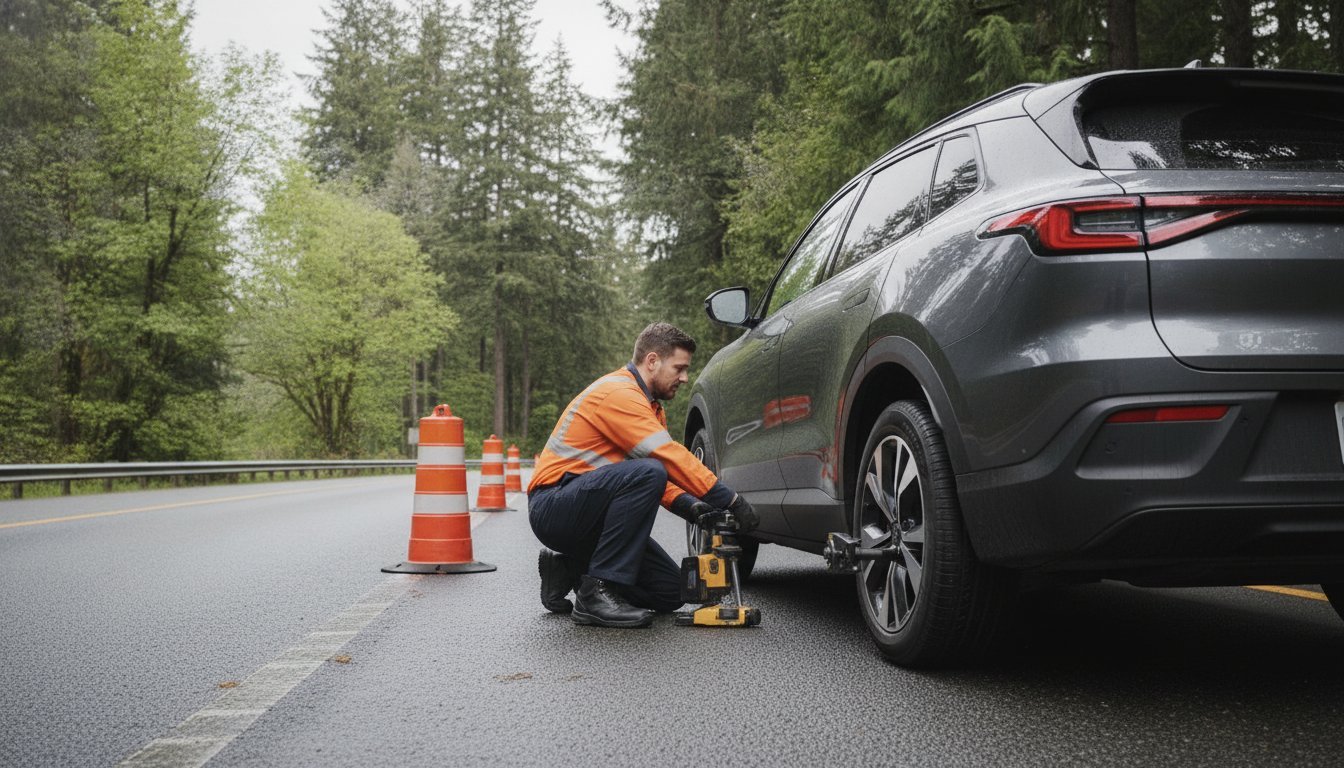
Did you know that roughly 60% of new passenger cars sold today don’t come standard with a spare tire? It’s a frustrating reality for many drivers who find themselves stranded on the shoulder of I-5 or Highway 217. You likely agree that a flat tire should be a minor inconvenience, but the physical strain of loosening seized lug nuts and the danger of high-speed traffic often turn it into a high-stress emergency. When you’re stuck on a narrow Oregon highway, the smartest tool you can use to secure professional tire change help is your phone.
This guide will help you understand when to call for assistance and how to choose a dependable local service that gets you back on the road safely. We promise to show you how to navigate these roadside situations without risking your vehicle or your personal well-being. We will preview the mechanical hurdles of modern EVs, the specific protections offered by Oregon’s Move Over law, and what to look for in a rapid-response team in Tigard or Beaverton. You’ll learn how to move quickly from a state of vulnerability to a state of resolution with the help of a seasoned expert who is ready to act.
Key Takeaways
- Learn to identify when traffic conditions or mechanical issues like seized lug nuts make professional tire change help the safest choice for your situation.
- Discover why prioritizing local expertise and 24/7 dispatching ensures faster response times on major Portland corridors like I-5 and Highway 217.
- Understand the specific risks of DIY attempts on modern vehicles, including the weight hazards of EVs and the lack of factory-supplied spares.
- Master a step-by-step safety protocol to protect yourself and your vehicle while waiting for a roadside technician to arrive.
- Evaluate how choosing a dedicated local partner in Tigard and Beaverton prevents further vehicle damage and secures a rapid return to the road.
The Realities of Roadside Flats: When to Seek Tire Change Help
Professional tire change help is more than a simple mechanical swap. It’s a critical safety intervention designed to remove drivers from vulnerable positions on the road. In the Portland metro area, tire failures often stem from construction debris on expanding suburban routes or the stress of frequent temperature fluctuations on aged rubber. While many motorists view a flat as a DIY task, modern vehicle designs and high-density traffic patterns have changed the risk profile of roadside repairs. It’s no longer just about knowing how to turn a wrench; it’s about managing a hazardous environment.
Most drivers rely on specialized roadside assistance to bridge the gap between a breakdown and a safe resolution. This service provides the heavy-duty equipment and professional composure needed when factory-supplied tools fail or the environment becomes hostile. When you’re stranded, the priority is getting your vehicle to a secure location without sustaining injury or further mechanical damage.
High-Traffic Hazards in Portland and Tigard
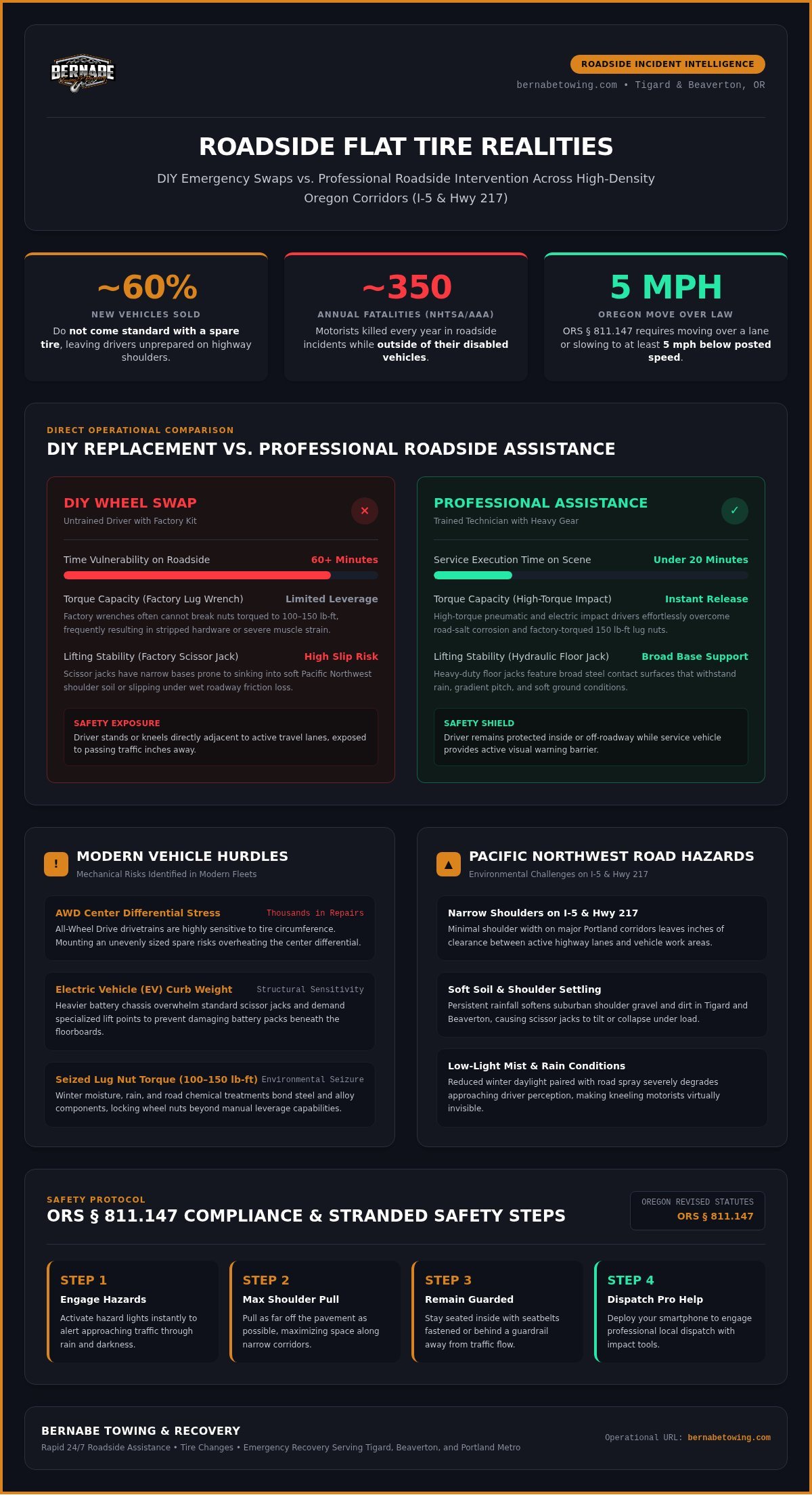
The geography of local commutes creates extreme risks for stranded drivers. Narrow shoulders on Highway 217 and the Interstate 5 corridor leave very little room between a disabled vehicle and active travel lanes. Oregon’s “Move Over” Law (ORS § 811.147) requires drivers to move to a non-adjacent lane or slow down to at least 5 mph below the posted limit. Despite these rules, compliance is never guaranteed. Data from the NHTSA and AAA shows that nearly 350 motorists are killed annually in roadside incidents while outside their vehicles. Attempting a tire change on a driver-side wheel with traffic passing inches away is a life-threatening gamble that isn’t worth the risk. Daily commuters facing these dangers can benefit from reviewing a dedicated roadside assistance for commuters emergency guide that covers rapid safety protocols for busy metro highway corridors.
Environmental Factors: Rain, Mud, and Nighttime
Oregon’s climate introduces unique mechanical challenges that a standard car jack isn’t prepared to handle. Heavy rainfall reduces the friction between a vehicle jack and the asphalt, which can lead to a dangerous slip while the car is elevated. In suburban areas like Tigard and Beaverton, soft soil on the shoulder often gives way under the concentrated weight of a jack. This causes the vehicle to tilt or drop unexpectedly. During the winter months, limited daylight and heavy mist make it nearly impossible for oncoming drivers to see a person kneeling by a wheel, even with hazard lights active.
The Limitations of Factory Tools
Standard vehicle kits aren’t built for emergency conditions. Factory lug wrenches are often too short to provide the leverage needed to break loose nuts torqued to 150 lb-ft. If your wheels are seized due to road salt or moisture, professional tire change help becomes a necessity. Experts arrive with high-torque impact tools and stable floor jacks that factory kits simply cannot match. Professional help ensures the job is done right without stripping your lug nuts or damaging your vehicle’s frame.
DIY vs. Professional Tire Change: A Cost-Benefit Analysis
Deciding whether to handle a flat yourself or call for professional tire change help depends on more than just mechanical skill. It’s a calculation of time, physical risk, and potential vehicle damage. A professional technician typically completes a wheel swap in under twenty minutes once they arrive on the scene. For an untrained driver using a basic factory scissor jack, the process often takes an hour or more. This time is usually spent in high-stress, unsafe conditions on the side of a busy road.
Physical requirements are another major hurdle. Lug nuts are frequently torqued to 100 or 150 lb-ft. Over time, moisture and road salt can cause these nuts to seize, making them nearly impossible to break loose with a short factory wrench. Many motorists suffer back strain or hand injuries attempting to force these nuts. Professional teams use high-torque impact tools that resolve these issues instantly, preventing injury and ensuring the wheel is secured to the correct specifications.
The AWD and SUV Factor
In the Pacific Northwest, All-Wheel Drive (AWD) vehicles are the standard for many commuters. These systems are incredibly sensitive to tire circumference. According to AAA’s tire safety and maintenance guide, maintaining proper tire health is vital for vehicle longevity. If you mount a spare tire that has a significantly different diameter than the other three tires, you risk overheating the center differential. This can lead to thousands of dollars in drivetrain repairs. Professional technicians understand these tolerances. They can determine if your spare is safe to use or if a flatbed tow is a more cost-effective way to protect your transmission.
Hidden Costs of Doing It Yourself
The financial impact of a DIY mistake often outweighs the cost of professional assistance. Improper jack placement is a common error that leads to crushed rocker panels or damaged floorboards. Even worse, driving a short distance on a flat tire to find a “better” spot can permanently ruin an expensive alloy rim. A professional service provides the stability of a floor jack and the expertise to handle heavy SUVs and light-duty trucks without causing secondary damage. If you’re unsure about the integrity of your spare or the safety of your current location, reaching out for tire change help ensures the job is done right the first time. This approach preserves your vehicle’s value and provides the peace of mind that comes from expert handling.
What to Look for in a Reliable Roadside Assistance Provider
Selecting the right company for tire change help requires more than just picking the first name that appears on a search page. In an emergency, you need a partner that combines technical skill with a deep understanding of the local landscape. A provider with specific local knowledge of Tigard and Beaverton understands the unique traffic patterns of the Highway 217 corridor and the backroads of Washington County. This expertise allows them to bypass congestion and reach you faster than a national call center might. Commuters who regularly travel these routes should familiarize themselves with localized roadside assistance for commuters that prioritizes direct dispatch over slow call-center queues.
Reliability also hinges on availability. A flat tire doesn’t follow a schedule. Look for a service that offers 24/7 availability for tire change help and utilizes real-time dispatching. This ensures that when you call, you aren’t left wondering about a technician’s location. You should receive clear, direct communication from a dispatcher who can provide an accurate arrival estimate and instructions on what to do while you wait.
Response Time and Dispatch Accuracy
Speed is essential, but accuracy is what truly matters when you’re stranded. Choosing a provider “near me” in the Portland metropolitan area isn’t just about distance; it’s about navigation. Local experts know which intersections to avoid during rush hour and how to access narrow shoulders on the I-5 safely. To prepare your vehicle for these situations, you can refer to the NHTSA vehicle safety checklist for essential maintenance and emergency kit tips. A dependable provider will keep you updated throughout the process, reducing your stress as they work to resolve your issue.
Professional Equipment Standards
The quality of the tools used during the service directly impacts your vehicle’s safety. Professional-grade hydraulic floor jacks provide a stable, wide base that far exceeds the safety of the “scissor” jacks found in most trunks. These hydraulic systems lift the vehicle smoothly, even on uneven surfaces, which prevents the car from shifting or falling during the change. This equipment is vital for handling heavier light-duty trucks and SUVs safely.
Equally important is the use of high-torque impact wrenches. These tools are necessary for removing stubborn, rusted lug nuts that have been exposed to Oregon’s damp climate. Once the change is complete, a professional technician will ensure proper torque settings are applied. This step prevents wheel loss or stud damage after you resume driving. Using a calibrated approach ensures your vehicle remains roadworthy and safe for the remainder of your trip.
Finally, assess the provider’s reputation for professional composure. Roadside emergencies are high-tension events. You need a technician who remains calm, works efficiently, and prioritizes your safety above all else. This steady presence helps lower your stress levels and ensures the vehicle is handled with the care it deserves. A seasoned professional treats your emergency with the urgency it requires while maintaining a methodical, no-nonsense approach to the task at hand.
Roadside Safety Checklist: What to Do While You Wait
When you realize you have a flat, your first priority is your physical safety. Don’t stop on a curve or just over a hill where visibility is limited for oncoming traffic. Aim for a straight stretch of road with a wide shoulder. If you’re on a high-speed route like Highway 26 or I-5, try to reach an off-ramp or a parking lot. If you must stay on the shoulder, pull as far to the right as possible to create a buffer between your car and the travel lanes. In Oregon’s frequent rain, visibility drops significantly, and other drivers may not see your vehicle until they’re dangerously close.
Immediate Safety Actions
- Turn your wheels away from the road: This prevents your vehicle from being shunted into active traffic if it’s struck from behind.
- Activate hazard lights immediately: Use your flashers and, if it’s dark or raining, set out flares or reflective triangles at least 100 feet behind your vehicle.
- Stay inside the vehicle: It’s generally safest to stay buckled in your seat. If you must exit, always use the passenger-side doors and move well beyond the guardrail.
Never stand between your car and the flow of traffic or attempt to inspect the damage from the driver’s side. The “Move Over” law exists to protect you, but you shouldn’t rely on every driver to follow it perfectly. Staying behind a concrete barrier or inside the steel frame of your car is the best way to avoid becoming a roadside statistic while you wait for tire change help to arrive.
Preparing for the Technician
Efficiency helps get you back on the road faster. While the technician is en route, locate your spare tire and the wheel lock key if your vehicle is equipped with one. Clear out heavy cargo or luggage from the trunk area so the specialist has immediate access to the spare tire well. If your car has modifications like a lowered suspension or oversized aftermarket rims, let the dispatcher know. This information ensures the team brings the correct hydraulic equipment for your specific vehicle setup.
Keep your passengers and pets calm and secure. Opening doors on the traffic side is extremely dangerous. If you have pets, ensure they are leashed or in a carrier before the service vehicle arrives. This prevents them from darting out into traffic when the technician opens the trunk or a passenger door to access tools.
Modern GPS is helpful, but landmarks are often more reliable for rapid dispatch. Mention nearby mile markers, exit signs, or prominent buildings when you call. If you’re in a specific suburb like Lake Oswego, Tigard, or Beaverton, note the nearest cross-street or business name. For immediate assistance from a dependable local expert, contact Bernabe Towing for professional tire change help to ensure your vehicle is handled with professional composure and care.
Bernabe Towing: Your Local Expert for Tire Change Help
Bernabe Towing & Recovery positions itself as a high-utility partner for every driver in the Portland metro area. We strike a balance between the urgency of a roadside emergency and the steady presence needed to lower your stress levels. When you call for tire change help, you receive assistance from a seasoned professional who is perpetually on standby. We don’t require annual club memberships or complex subscriptions to access our services. Our goal is to provide a grounded and practical solution that gets you home or to a shop without further damage to your vehicle.
Our brand identity is built on immediate reliability and professional composure. We lead with the specific assistance offered, ensuring that you understand the immediate benefit of our dispatch. By maintaining a methodical and fast-paced rhythm, we move you quickly from a state of need to a state of resolution. We treat every call with a sense of duty, positioning our business as a consistent and trustworthy fixture within the community.
Serving the Portland Metropolitan Area
Our local expertise extends well beyond Tigard and Beaverton. We maintain constant readiness across a wide geographical range to ensure that help is always within reach. Our primary service areas include:
- Hillsboro and Sherwood
- Tualatin and Lake Oswego
- Oregon City and Happy Valley
This comprehensive coverage ensures that commuters on major corridors like Highway 217 and I-5 have access to rapid response times when they need it most. We understand the specific road conditions of the Pacific Northwest, from the narrow shoulders of Highway 26 to the slippery surfaces of local backroads during the rainy season. For situations that involve more than a flat tire, our Accident Recovery Guide provides a thorough overview of how we handle vehicle recovery after a crash.
A Ready-to-Act Attitude
Our technicians are trained to treat your vehicle with the highest level of care. We prioritize functional efficiency, focusing on the technical proficiency needed to secure your spare tire correctly. This no-nonsense service model relies on transparent communication from the first dispatch call to the final wheel swap. We utilize specialized equipment for light-duty trucks and SUVs, ensuring that your vehicle’s frame and drivetrain remain protected during the process.
In addition to tire changes, we offer a comprehensive Car Lockout Service for drivers who find themselves stranded for other reasons. Our team combines technical proficiency with a sense of community-focused care, making us a dependable partner on Oregon’s roads. We remain committed to providing professional, accessible assistance that removes the barriers to communication during a roadside crisis.
Secure Your Journey on Oregon Roads
Roadside emergencies don’t have to compromise your safety or your vehicle’s integrity. We’ve explored how the narrow shoulders of I-5 and the technical demands of modern AWD systems make professional intervention a necessity rather than a luxury. By prioritizing local experts who utilize hydraulic floor jacks and high-torque tools, you avoid the physical risks of DIY attempts and the potential for costly drivetrain damage. Staying buckled inside your car and communicating your exact location ensures a methodical and safe resolution to a stressful event.
When you require tire change help in the Portland metro area, you need a partner who is perpetually on standby. Bernabe Towing & Recovery provides 24/7 Local Emergency Support across Tigard, Beaverton, and Portland. Our rapid response guarantee ensures you spend less time on the shoulder and more time moving toward your destination. We treat every vehicle with technical proficiency and a deep sense of duty to our community. Call Bernabe Towing & Recovery for Immediate Tire Change Help and experience the composure of a dependable local expert. Drive with the confidence that professional support is always just a phone call away.
Frequently Asked Questions
How much does professional tire change help cost in Portland?
Service costs for roadside assistance in the Portland area depend on the time of day and the complexity of your situation. While national averages for mounting a usable spare often range between $75 and $120, local rates vary based on your specific location in Tigard or Beaverton. Factors like emergency dispatch during peak traffic hours or the need for specialized equipment for SUVs influence the final rate. We focus on transparent communication regarding our service fees.
Can a roadside technician change a tire on a highway shoulder?
Technicians can perform a tire change on a highway shoulder, provided there is enough space to work safely. In high-traffic corridors like I-5 or Highway 217, the priority is creating a safety buffer. Oregon’s “Move Over” law requires other drivers to slow down or change lanes, but our technicians also use high-visibility lighting and professional-grade jacks to minimize the time spent in these vulnerable positions. We prioritize your safety and vehicle stability throughout the process.
Do I need to have my own spare tire for the service?
A standard roadside tire change involves mounting your vehicle’s existing, functional spare tire. Our technicians arrive with the professional tools needed to remove the flat and secure your spare to factory specifications. It’s helpful to verify the location of your spare and any necessary wheel lock keys before we arrive. If your vehicle didn’t come with a spare, we can discuss alternative solutions like towing your car safely to a nearby repair shop in Portland.
What happens if my spare tire is flat or missing?
If your spare tire is missing, damaged, or severely under-inflated, a standard on-site change isn’t possible. In these instances, the service typically transitions to a towing request. We provide flatbed towing for light-duty vehicles to transport your car safely to a tire center in Hillsboro or Beaverton. This ensures your vehicle’s drivetrain and rims aren’t damaged by attempting to drive on a compromised tire or an unusable spare. We handle the transition quickly.
How long does it usually take for a tow truck to arrive for a tire change?
Arrival times vary based on current traffic patterns and your proximity to our dispatch centers in Tigard and Beaverton. We prioritize rapid response times for commuters on Highway 26 and I-5 to reduce your exposure to roadside hazards. Most local drivers can expect a technician to reach them quickly, especially when providing clear landmarks or GPS coordinates. Our dispatchers provide real-time updates so you know exactly when help will arrive.
Is tire change help covered by my car insurance?
Many auto insurance policies in Oregon include roadside assistance as an optional add-on, typically costing between $10 and $20 annually. You should check your specific policy documents to see if tire change help is a covered benefit. If you don’t have coverage, we offer on-demand, pay-per-event service. This allows you to get professional help without being locked into an annual motor club membership or paying high monthly fees for services you might rarely use.
Can you change a tire on a lowered car or a vehicle with custom rims?
We utilize specialized equipment designed to handle lowered vehicles and custom aftermarket rims. Standard factory jacks often cannot fit under cars with reduced ground clearance, but our professional hydraulic floor jacks are low-profile and stable. We take extra care to prevent scratches or damage to expensive custom wheels. Please inform our dispatcher about any vehicle modifications so the technician brings the most appropriate tools for your specific setup in areas like Lake Oswego or Tualatin.
What should I do if my lug nuts are stripped or rusted shut?
If your lug nuts are seized due to rust or previous over-tightening, you should stop attempting to loosen them to avoid further damage. Our technicians use high-torque impact wrenches that can break loose even the most stubborn hardware. In cases where the lug nuts are completely stripped, we may need to tow the vehicle to a shop for specialized removal. Professional tire change help ensures these mechanical hurdles are resolved without ruining your wheel studs.