Bernabe Towing & Recovery
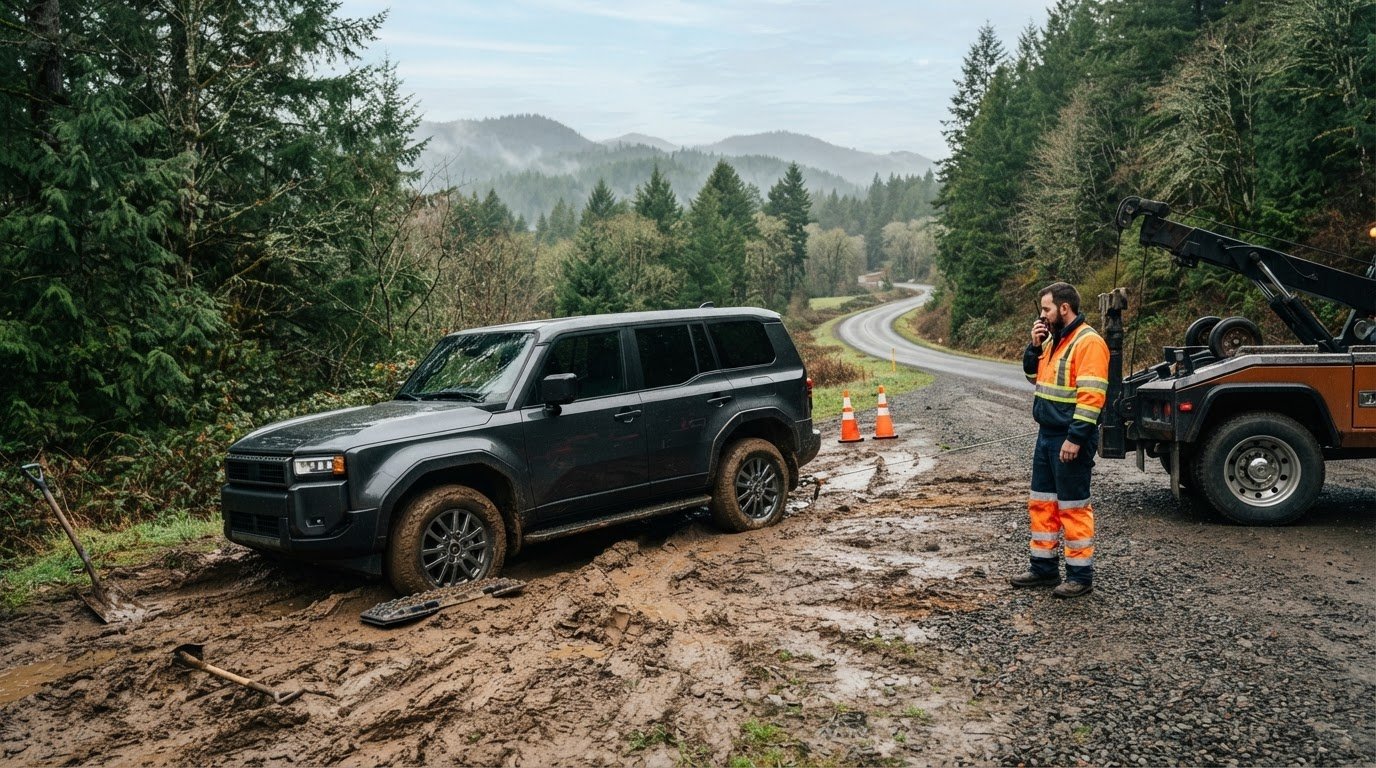
More throttle can make a muddy recovery harder, not easier. If your car is stuck in mud, spinning the wheels can dig the tires deeper and leave the vehicle less stable. A safe car stuck in mud recovery starts with stopping, checking your surroundings, and resisting the urge to keep accelerating.
It’s frustrating to feel the vehicle sink while you decide whether traction mats, a gentle attempt to move, or a tow is the right choice. This guide shows you how to assess the scene, try controlled traction steps when it’s safe, and recognize when another attempt could damage the vehicle or put someone at risk.
You’ll also learn when to stop and request a professional winch-out. Bernabe Towing & Recovery provides vehicle recovery for cars, SUVs, and light-duty trucks across the Portland metropolitan area, including Portland, Beaverton, and Tigard. The right next step depends on the ground, the vehicle’s position, and whether a simple traction measure can help without worsening the rut.
Key Takeaways
- For car stuck in mud recovery, make the scene safe first and stop if wheelspin is digging the tires in deeper.
- Check the vehicle’s position, the ground, and nearby hazards before deciding whether a traction attempt is appropriate.
- Use controlled, low-risk traction steps. Clear mud around the tires only when you can do so safely.
- Worsening ruts, underbody contact, a slope, visible damage, or unsafe surroundings are reasons to stop DIY attempts.
- When requesting professional recovery in the Portland area, share your vehicle type, location, access conditions, and visible hazards.
Car Stuck in Mud? Start with Safety Before Recovery
A car stuck in mud can be stressful, but you don’t need to rush into a recovery attempt. Protect people first, then check whether the vehicle and its surroundings are stable enough for any action. If the tires spin or the vehicle sinks farther, stop accelerating. Wheelspin can worsen the situation, and extra throttle won’t make unsafe ground safer.
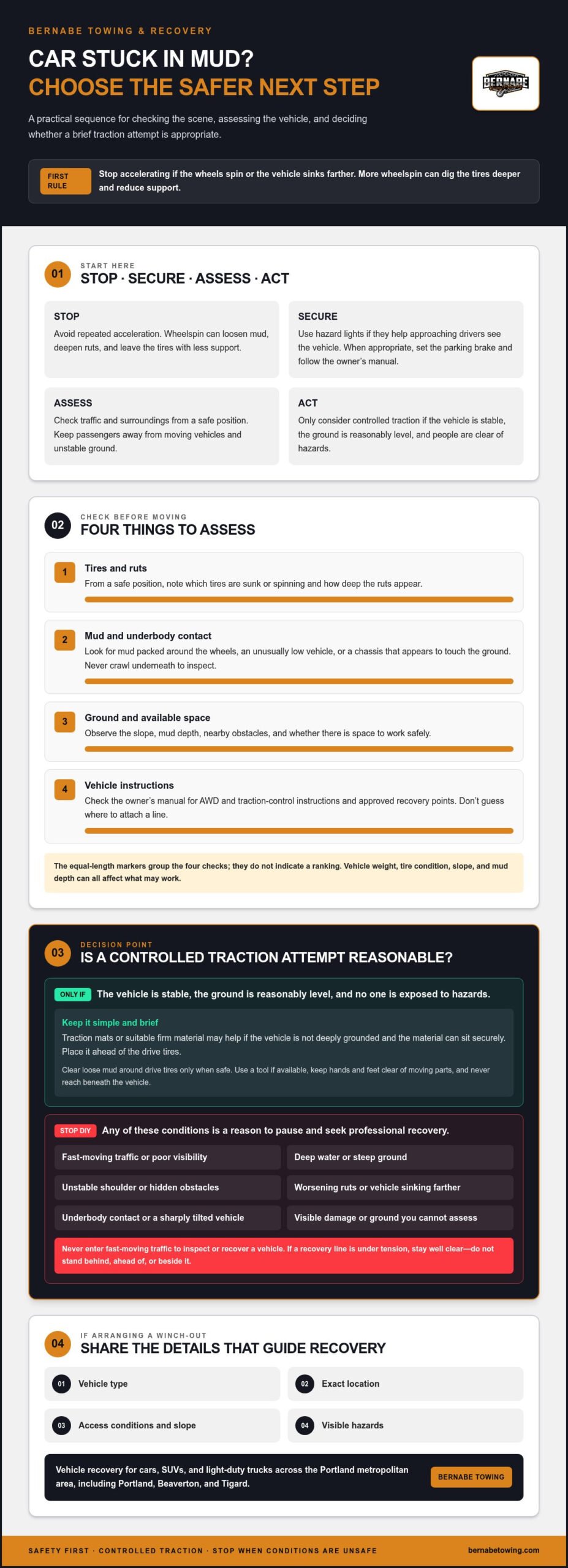
A safe first response is simple: stop, secure, assess, then act. This gives you time to spot hazards before trying to move the vehicle. It also helps you decide whether a basic traction step is appropriate or whether the situation calls for professional recovery, as outlined in this overview of Vehicle recovery.
What should you do first when a car is stuck in mud?
Switch on your hazard lights if they’ll help approaching drivers see the vehicle. Check traffic from a safe position, and keep passengers away from moving vehicles, soft shoulders, and other unstable ground. Move to a safer nearby place only if you can do so without crossing traffic or stepping onto uncertain terrain.
When appropriate, secure the vehicle with the parking brake and follow the owner’s manual for vehicle-specific controls. Before anyone approaches the tires, look for water, steep ground, hidden obstacles, and a safe route away from the vehicle. Don’t crawl underneath it or reach beneath the chassis.
When is it unsafe to attempt a DIY recovery?
Some conditions are clear stop signs: nearby fast-moving traffic, deep water, a steep slope, an unstable shoulder, or poor visibility. Hidden obstacles can also make the vehicle’s position less predictable. If you can’t assess the ground or keep people safely clear, don’t begin a traction or pulling attempt.
Never enter fast-moving traffic to inspect or recover a vehicle. If a recovery line is under tension, stay well clear of it. Don’t stand behind, ahead of, or beside the line, where a sudden failure or movement could cause serious injury.
Call for professional help if the vehicle, occupants, or surroundings seem unsafe, or if you’re unsure how to proceed. Bernabe Towing & Recovery provides local winch-out service and vehicle recovery for cars, SUVs, and light-duty trucks across the Portland metropolitan area. When conditions make a DIY attempt unsafe, pausing and requesting help is the safer next step.
How to Assess a Mud-Stuck Car Before Trying to Move It
Before choosing a traction method, take a moment to understand what’s holding the vehicle. A quick assessment can show whether the tires need help finding grip or whether the car is resting on its underbody and needs professional recovery. Don’t use the accelerator as a test: repeated wheelspin can loosen the mud, deepen the ruts, and leave the tires with even less support.
Controlled traction is safer than repeated acceleration because it limits wheelspin and lets you see whether the vehicle is gaining ground. Check these points before any attempt:
- From a safe position, note which tires are sunk or spinning and how deep the ruts appear.
- Look for mud packed around the wheels and check whether the vehicle appears to be resting on its underbody.
- Observe the slope, mud depth, and available space around the vehicle.
- Check the owner’s manual for instructions on AWD, traction control, and designated recovery points.
How do you tell whether the tires or underbody are stuck?
Visible signs include tires partly buried in soft mud, mud packed tightly around the wheels, or a vehicle that sits unusually low. If the chassis appears to be touching the ground, the tires may not be able to provide enough force to move the car. Look from outside at a safe distance. Never crawl beneath an unsupported vehicle to inspect it.
Underbody contact or a sharply tilted vehicle calls for professional assessment rather than a DIY pull. These conditions can make the vehicle’s movement harder to predict and may increase the chance of damage.
How do drivetrain and ground conditions affect recovery?
Drivetrain settings vary. Follow the owner’s manual for your vehicle’s AWD system, traction-control settings, and approved recovery points rather than guessing or attaching a line to an unsuitable part. Wet weather around Portland can leave driveways and roadside shoulders muddy, so assess the actual ground in front of you instead of assuming it will support the vehicle.
Vehicle weight, tire condition, slope, and mud depth all affect what might work. A lightly sunk car on level ground is different from a heavier vehicle with worn tires on a slope. If you can’t identify a safe, suitable approach, stop and arrange professional help.
If the assessment points to a winch-out, share the vehicle type, exact location, access conditions, slope, and any visible hazards when requesting help. For local Portland-area vehicle recovery, Bernabe Towing & Recovery assists with cars, SUVs, and light-duty trucks.
How to Get a Car Out of Mud with Controlled Traction
If the vehicle is stable, the ground is reasonably level, and no one is exposed to traffic or other hazards, a careful traction attempt may help. Keep it simple and brief. The goal is to give the tires a firmer surface, not to force the car through mud that’s holding it in place.
Can traction mats or firm material help a car stuck in mud?
Traction mats or suitable firm material can help tires regain grip when the vehicle isn’t deeply grounded and the material can sit securely on the ground. Clear loose mud from around the drive tires only if you can do so safely. Use a tool if available, keep your hands and feet clear of moving parts, and never reach beneath the vehicle.
Place the traction aid directly ahead of the drive tires, in the direction you intend to move. Make sure people are well clear before anyone gets back in the vehicle. Avoid loose, brittle, or unstable objects: a tire can shift or eject them, creating a hazard. If the material won’t stay in place, don’t try to hold it while the vehicle moves.
How should you make a careful attempt to move?
Check the owner’s manual for the correct drive mode and traction-control guidance for your vehicle. Select the appropriate setting before moving, then use gentle, steady accelerator pressure and keep the steering smooth. Avoid abrupt throttle or steering inputs. Don’t rock the vehicle aggressively. Use a rocking procedure only if the manufacturer’s instructions specifically support it for your vehicle.
Stop immediately if the tires spin, the vehicle sinks, the traction aid shifts, or the car doesn’t move as expected. Wheelspin can dig the tires deeper, so more throttle may turn a manageable situation into a harder recovery.
- Make one brief, controlled attempt and check whether the vehicle has gained ground.
- If needed, reposition the traction aid only after the vehicle is fully stopped and people are clear.
- After one or two unsuccessful attempts, stop and reassess instead of repeating the same maneuver.
Even a basic car stuck in mud recovery attempt can become unsafe if the ground gives way, the vehicle shifts, or the tires keep spinning. If traction aids don’t help promptly, or you see signs of underbody contact or instability, stop the DIY effort. A professional winch-out may be the safer next step for a vehicle that can’t move with controlled traction.
When to Stop DIY Car Stuck in Mud Recovery Attempts
More throttle won’t solve every muddy situation. If the tires keep spinning, they can churn away the firmer surface, loosen the mud, and deepen the ruts. Stop rather than repeating an attempt that isn’t changing the vehicle’s position. A pause gives you a chance to notice whether the ground, vehicle, or surroundings have become less safe.
Stop DIY recovery if you see any of these warning signs:
- Worsening ruts: Tires are digging deeper or the vehicle is settling farther into the mud.
- Underbody contact: The car appears grounded instead of resting on its tires.
- A steep slope: The vehicle could shift or slide during an attempt.
- Possible damage: You notice a new scrape, leak, unusual noise, or other sign of damage.
- Unsafe surroundings: Traffic, poor visibility, unstable ground, or nearby water makes it unsafe to work around the vehicle.
What should you avoid when a car is bogged in mud?
Avoid prolonged wheelspin, sudden acceleration, and repeated attempts that leave the vehicle in a worse position. Don’t improvise a pull with a tow strap or winch. Recovery equipment stores energy under tension, and using it safely requires suitable equipment, approved attachment points, and the knowledge to set up the pull correctly.
Never attach recovery equipment to a bumper, suspension component, or any point the vehicle manufacturer hasn’t approved for recovery. Keep everyone away from the path of a strap, cable, vehicle, or other tensioned equipment. If you’re on a muddy Portland-area roadside, prioritize distance from traffic. Don’t put yourself in the roadway to attach gear or direct a pull.
When does a stuck car need a professional winch-out?
Arrange professional recovery when traction aids haven’t worked, the vehicle is grounded, or the scene is hazardous. The safest recovery method depends on the vehicle’s position, access, ground conditions, and approved attachment points. Bernabe Towing & Recovery provides winch-out service for cars, SUVs, and light-duty trucks, with recovery guided by the conditions at the scene.
For more detail on what a recovery may involve, read the professional winch-out service guide. If self-help isn’t safe or hasn’t worked, request professional vehicle recovery.
What to Expect from Professional Mud Recovery in the Portland Area
If safe traction steps haven’t freed the vehicle, stop trying and arrange professional recovery. A winch-out is a practical next step when tires can’t regain grip, the car is grounded, or the scene makes a DIY attempt unsafe. Clear information helps the recovery team understand the vehicle’s position and access conditions.
What details help a recovery team assess a muddy vehicle?
Share the vehicle type and its exact location, including a nearby address, road name, driveway entrance, or landmark. Then briefly describe what happened and what you can see. For example, explain whether the tires are sunk, whether the car appears to be resting on its underbody, and whether a controlled traction attempt has already failed.
Also mention conditions that could affect safe access or recovery:
- Steep or uneven ground, deep water, or soft shoulders
- Nearby traffic or limited visibility
- Narrow access, gates, or space constraints around the vehicle
- Visible damage or anything that appears unstable
Stay in a safe place while arranging help and follow the instructions you receive. Don’t return to traffic or unstable ground to get a closer look. Details you can provide from a safe position help the team understand the scene without putting you at additional risk.
How can local winch-out assistance help resolve the situation?
Professional vehicle recovery begins with assessing the car’s position, the ground, available access, and suitable recovery points. Those factors guide the recovery approach. A vehicle in deep mud or on a slope may need a different plan from one that’s lightly stuck on level ground. Avoid attaching your own strap or cable while waiting.
Bernabe Towing & Recovery provides winch-out service and vehicle recovery for cars, SUVs, and light-duty trucks throughout the Portland metropolitan area, including Tigard, Beaverton, Tualatin, Sherwood, Hillsboro, Wilsonville, King City, Lake Oswego, and Portland, Oregon. If DIY traction hasn’t worked or the scene feels unsafe, professional help can take over the car stuck in mud recovery process.
Request local towing and recovery assistance.
Choose the Safest Next Step for Mud Recovery
A safe car stuck in mud recovery starts with protecting people and assessing the vehicle before attempting to move it. If conditions are stable, a brief, gentle traction attempt may help. Spinning tires, worsening ruts, underbody contact, a slope, or nearby hazards are signs to stop rather than push harder.
When simple traction measures fail, professional off-road winch-out recovery can help move the vehicle without guesswork. Bernabe Towing & Recovery provides winch-out service and vehicle recovery for cars, SUVs, and light-duty trucks across the Portland metropolitan area.
If your vehicle is stuck and you need help, request local towing and recovery assistance. Make safety your first priority, share clear details about the vehicle and its location, and take the next step with confidence.
Frequently Asked Questions
Is it safe to use a tow strap to pull a car out of mud?
A tow strap recovery can be hazardous without compatible, properly rated equipment, manufacturer-approved attachment points, and trained handling. Never hook a strap to a bumper, suspension part, or another point not approved for recovery. Keep everyone well clear of the strap’s path, and never stand beside or in front of a tensioned line. If you lack suitable equipment or a safe place to work, stop and arrange professional vehicle recovery.
Can I get a car out of mud by rocking it back and forth?
Rocking may help in limited cases, but repeated rocking or aggressive throttle can deepen ruts, stress vehicle components, and reduce control. Check your owner’s manual and use only a technique the manufacturer approves for your vehicle. Keep any attempt brief and controlled. If the car sinks farther, rests on its underbody, or doesn’t move promptly, stop rather than repeating the maneuver and arrange professional recovery.
How do you get a car out of mud without a tow truck?
Start by making sure people and the vehicle are clear of traffic and unstable ground. Assess which tires are stuck, the slope and mud depth, and whether the underbody is grounded. If the scene is safe and the car rests on its tires, clear loose mud around them and place suitable traction aids securely. Try gentle, steady movement only. Stop if tires spin, the vehicle shifts unpredictably, or initial controlled attempts fail.
What should I put under my tires when stuck in mud?
Use purpose-made traction mats or firm, stable material suited to the vehicle and conditions. Place it securely ahead of the drive tires in the intended direction of travel, then make sure everyone is clear before moving. Avoid loose, brittle, or unstable items that could shift or be thrown by a tire. Never crawl under an unsupported vehicle to position material. If the car is deeply stuck or the ground is unstable, arrange professional help.
When should I call for professional car stuck in mud recovery?
Call for professional car stuck in mud recovery if the vehicle is grounded, sinking, on a slope, damaged, or exposed to traffic or another hazard. Stop if traction aids fail or wheelspin worsens the rut. A recovery professional can assess the vehicle’s position, access, ground conditions, and suitable recovery points. Bernabe Towing & Recovery provides winch-out support around Tigard, Beaverton, Tualatin, Sherwood, Hillsboro, Wilsonville, King City, Lake Oswego, and Portland, Oregon.
Can spinning the tires make a car sink deeper in mud?
Yes. Spinning tires can loosen the mud around them and deepen the ruts, leaving less firm ground for grip. Continued wheelspin may make the vehicle harder to move and put added stress on components. If the tires turn without moving the car forward, ease off the accelerator and reassess the scene. Try a controlled traction step only if the vehicle and surroundings are stable. Otherwise, stop and arrange recovery.
Does AWD guarantee a car can drive out of mud?
No. All-wheel drive can distribute power to more than two wheels, but it can’t create grip if the tires are on slick mud or the vehicle is resting on its underbody. Tire condition, mud depth, slope, vehicle weight, and driver input affect the outcome. Follow the owner’s manual for AWD and traction-control settings. If brief, controlled attempts don’t move the car, stop rather than relying on AWD or adding throttle.