Bernabe Towing & Recovery
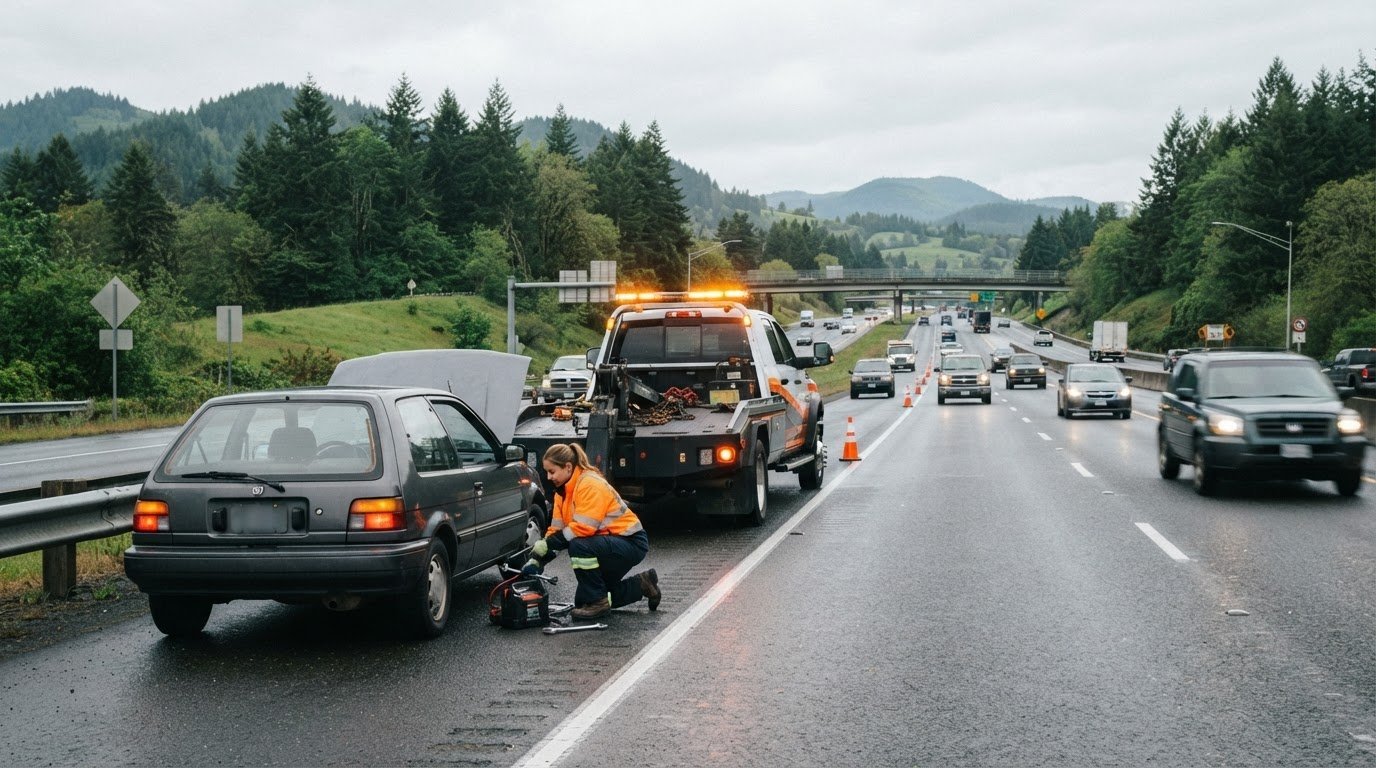
Getting stranded on a packed highway shoulder during peak rush hour is an immediate safety crisis, not a routine administrative delay. When your vehicle suddenly stalls along a busy corridor like I-5 or Highway 217, every passing minute spikes your stress and threatens your entire day. You already know the helpless frustration of watching traffic roar past at high speeds while stuck in a national call-center queue, wondering if help will arrive before you miss an important shift or family commitment. Reliable roadside assistance for commuters must prioritize rapid, localized action over sluggish call-center bureaucracy.
In this guide, you’ll discover essential commuter roadside solutions and immediate safety protocols to minimize delays across metro highway corridors. We break down critical physical safety steps for surviving exposed shoulders, explore rapid on-site triage that can get you rolling without an unnecessary tow, and explain how direct local dispatch gets you back on schedule with total peace of mind.
Key Takeaways
- Master the essential roadside assistance for commuters that quickly resolves dead batteries, flat tires, and accidental lockouts without derailing your workday.
- Learn step-by-step defensive safety protocols to stay protected from high-speed traffic while stranded on exposed metro highway shoulders.
- Discover why bypassing national call-center phone trees in favor of direct local dispatch eliminates long delays and gives you accurate arrival times.
- Understand how on-site triage identifies whether quick roadside adjustments can restore mobility immediately or if direct towing to a preferred repair shop is necessary.
- See how strategically positioned response units navigate major regional bottlenecks along I-5 and Highway 217 to reach commuters faster during peak rush hours.
Essential Roadside Assistance Services Every Daily Commuter Needs
Daily highway driving accelerates mechanical wear on passenger vehicles. Navigating constant stop-and-go congestion stresses alternators, wears down brake pads, and exposes tires to hazardous road debris. Unlike enterprise vanpool programs that operate on rigid maintenance schedules, individual drivers need rapid, on-demand response when a mechanical failure strikes during peak travel windows. Standard municipal service patrols can occasionally push a vehicle off a travel lane, but they rarely offer private recovery or personalized mechanical triage. Comprehensive roadside assistance ensures that a sudden mechanical defect does not turn into an entire lost workday.
Specialized light-duty roadside assistance for commuters prioritizes quick roadside fixes to restore vehicle drivability immediately. Getting rolling under your own power is always faster than waiting for a flatbed transport. When minor faults can be resolved roadside, commuters can safely continue their drive rather than losing hours managing garage intake procedures.
On-Site Triage for Battery Failures and Punctures
Frigid morning temperatures often deplete aging car batteries right before major freeway merges. A vehicle that starts sluggishly in a suburban driveway can stall entirely at a crowded arterial stoplight. Professional jump start units deliver the correct amperage safely, eliminating the risk of leaving your vehicle stranded in an office park or park-and-ride lot.
Roadway punctures are equally disruptive on busy corridors. Striking metal scrap or construction debris at 55 mph causes rapid air loss that forces drivers onto narrow shoulders. Rather than attempting a hazardous tire swap beside rushing traffic, relying on skilled tire change help ensures heavy impact tools quickly seat your spare, safely torquing lug nuts so you can exit hazardous lanes right away. For a roadside flat tire checklist, review the safety steps and details to share when requesting assistance.
Vehicle Entry and Lockout Recovery for Busy Schedules
Rushing through departure routines creates simple errors. Stepping away from a running engine while clearing windshield frost often leads to keys sealed inside locked cabins. Fast-acting roadside assistance for commuters resolves these delays before shift start times pass.
Modern vehicles feature delicate perimeter wiring and sensitive electronic lock mechanisms. Forcing coat hangers or generic metal bars past weather stripping risks denting doorframes or snapping interior cables. Contacting a professional car lockout service secures damage-free entry using specialized air wedges and precision reach tools, restoring access to your keys within minutes.
Rush-Hour Breakdown Protocols: Safety Steps on Busy Corridors
Highway shoulders during peak transit hours carry severe risks of secondary collisions. When traffic moves at full speed just feet away, a stalled vehicle becomes an immediate hazard. Drivers must execute decisive safety protocols the moment engine output drops or a tire fails. Following established official breakdown safety procedures protects your personal safety while setting up a smooth dispatch for incoming recovery vehicles.
Securing the Vehicle Away from Active Traffic Lanes
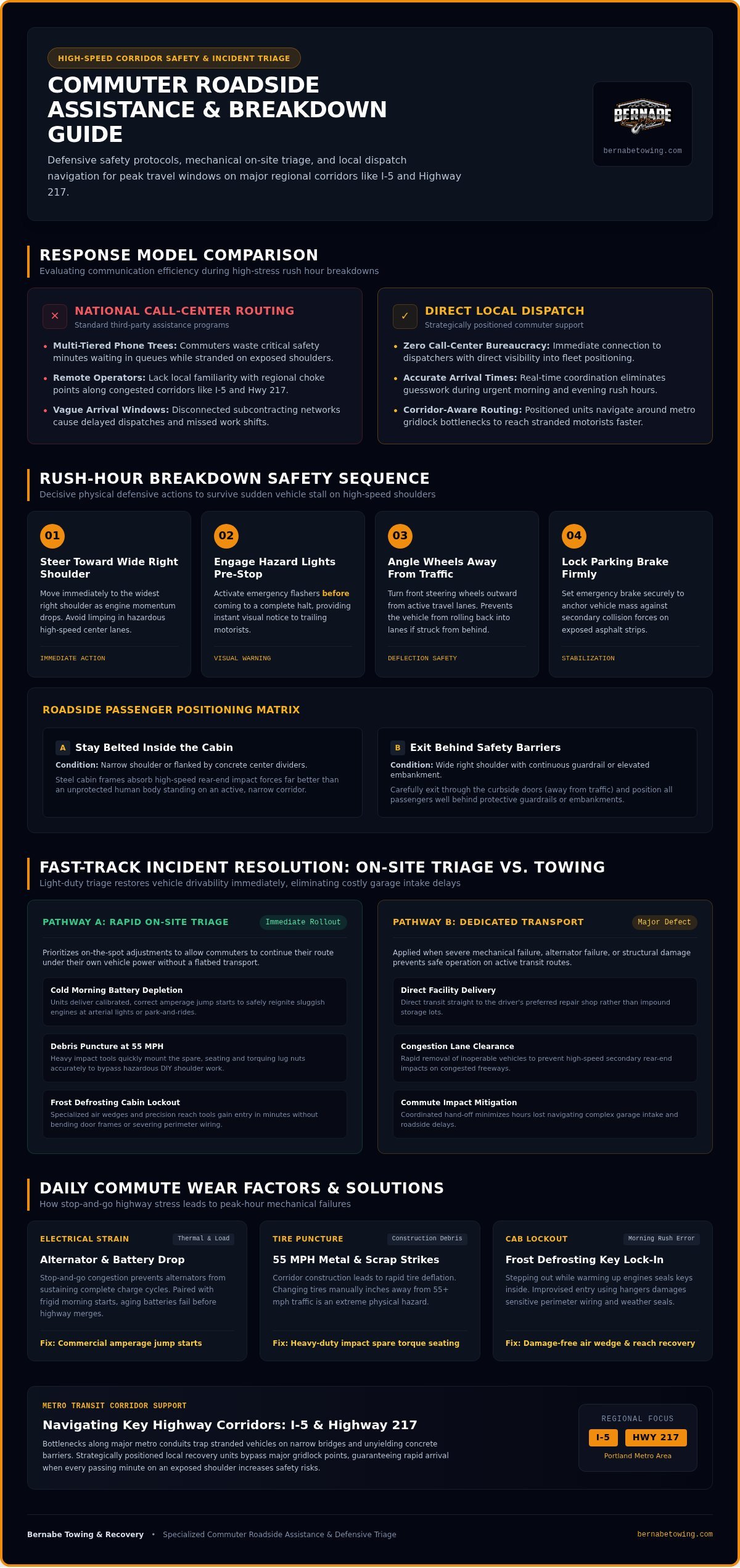
Every second counts when momentum starts to fade. Steer toward the widest available right shoulder immediately rather than trying to limp along in high-speed center lanes. Activate your hazard warning lights before your vehicle comes to a complete halt so trailing motorists get immediate visual notice. Once you pull as far right as possible, turn your front steering wheels away from traffic lanes and firmly engage the emergency parking brake. This simple wheel adjustment prevents your vehicle from rolling backward into active lanes if it gets struck from behind.
Passenger Positioning and Communicating Dispatch Coordinates
Deciding whether to stay inside or leave the car depends strictly on physical roadside conditions:
- Stay belted inside: If the highway shoulder is narrow or flanked by concrete center dividers, stay in your seat with your seatbelt buckled. Steel cabin frames absorb rear-end impacts far better than an unprotected human body on an exposed asphalt strip.
- Exit toward safety barriers: If your vehicle sits on a wide shoulder with a continuous guardrail or a deep grass embankment, exit exclusively through the passenger-side doors. Step completely behind the safety barrier, well uphill and away from the vehicle.
Calling for roadside assistance for commuters requires precise geographical details. Calling from a high-stress shoulder can feel disorienting, but dispatchers need actionable landmarks to deploy light-duty recovery units without delay. Note the nearest highway mile markers, overhead exit signs, or overpass bridges. Opening your smartphone map application to drop a direct GPS pin ensures technicians locate your exact shoulder position on their first pass. When dealing with sudden failures along congested corridors, contacting Bernabe Towing connects you directly with local operators who know these suburban pinch points, ensuring fast, dependable roadside assistance for commuters when seconds count.
Selecting Commuter Roadside Support: Evaluating Speed and Reach
Stranded motorists quickly realize that not all breakdown coverage performs equally during rush hour. Many drivers rely on national auto clubs, assuming membership guarantees prompt rescue. When thousands of vehicles pack regional arteries simultaneously, large motor clubs route calls through centralized phone banks that know nothing about local gridlock. Drivers often sit trapped on highway shoulders for hours while distant dispatchers scramble to find available contractors. Selecting effective roadside assistance for commuters requires understanding how dispatch infrastructure and fleet positioning directly impact arrival speeds. When evaluating roadside assistance plans, responsiveness on active travel corridors matters far more than generic nationwide marketing claims.
Direct Local Dispatch vs. National Motor Club Queues
National auto club hotlines funnel calls through rigid phone trees, automated voice menus, and regional routing queues. This corporate middleman layer introduces severe delays before a local tow operator even receives your coordinates. Local dispatch teams operate differently:
- Direct communication: Speaking straight to a local dispatcher eliminates game-of-telephone miscommunications about your exact location.
- Accurate arrival estimates: Local operators monitor regional choke points, giving you realistic arrival timelines based on current highway conditions.
- Strategic routing: Local drivers know secondary arterials and back roads, allowing them to bypass highway bottlenecks to reach you quickly.
That local expertise makes all the difference when morning congestion threatens your entire workday schedule.
Equipment Versatility for Varied Commuter Vehicle Platforms
Today’s daily commuter vehicle fleet is remarkably diverse. Getting drivers off dangerous shoulders requires equipment engineered for specific drivetrains. Modern all-wheel-drive crossovers, hybrid hatchbacks, and battery electric cars cannot be towed with traditional two-wheel dollies without risking severe transmission and motor damage. Flatbed recovery decks carry these vehicles safely with all four wheels elevated, protecting complex drivelines from costly wear.
Urban commuting environments demand compact maneuverability. Low-clearance wheel-lift wreckers can enter parking structures and transit center garages where standard flatbed haulers cannot fit. When wet regional weather causes vehicles to slide into soft mud or grassy roadside swales, dedicated winch-out rigging pulls cars back onto solid pavement without twisting control arms or tearing off plastic body valances. Choosing specialized roadside assistance for commuters ensures the dispatched truck arrives fully prepared to manage your vehicle platform safely.
Fast-Track Roadside Solutions: Immediate Triage vs. Towing
Every minute spent stranded on a shoulder compounds commute delays. Instead of treating every breakdown as an automatic flatbed transport, skilled technicians perform immediate roadside triage. This rapid evaluation determines whether simple mechanical adjustments can safely restore movement or if professional vehicle transport is necessary. Prioritizing on-site resolution keeps daily travel plans intact while minimizing costly shop visits. Effective roadside assistance for commuters centers on this decisive troubleshooting process.
On-the-Spot Mechanical Recovery for Urgent Schedules
Quick interventions resolve many common corridor strandings within minutes. High-output commercial jump packs deliver clean voltage spikes to overcome stubborn starter motors and drained batteries. Technicians monitor post-start charging voltages to confirm whether a depleted battery or a failing alternator caused the sudden stall, ensuring you don’t stall again two miles down the freeway.
Rapid tire mounting provides another path back onto the road. Swapping a shredded tire for a properly inflated compact spare takes minutes when using professional hydraulic jacks and impact wrenches. Responders verify that lug nuts meet exact factory torque specifications before checking surrounding suspension parts. If the tire change service passes inspection, you can merge safely back into traffic without calling out of work.
Transitioning to Emergency Towing When On-Site Fixes Fail
Certain mechanical breakdowns simply cannot be resolved on an active shoulder. Persistent overheating, snapped accessory drive belts, seized wheel bearings, and severe transmission slips make further driving impossible. Forcing a compromised engine to run invites catastrophic internal failure that can destroy a vehicle permanently.
When physical collisions occur during bumper-to-bumper transit, vehicles often suffer hidden structural or suspension damage. Reviewing proven steps for towing after accident situations ensures your car is stabilized properly while protecting insurance documentation. Professional flatbed carriers secure the disabled vehicle via wheel straps rather than chassis chains, preserving delicate aluminum suspension components. You retain total control over the drop-off location, directing the truck to your trusted neighborhood mechanic or home driveway. If a sudden breakdown halts your trip and cannot be resolved roadside, request prompt towing service from Bernabe Towing to transport your car safely off congested commuter corridors.
Bernabe Towing: Commuter Roadside Assistance Across the Portland Metro Area
Regional transit across northwestern Oregon brings distinct driving challenges. Daily commuters frequently encounter heavy rain, oil-slicked surfaces, and notorious bottlenecks like the I-5 Rose Quarter, which experiences up to 12 hours of congestion per day. In these demanding driving environments, having reliable roadside assistance for commuters is a necessity. Bernabe Towing delivers rapid emergency roadside help tailored specifically to local highway networks, resolving unexpected vehicle disablements before they ruin your workday.
Our locally owned and operated fleet features versatile light-duty equipment built for immediate response. Whether you need emergency towing after an unexpected engine shutdown, a high-output jump start on a chilly morning, an on-site tire change, lockout assistance, or an emergency winch-out, our technicians arrive equipped to restore your mobility.
Dedicated Suburban Corridor and Highway Coverage
Navigating the Portland metropolitan area requires deep familiarity with suburban thoroughfares and peak congestion patterns. Our operators know how traffic shifts between 7-9 AM and 4-6 PM, allowing them to bypass gridlocked interchanges using smart secondary access routes. Strategic positioning guarantees fast dispatches across major commuter hubs:
- Core Highway Arteries: Rapid roadside deployment along Interstate 5, Highway 217, US-26, I-84, and I-205.
- Westside Tech & Suburban Corridors: Immediate recovery support across Tigard, Beaverton, Hillsboro, and Tualatin.
- South Metro Communities: Reliable regional reach serving Lake Oswego, King City, Sherwood, and Wilsonville.
From wet pavement slides requiring gentle winch extractions to narrow-shoulder tire changes during dark winter commutes, our crews handle Northwest driving conditions with seasoned composure.
Direct Dispatch for Immediate Commuter Rescue
When you’re stranded on an exposed shoulder, automated call-center phone trees waste critical time. Calling our dispatch desk connects you straight to a local professional who knows your exact location and routes the nearest available truck instantly. We provide clear, realistic arrival updates so you can communicate confidently with supervisors, clients, or family members. Protect your schedule and contact Bernabe Towing & Recovery for prompt roadside assistance for commuters across the greater Portland region.
Take Control of Your Daily Drive with Dependable Roadside Protection
Corridor breakdowns don’t have to derail your workday or compromise your physical safety on busy highway shoulders. Taking immediate defensive safety precautions, requesting on-site mechanical triage, and avoiding corporate call-center delays give you the power to handle unexpected vehicle trouble quickly and decisively.
When unexpected mechanical failure halts your morning or evening drive, having an experienced partner on standby makes all the difference. Bernabe Towing provides prompt, reliable roadside assistance for commuters across Tigard, Beaverton, Hillsboro, and the greater Portland area. Our locally owned team brings deep regional highway expertise and a comprehensive fleet of light-duty recovery vehicles to resolve dead batteries, sudden punctures, accidental lockouts, and emergency towing needs without unnecessary delays.
Never let a breakdown leave you stranded in traffic. Call Bernabe Towing & Recovery for Rapid Commuter Roadside Assistance and navigate your daily route with complete peace of mind.
Frequently Asked Questions
How quickly can roadside assistance reach me during peak morning rush hour?
Response times during peak morning hours depend on regional arterial traffic, but direct local dispatchers reach stranded drivers much faster than national call centers. By positioning recovery units near central travel arteries like Highway 217 and Interstate 5, local operators bypass major gridlock using secondary roads. When you request roadside assistance for commuters from a local team, you receive an accurate, realistic arrival window based on real-time road conditions.
What should I do if my car stalls in a live traffic lane on the highway?
Immediately activate your emergency hazard flashers and keep your seatbelt firmly fastened. Never exit your vehicle into live traffic lanes, as surrounding vehicles travel at high speeds. Call 911 right away to report an active travel lane blockage so highway patrol can provide rear-guard warning support. Once emergency responders slow incoming traffic, our dispatch team can safely coordinate an emergency recovery vehicle to clear your car from the roadway.
Can my commuter vehicle be jump-started in a low-clearance parking garage?
Yes, modern roadside assistance equipment easily reaches vehicles parked inside multistory parking garages and park-and-ride structures. Technicians use portable, handheld commercial jump packs rather than requiring a support truck to pull alongside your vehicle. These compact, high-output power units deliver sufficient cold-cranking amps to turn over dead starter motors safely, allowing drivers to exit tight subterranean decks without needing an awkward overhead tow maneuver.
Will roadside technicians change my flat tire if I do not have a spare wheel?
Roadside technicians require an intact, road-worthy spare wheel and tire mounted in your vehicle to complete an on-site swap. If your vehicle lacks a spare or only carries an unusable repair canister, on-site mounting isn’t possible. In these scenarios, the technician transitions directly to light-duty towing service, loading your car onto a flatbed carrier to deliver it straight to your preferred tire center or repair garage.
What key vehicle details must I give dispatchers when calling from the highway?
Give the dispatcher your vehicle’s make, model, color, and license plate number alongside your precise travel direction. Note whether your automobile is all-wheel drive, front-wheel drive, or a hybrid platform, as drivetrain specifics determine the proper recovery equipment needed. State whether your car rolls freely or has locked steering, and share your exact milepost or cross-street landmark so our roadside team finds your vehicle on their first pass.
Is it safer to stay inside my car or step outside onto the shoulder while waiting?
Remain seated with your seatbelt buckled inside the vehicle cabin if the highway shoulder is narrow or bordered by concrete barriers. You should only exit the vehicle if there is a substantial grass embankment or permanent guardrail safely away from active lanes. If exiting, leave exclusively through passenger-side doors and stand far uphill behind the physical barrier, facing traffic at all times while awaiting your tow truck.
Can roadside assistance tow my vehicle directly to my workplace or mechanic?
Yes, professional towing services transport disabled vehicles to any destination you designate within the regional service area. When you schedule roadside assistance for commuters, you choose whether the driver drops your vehicle at your workplace parking lot, your primary residence, or a local repair facility. Direct local transport gives you complete authority over post-breakdown logistics, ensuring your car arrives exactly where repairs can begin promptly.