Bernabe Towing & Recovery
A sudden loss of power on the road is one of the most stressful situations a driver can face. One moment you’re cruising down OR-217, and the next, your engine goes silent, the steering gets heavy, and you’re coasting to a stop. In that critical moment, a single question takes over: “Do I need a tow truck, or can this be fixed right here?” Understanding the signs that your vehicle requires professional recovery is key to ensuring your safety and preventing further damage.
This guide is designed for drivers in the Portland metro area who find themselves in this exact situation. We’ll walk you through immediate safety protocols for our local highways, help you diagnose whether you need a simple jump start or a full tow, and explain how to prepare for the arrival of a local towing service. Learn how to handle a stalled vehicle safely, determine if you need a tow truck, and get ready for a professional recovery.
Immediate Safety Protocol for a Stalled Vehicle
When your car stalls, your first priority is no longer your destination—it’s your safety and the safety of others on the road. Whether you’re in fast-moving traffic on I-5 or on a quieter street in Tigard, a stalled vehicle is a hazard. Taking immediate, decisive action can prevent a bad situation from becoming much worse.
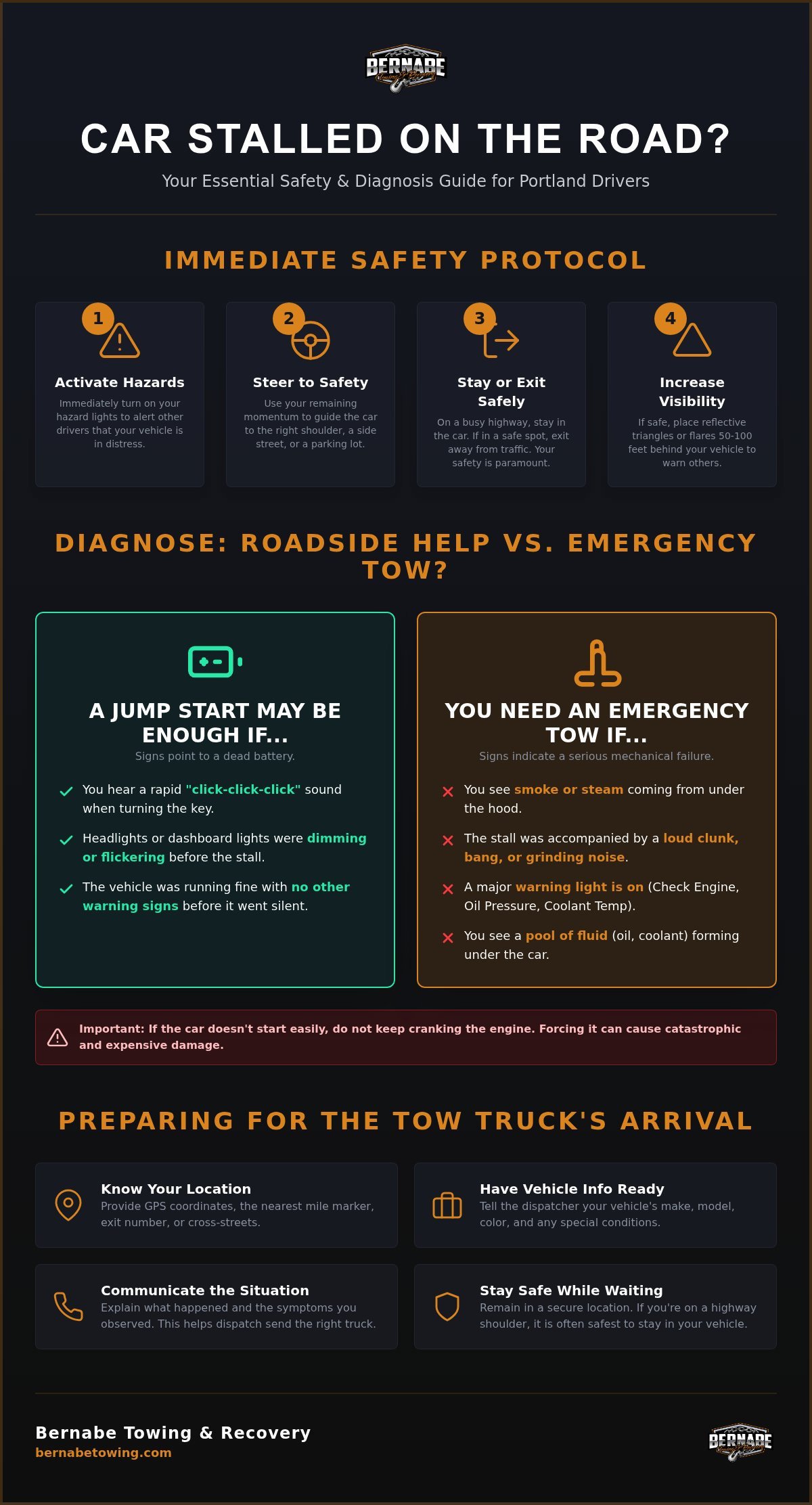
- Prioritise visibility by activating hazard lights immediately upon losing power. This is the universal signal for a vehicle in distress and your most important first step to alert other drivers.
- Steer toward the right shoulder or a safe location while the vehicle still has momentum. If you’re on a multi-lane highway like I-205 or US-26, try to cross lanes smoothly and predictably to reach the shoulder. If you’re on a surface street like Highway 99W, look for a parking lot, a side street, or a wide curb.
- Evaluate the safety of exiting the vehicle versus staying inside. On a busy highway with a narrow shoulder, it is often safer to remain in your vehicle with your seatbelt on. If you’ve made it to a secure location away from traffic, exiting the vehicle from the side opposite traffic may be safer.
- Set up emergency flares or reflective triangles if it is safe to do so. Place them 50 to 100 feet behind your vehicle to give oncoming traffic ample warning, especially on curves or at night.
Navigating Traffic When Power Fails
Losing engine power means you also lose power steering and power brakes, which can be alarming. The systems still work, but they require significantly more physical effort to operate. You must be prepared to steer firmly and press the brake pedal much harder than usual. Use your remaining momentum to guide the car to the safest possible spot. If your electronic signals fail, use hand signals to indicate your intention to change lanes or pull over. The “safest possible” stopping point varies—on I-5, it’s a full-width shoulder away from an overpass. In a dense Beaverton neighborhood, it might be a designated parking space.
Visibility and Communication Steps
Once you are stopped, your goal is to remain visible and get the right help. At night, turn on your interior dome light to make your vehicle more visible to other drivers. Next, determine who to call. If your car is in a live lane of traffic or another dangerous position where it poses an immediate threat to public safety, call 911 first. They can dispatch police to secure the scene. For most situations on a shoulder or in a parking lot, you can call a private towing company directly. Be prepared to communicate your exact location using GPS coordinates from your phone, the nearest exit number, a mile marker, or cross-streets.
Diagnosing the Stall: Roadside Help vs. Emergency Towing
With your immediate safety secured, the next step is to figure out the problem. Is this a simple issue that roadside assistance can fix, or a major failure that requires a tow truck for your stalled car? Making the right call saves you time, money, and the frustration of getting the wrong type of service.
- Differentiating between a battery failure and a bigger issue. A dead battery is a common cause of a stall, but so is a failed alternator, a clogged fuel filter, or a broken timing belt. The symptoms can help you tell the difference.
- Signs that a jump start service can get you back on the road. If you hear a rapid clicking sound when you turn the key, or if your lights and radio were dimming before the car stalled, a dead battery is the likely culprit. A jump start may be all you need.
- Critical indicators that the vehicle is unsafe to drive and requires an emergency tow. Any stall accompanied by smoke, a loud clunking or grinding noise, or a sudden pool of fluid under the car points to a serious mechanical failure.
- Why “forcing” a stalled car to restart can lead to expensive engine damage. If the car doesn’t start after one or two attempts, don’t keep cranking the engine. If the stall was caused by a major issue like a snapped belt, trying to force a restart can cause catastrophic engine damage.
When a Jump Start Is the Solution
The classic “click-click-click” sound when turning the key is the starter solenoid trying to engage without enough power from the battery. Before the stall, you may have noticed your headlights were weak or the dashboard lights were flickering. These are strong indicators that your battery is the problem. While jumper cables can work, a professional roadside assistance jump start is often safer. Technicians use commercial-grade equipment with built-in surge protection, which protects the sensitive electronics in modern vehicles from damage.
When the Vehicle Requires a Professional Tow
Certain symptoms are red flags that demand an immediate call for a tow. If you see smoke or steam coming from under the hood, pull over and turn the engine off immediately—this often indicates severe overheating. A car that stalls after a loud “bang” or “clunk” could have a transmission failure or a broken engine component. Similarly, if your car stalls and a warning light like “Check Engine,” “Oil Pressure,” or “Coolant Temp” is illuminated, it’s not worth the risk to try and drive it further. In these cases, a tow to a trusted mechanic is the only safe option.
Choosing the Right Tow Truck for a Stalled Car
Not all tow trucks are the same, and sending the right equipment is crucial for protecting your vehicle. When you call for help, the dispatcher will ask questions to determine the best truck for your situation. Knowing the options helps you understand the process and ensure your car, especially if it’s an All-Wheel Drive (AWD) model common in Oregon, is handled correctly.
- The benefits of flatbed towing for vehicle protection. A flatbed truck carries your entire vehicle on its back, ensuring none of its wheels are on the ground. This is the safest method for transport.
- When a wheel-lift or “wrecker” truck is necessary. These trucks lift the vehicle by its front or rear wheels. They are more maneuverable and essential for recovering cars from tight spaces, like a downtown Portland parking garage.
- Special considerations for All-Wheel Drive (AWD) and 4WD vehicles. AWD systems can be damaged if two wheels are turning on the pavement while the other two are lifted. These vehicles almost always require a flatbed tow.
- Why lowered cars or vehicles with low ground clearance require specific equipment. A flatbed with a low-angle ramp or special blocks is needed to load a lowered vehicle without damaging the bumper, side skirts, or undercarriage.
Flatbed Towing: The Gold Standard for Safety
For most vehicle breakdowns in the Portland area, flatbed towing is the preferred method. It eliminates any risk of transmission or drivetrain wear during transport because the vehicle is not being dragged. The process involves a hydraulic ramp that tilts down to allow the stalled car to be winched up onto the platform. Because of the superior protection it offers, a flatbed towing service is the best choice for AWD vehicles, luxury cars, SUVs, and any car you want to protect from potential road debris during transit.
Winch-Out Services for Off-Road Stalls
Sometimes a stall happens after your vehicle has left the pavement. Sliding into a ditch on a slick road near Hillsboro or getting stuck in mud on an unpaved path requires more than a standard tow. A winch-out service uses a powerful, cable-and-pulley system mounted on a recovery truck to pull your vehicle back onto solid ground. Professional operators are skilled at finding secure anchor points on your vehicle’s frame to perform the extraction without causing bending or twisting damage.
How to Prepare for the Arrival of a Tow Truck
Once you’ve made the call for a tow, there are a few things you can do to make the recovery process smoother and safer for both you and the tow truck operator. Being prepared helps expedite the service and ensures all the necessary details are handled correctly.
- Gather essential documents. Have your driver’s license, vehicle registration, and insurance card ready. The operator may need to verify this information.
- Clear personal valuables from the vehicle. Before the truck arrives, remove any personal belongings you need, such as your phone, wallet, house keys, or medication. It’s easier to do this before the car is hooked up.
- Communicate specific symptoms to the operator. When the driver arrives, briefly explain what happened. Mentioning if the brakes feel soft or if the steering is locked can help them load the vehicle more safely.
- Confirm the destination. Know where you want the vehicle taken. Whether it’s your home, a dealership, or a trusted local auto shop in Beaverton or Tualatin, having the address ready saves time.
Preparing the Vehicle for Transport
If possible and safe to do so, there are a few small steps to take. Straighten the steering wheel, as this makes it easier for the operator to align the vehicle for loading. You’ll also need to put the car in Neutral. For some modern cars with electronic shifters, this may require a special override procedure, which the tow professional can assist with. If the stall was caused by a minor collision, secure any loose parts like a dangling bumper cover so they don’t fall off during transport.
Managing Logistics with the Operator
For your own security, always verify the identity of the tow truck operator. They should be in a clearly marked truck representing the company you called. Don’t be afraid to ask for identification. Discuss what will happen if you’re being towed to a repair shop that is closed for the night. The towing company can often store the vehicle securely in their yard until the shop opens. Before they leave, be sure to get a receipt or an invoice for the service, as you will likely need it for insurance reimbursement.
Professional Recovery with Bernabe Towing & Recovery
When your vehicle breaks down in the Portland metro area, you need a local team that understands the urgency and stress of the situation. Bernabe Towing & Recovery is a trusted local provider of emergency towing and roadside assistance, serving drivers in Tigard, Beaverton, Tualatin, Sherwood, Lake Oswego, and throughout the surrounding communities. We know the roads, from I-5 and US-26 to the local streets, and we are equipped to handle vehicle breakdowns quickly and safely.
Our goal is to provide a calm, capable, and efficient solution when you need it most. We offer comprehensive services for cars, SUVs, vans, and light- to medium-duty trucks. Whether you need a simple jump start for a dead battery or a flatbed tow for a major mechanical failure, our team is ready to respond.
Reliable Emergency Towing Solutions
A stalled car on a busy road is more than an inconvenience; it’s a safety risk. Our team is on standby 24/7 to ensure you aren’t left stranded. We dispatch the right equipment for the job, whether it’s a versatile wheel-lift truck for a tight spot or a secure flatbed for your AWD vehicle. As a local company, we pride ourselves on being a dependable partner for drivers in our community during a crisis, providing the technical skill needed for safe vehicle transport and accident recovery.
Contacting Bernabe for Immediate Assistance
When you call, our dispatchers will ask for key information to ensure a fast response: your precise location, the make and model of your vehicle, and a brief description of the problem. This allows us to send the right truck and operator to help you. We handle every vehicle with care and a focus on safety and efficiency.
If you’re stranded with a stalled car, take the next step toward a solution. Contact Bernabe Towing & Recovery for professional assistance.
Frequently Asked Questions (FAQs)
- How long should I wait for a tow truck if my car is in a dangerous spot?
- If your vehicle is in a live lane of traffic or a location that poses an immediate danger (like just around a blind curve on US-26), your first call should be to 911. Police can secure the area to prevent an accident. Then, call for a tow and inform the dispatcher of the high-priority situation. A reputable local company will prioritize your call.
- Can a tow truck jump start my car if it just has a dead battery?
- Yes. Most professional towing companies, including Bernabe Towing & Recovery, offer a full suite of roadside assistance services. If you suspect a dead battery, you can request a jump start service specifically. The responding technician can test your battery and get you started if that’s the only issue.
- Do I need to stay with my stalled car until the tow truck arrives?
- It is highly recommended that you stay with your vehicle if it is safe to do so. This prevents any issues with liability, theft, or parking violations. If you absolutely must leave, make sure you have removed all valuables, locked the car, and communicated clearly with the towing dispatcher about how the driver can get the keys.
- What is the average cost of a tow truck for a stalled car?
- The cost of a tow is not standardized and depends on several factors, including the time of day, the distance to be towed, the type of truck required (flatbed vs. wheel-lift), and the complexity of the recovery (e.g., a winch-out). We cannot provide specific pricing, but you can always ask for a quote from the dispatcher when you call.
- Will towing my stalled car damage the transmission?
- When done by a professional, towing will not damage your transmission. Reputable operators know how to tow any vehicle type safely. For front-wheel-drive cars, a wheel-lift from the front is safe. For rear-wheel-drive, they may lift from the rear or use dollies. For AWD and 4WD vehicles, a flatbed is always used to prevent any drivetrain damage.
- Can a tow truck pick up my car if it is stuck in a parking garage?
- Yes. Towing companies have smaller, more maneuverable wheel-lift trucks (wreckers) specifically designed for low-clearance environments like the many parking garages in downtown Portland and Beaverton. Be sure to mention you are in a garage and if possible, provide the clearance height when you call.
- What should I tell the dispatcher when my car stalls on the highway?
- Be as specific as possible. Provide the highway number (e.g., I-5 South), the nearest exit number or mile marker, a description of your vehicle (color, make, model), the nature of the problem (e.g., “won’t start,” “overheating”), and confirm that you are in a safe location on the shoulder.
- Does insurance usually cover the cost of a tow truck for a stalled car?
- Many auto insurance policies include roadside assistance coverage, which often covers a portion or the full cost of a tow up to a certain mileage. You should check your specific policy details. Even if it’s not fully covered, you can submit the receipt from the towing company for potential reimbursement.