Bernabe Towing & Recovery
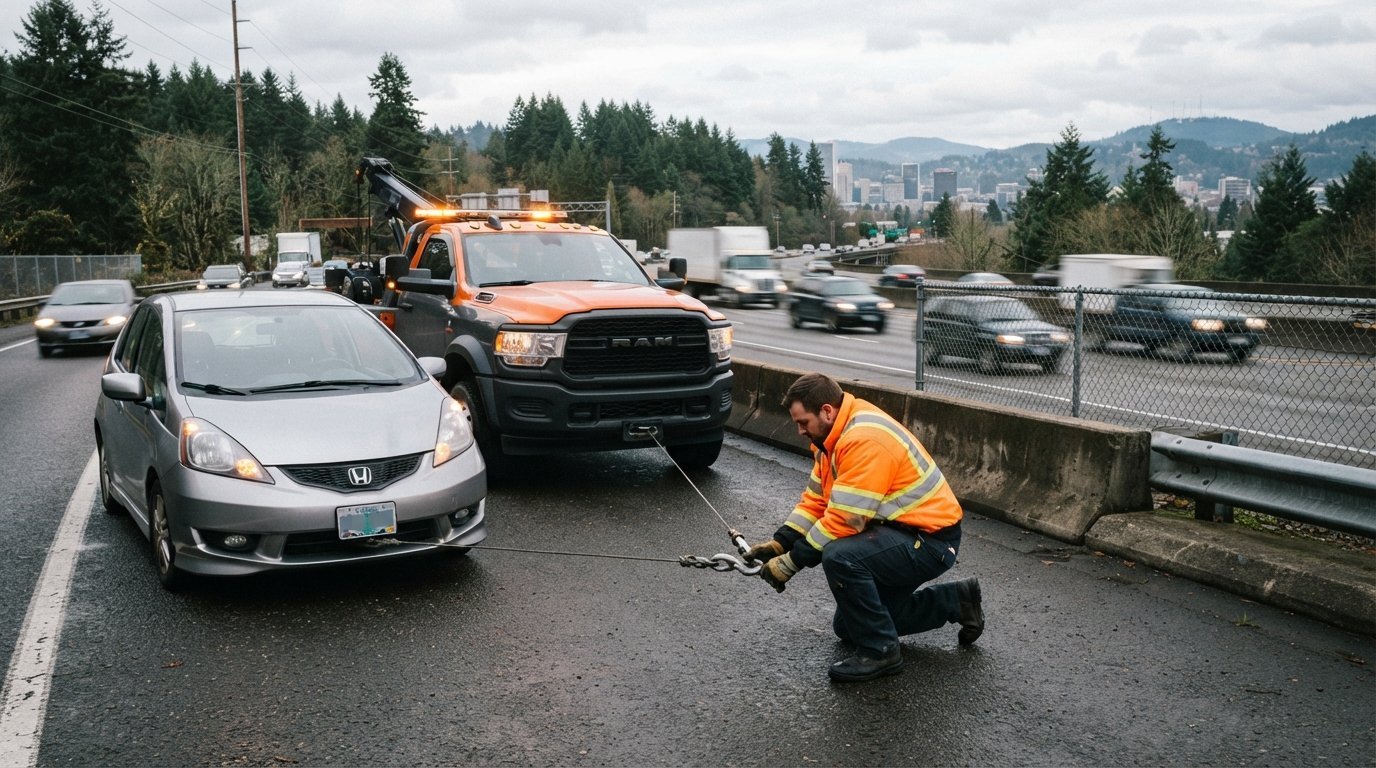
Approximately 12% of all interstate highway fatalities occur on road shoulders, yet thousands of stranded drivers spend hours waiting next to live traffic lanes. If you are stuck on the shoulder of Highway 217 or watching rush-hour traffic whip past your car on the Sunset Highway, examining AAA wait times vs private local towing Portland drivers encounter is not just an academic exercise. It is a matter of immediate personal safety.
You pay your annual motor club membership fees expecting prompt emergency roadside assistance, not vague automated text updates that keep pushing back your driver’s arrival time. When you are stranded in a hazardous spot, waiting through an open-ended regional dispatch backlog creates immense frustration. Discover the real differences between motor club dispatch delays and direct local towing response times across the Portland metro area. Below, we break down how call triage works, when to bypass the club queue entirely, and how to get reimbursed if you hire private towing instead.
Key Takeaways
- Comparing AAA wait times vs private local towing Portland drivers experience reveals how layered call queues cause severe delays during peak traffic hours.
- Motor clubs route roadside requests through regional third-party call centers, while direct local towing dispatches an available truck straight from the local community.
- Hazardous breakdown zones along corridors like I-5, Highway 217, and US-26 require fast action rather than waiting out open-ended dispatch backlogs.
- Drivers who call a private local towing service directly can request an itemized receipt to submit for motor club reimbursement.
- Direct-dispatch operators stationed across Tigard, Beaverton, and the wider Portland metro provide accurate arrival times without third-party app guesswork.
The Reality of Roadside Wait Times Across Greater Portland
In the towing industry, roadside response time measures the exact duration between your initial call and the moment an operator positions their truck behind your disabled vehicle. While marketing materials frequently advertise arrival windows under an hour, drivers evaluating AAA wait times vs private local towing Portland options face starkly different real-world timelines. Routine congestion along Interstate 5, Interstate 205, and Highway 217 magnifies minor service lags into prolonged delays. Throw in sudden Pacific Northwest rainstorms, and service request volumes spike across the valley simultaneously. When hundreds of calls flood the system at once, standing beside a narrow freeway shoulder shifts from a minor inconvenience into an extreme safety hazard.
Why Roadside Delays Occur Along Major Portland Arterials
Portland features several notorious transit bottlenecks that choke towing fleet movement. The winding Terwilliger curves along I-5 and the steep grades leading into the US-26 Vista Ridge Tunnel regularly grind traffic to a halt. When secondary arterials like Highway 99W or Beaverton-Hillsdale Highway clog during weekday commuter rushes, recovery flatbeds cannot bypass the gridlock. Extensive construction zones along Highway 217 strip away shoulder space entirely, turning simple flat tires into urgent recovery events that require immediate clearance before secondary collisions occur.
Understanding these bottlenecks highlights the systemic divergence between traditional motor club roadside assistance dispatch models and nimble, direct-dispatch operators. Regional networks juggle incoming calls through distant call centers, whereas locally staged providers track highway choke points in real time and route trucks via alternate surface streets.
Safety Risks of Extended Highway Waits
Extended delays on active roadways carry severe consequences. Oregon Department of Transportation crash data documents hundreds of serious incidents involving stopped shoulder vehicles, with freight corridors through Tualatin and Wilsonville presenting severe risks. Consider how physical exposure compounds with each passing minute:
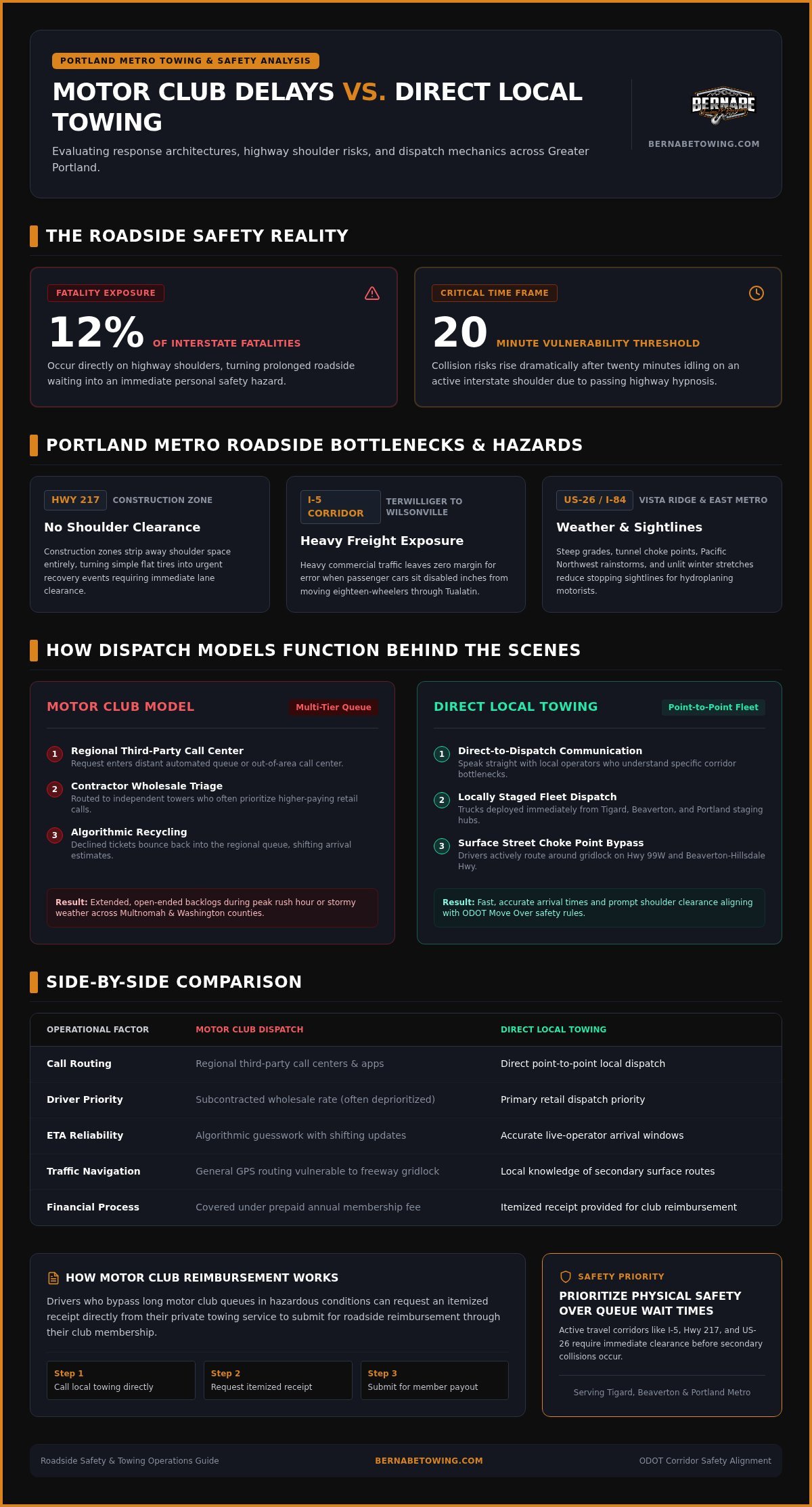
- The 20-minute vulnerability threshold: Collision risks rise dramatically after twenty minutes spent idling on an active interstate shoulder as passing drivers experience highway hypnosis.
- Inclement weather hazards: Heavy coastal rain and winter darkness along unlit stretches of I-84 or US-26 reduce stopping sightlines, leaving stopped cars vulnerable to hydroplaning motorists.
- Commercial freight exposure: Heavy commercial traffic on the I-5 corridor leaves zero margin for driver error when standard passenger cars sit disabled inches from moving eighteen-wheelers.
Assessing AAA wait times vs private local towing Portland motorists encounter comes down to mitigating these exact roadside hazards. When your car stalls in an active travel corridor, waiting hours for third-party queue processing compromises your physical safety.
Comparing Towing Dispatch Models: Motor Clubs vs. Direct Local Towing
The stark difference in roadside response speeds comes down to operational architecture. While motor clubs run on multi-tiered dispatch networks, local operators manage direct point-to-point fleets. Understanding the mechanics behind AAA wait times vs private local towing Portland drivers face explains why your app arrival estimate keeps shifting during an emergency.
How Motor Club Call Routing Functions Behind the Scenes
National auto clubs do not dispatch proprietary trucks to every scene. Instead, your request enters a regional call center or automated app queue before routing to independent, subcontracted tow companies across Washington and Multnomah counties. During peak commute hours or bad weather, those third-party operators face sudden surges in demand. Because motor clubs pay contractors low, fixed wholesale rates per call, independent operators often prioritize higher-paying private retail tows, corporate accounts, or law enforcement calls first.
When an assigned contractor turns down or delays a motor club ticket, the system bounces your request back into the queue for reassignment. This algorithmic recycling explains why an initial 30-minute estimate frequently balloons into a three-hour ordeal. These extended delays conflict directly with ODOT roadside safety and Move Over regulations, which focus on rapid shoulder clearance to minimize dangerous secondary impacts.
The Direct Dispatch Advantage of Independent Local Operators
Direct local towing eliminates every intermediary layer between your phone call and the truck on the road. When you contact an independent company, you speak directly with a local dispatcher who monitors real-time fleet locations across Portland, Beaverton, and Tigard. Your call does not sit in a national triage algorithm. Instead, the dispatcher assigns the nearest available flatbed or service vehicle immediately.
This streamlined approach offers tangible operational benefits when time is critical:
- Direct driver communication: You speak straight to the local team, receiving precise updates rather than automated generic text estimates.
- Strategic depot staging: Local fleets position equipment near high-incident interchanges like Highway 217 and Interstate 5 for rapid access.
- Navigational agility: Local drivers know surface street bypasses around Willamette River bridge lifts, bottlenecked tunnel approaches, and rush-hour construction.
Choosing a dedicated provider like Bernabe Towing & Recovery gives you immediate access to an active local fleet, turning an unpredictable multi-hour waiting game into a rapid, accountable recovery.
Membership Value vs. Immediate Safety: Evaluating the Trade-Off
Drivers who pay for an annual motor club membership naturally expect to use it during an emergency. That prepaid membership, however, often creates a psychological sunk-cost trap. Motorists endure dangerous roadside waits simply to avoid paying for an independent truck out of pocket. When analyzing AAA wait times vs private local towing Portland residents encounter during rush hour, personal safety and schedule predictability quickly outweigh the perceived savings of waiting out an unresponsive queue.
Hidden Costs of Waiting Hours for Roadside Rescue
Enduring an open-ended roadside wait creates substantial secondary costs. Missed work shifts, lost client meetings, and delayed family pickups quietly drain productivity while you watch traffic roar past. Worse, leaving a stalled car near moving lanes invites municipal intervention. Oregon State Police and ODOT actively clear vehicles that impede highway flow or pose safety hazards. If an officer calls a city rotation tow truck before your club arrives, your car gets towed to a regional holding facility. Reviewing our accident recovery guide illustrates the steep impound fees and logistical hurdles drivers face when law enforcement steps in. In addition, analyzing third-party roadside assistance coverage and towing limits reveals that entry-level memberships carry restrictive mileage caps, meaning you could wait hours only to face unexpected mileage overages anyway.
How to File for Reimbursement After Using Private Towing
Bypassing an extended motor club backlog does not necessarily mean losing your membership benefit. Most major motor clubs maintain clear out-of-pocket reimbursement policies when their contracted network experiences extreme dispatch delays or cannot provide prompt service. You can secure immediate assistance from an independent local operator and recoup your expenses afterward by following three practical steps:
- Capture real-time dispatch proof: Take digital screenshots of your motor club app interface displaying repeated arrival pushbacks, open-ended delays, or system-canceled service tickets.
- Request an itemized company invoice: Ask your responding towing operator for a detailed receipt clearly listing the call date, pickup address, drop-off location, mileage, and vehicle information.
- Submit through your club portal: Upload your receipts and dispatch screenshots through your member account under roadside service reimbursement, citing emergency clearance needs.
Balancing AAA wait times vs private local towing Portland drivers navigate comes down to situational control. When safety is on the line, calling a direct operator gets you off the shoulder immediately without giving up your reimbursement rights.
Roadside Guide: When to Wait vs. Call Private Help
Deciding between motor club triage and direct roadside dispatch requires an honest look at your physical surroundings. Rather than leaving your schedule to chance, use a practical risk-assessment framework. Comparing real-world AAA wait times vs private local towing Portland drivers encounter means weighing physical comfort against real roadway danger. A strict 45-minute decision rule keeps you safe: if your motor club cannot confirm an en-route truck within 45 minutes of your initial breakdown, switch immediately to a direct-dispatch local service.
Scenarios Where Waiting for Motor Club Dispatch Is Acceptable
Certain non-emergency situations present low risk, allowing you to comfortably wait out longer service queues without compromising personal safety:
- Protected suburban locations: Your vehicle sits in a private residential driveway, apartment complex stall, or illuminated retail parking lot.
- Safe daytime conditions: Clear daylight visibility, dry pavement, and moderate ambient temperatures minimize exposure risks.
- Access to shelter: You have immediate indoor access to heat, restrooms, and phone charging while waiting.
- Non-urgent lockouts: You are locked out of your vehicle in a secure location. You can read how professional car lockout services regain entry without damaging vehicle seals while you wait safely nearby.
High-Priority Situations Requiring Immediate Direct Towing
Hazardous breakdown zones demand immediate action. If your car sits within inches of live traffic along Highway 217, the Sunset Highway, or Interstate 5, sitting through open-ended dispatch cycles places your life on the line. Escalate immediately under the following high-risk conditions:
- Constrained roadway shoulders: The vehicle rests on a narrow interstate shoulder, curved interchange ramp, or active bridge deck where traffic speeds exceed 55 mph.
- Severe weather events: Heavy rainfall, dropping winter temperatures, freezing fog, or slick road surfaces drastically increase hydroplaning risks for passing cars.
- Vulnerable vehicle occupants: Traveling with infants, elderly family members, or individuals requiring time-sensitive medical care demands prompt vehicle extraction.
- Repeated dispatch delays: Your motor club app resets your driver arrival time more than twice, indicating active contractor shortages across the metro region.
When physical exposure makes waiting a dangerous gamble, skip the third-party middleman. Contact Bernabe Towing & Recovery for fast roadside assistance to dispatch a dedicated flatbed directly to your breakdown site.
Bernabe Towing & Recovery: Fast, Local Response Across Greater Portland
Eliminating middleman dispatch queues requires a dedicated local presence. Instead of routing calls through out-of-state call centers, Bernabe Towing & Recovery operates right here in the community, providing rapid 24/7 emergency response throughout Portland, Tigard, Beaverton, Tualatin, Hillsboro, and Lake Oswego. Evaluating AAA wait times vs private local towing Portland drivers encounter makes one reality clear: direct operator dispatch consistently gets you off dangerous highway shoulders faster than waiting on layered corporate networks.
Comprehensive Light-Duty Towing and Roadside Capabilities
Modern passenger vehicles require specialized equipment to prevent drivetrain damage during transit. Whether dealing with an all-wheel-drive sedan, an electric crossover, or a light-duty work truck, our fleet handles roadside recoveries safely and methodically. Core service capabilities include:
- Light-duty flatbed towing: Damage-free transport for disabled passenger vehicles, sports cars, and all-wheel-drive platforms across the metro area.
- Accident recovery and winching: Winch-out service for vehicles stuck in slick roadside ditches, soft highway medians, or muddy runoffs.
- Emergency roadside assistance: On-demand jump start service, professional lockout assistance, and rapid tire change service to get you rolling again.
- Suburban corridor clearance: Rapid staging around Interstate 5, Highway 217, and Highway 99W to minimize roadside exposure.
How to Secure Immediate Roadside Assistance in Portland Today
When you call for emergency assistance, you speak straight to a local operator who understands Portland roads. You receive an accurate, realistic arrival window based on actual traffic conditions, not an automated algorithm’s best guess. To ensure the fastest dispatch, follow these quick steps:
- Note your exact location: Identify your nearest highway mile marker, cross street, or prominent landmark along the corridor.
- Communicate specific vehicle conditions: Let our dispatchers know if your steering is locked, if tires are missing, or if your car sits in an active travel lane.
- Mention vehicle occupants: Inform the team if you have young children or pets with you so the responding operator can prepare safe vehicle cabin space.
When delays threaten your schedule and safety, bypassing national club queues is the smartest decision. Contact Bernabe Towing & Recovery today for rapid, dependable towing support across Greater Portland.
Take Control of Your Roadside Safety in Portland
When an unexpected breakdown leaves you stranded, evaluating AAA wait times vs private local towing Portland drivers face gives you the upper hand. Multi-tiered club algorithms often leave motorists waiting through compounding delays on active highway shoulders, whereas direct local dispatch connects you instantly with an en-route truck. Bypassing national call queues protects both your daily schedule and physical safety, and you can still submit your itemized receipt for club reimbursement later.
Bernabe Towing & Recovery eliminates middleman call centers by connecting you directly to local dispatchers. Our drivers deliver rapid coverage across Portland, Tigard, Beaverton, Tualatin, and Lake Oswego with full-service light-duty transport and roadside assistance capabilities. When you need immediate relief without the guessing games, get fast, reliable local towing in Portland with Bernabe Towing & Recovery. Keep our number ready so you never have to face open-ended highway delays alone.
Frequently Asked Questions
Why are AAA wait times often so long in the Portland metro area?
Delays happen because motor clubs route requests through tiered call centers rather than running dedicated, proprietary fleets. Inbound tickets get assigned to third-party independent contractors across Multnomah and Washington counties. During rush hour, bad weather, or high-volume traffic events, these independent operators often complete higher-paying direct calls and police impounds first. If a contractor declines an assignment, your request recycles through the system, extending your roadside wait.
Can I submit a private towing invoice to AAA for reimbursement?
Yes, most auto clubs permit reimbursement claims when their contracted network experiences excessive delays or fails to provide timely service. Request an itemized invoice from your responding tow truck operator showing the service date, breakdown location, drop-off destination, and vehicle details. Document your motor club call log with screenshots, then submit the invoice through your member account under emergency roadside reimbursement.
How quickly can a local private towing company reach me in Beaverton or Tigard?
A direct local provider typically reaches motorists in Beaverton or Tigard within 20 to 45 minutes under normal traffic conditions. Because local fleets operate from dedicated suburban depots, they bypass third-party dispatch centers entirely. The dispatcher coordinates straight with the nearest driver, using surface street bypasses along Highway 217 and Highway 99W to avoid major corridor gridlock.
What should I do if my car breaks down in an unsafe highway spot while waiting?
Turn on your hazard lights immediately and exit the vehicle through the passenger side if a sound barrier or grassy embankment provides safe clearance. If concrete barriers block your exit, stay buckled inside your vehicle with your seatbelt securely fastened. Comparing real-world AAA wait times vs private local towing Portland drivers encounter proves that calling a direct-dispatch tow truck gets you off high-speed travel lanes much faster.
Does hiring a private towing service cancel my roadside assistance membership?
No, hiring an independent tow company does not cancel or negatively impact your auto club membership. You remain an active member in good standing and retain your standard plan benefits for future incidents. Paying out of pocket simply means you opted for immediate service during a high-risk situation, which you can subsequently submit for roadside reimbursement review.
How do I know whether to wait for roadside assistance or call a local tow truck?
Use location safety and elapsed time as your primary decision criteria. If you are parked in a secure residential driveway or daylight shopping center, waiting out a club queue is safe and cost-effective. If you are stranded along narrow shoulders on I-5, US-26, or Highway 217, assessing AAA wait times vs private local towing Portland options favors calling a direct local tower after 45 minutes of delay.
What vehicle details do I need when calling a private towing company directly?
Provide your vehicle’s make, model, year, and drivetrain type, such as all-wheel drive, front-wheel drive, or electric. Let the dispatcher know your exact location, nearest highway mile marker or cross street, and the current condition of the car. Mentioning whether your vehicle has flat tires, locked steering, or sits down an embankment ensures the company sends the correct flatbed or recovery equipment.