Bernabe Towing & Recovery
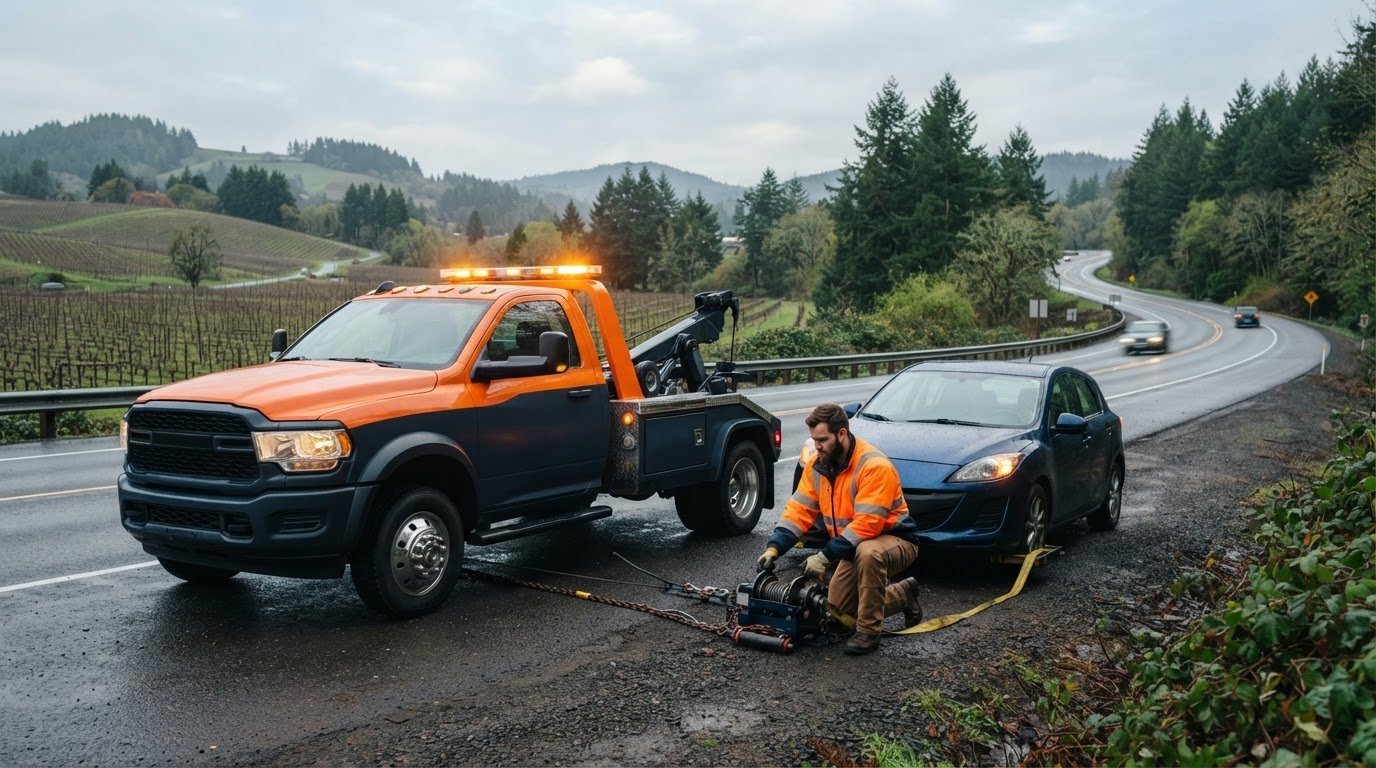
An emergency towing service around Tigard and Portland can help when a vehicle cannot safely continue, whether it needs roadside assistance, a winch-out, or accident recovery. The right response depends on what happened and where the vehicle is stopped. After an emergency stop on an expressway, pull completely off the road to the farthest edge of the shoulder, according to the U.S. Environmental Protection Agency.
A breakdown or collision can make it hard to decide what kind of help you need, especially when your priority is staying safe. This guide covers roadside assistance and towing options across the Portland area, including Tigard, Beaverton, Tualatin, Sherwood, Hillsboro, Wilsonville, King City, Lake Oswego, and Portland, Oregon. You’ll also learn what winch-outs involve and which details to share when requesting help, so the situation and location are clear from the start.
Key Takeaways
- Learn what roadside help may address a breakdown, lockout, flat tire, or dead battery in the Newberg area.
- Understand when a winch-out may help recover a vehicle stuck off the road and what details matter when describing its position.
- See how the vehicle and situation shape towing needs, including the distinction between light-duty towing and heavy-duty recovery.
- Get a clearer picture of the Newberg, Dundee, and Yamhill County coverage discussed in the article.
- Find out when Bernabe Towing & Recovery’s emergency towing, accident recovery, lockout assistance, or jump start service may fit your situation.
Emergency roadside assistance in Newberg
Roadside help starts with a clear location and a specific description of the problem. Whether you’re near Tigard, Beaverton, or Tualatin, name the city first, then share the road, direction of travel, and nearest intersection. A visible business or road sign can help identify your vehicle. Explain what happened, such as a dead battery, flat tire, lockout, or vehicle that won’t run. Mention whether the car blocks traffic or is difficult to access.
A tow truck’s arrival time depends on its dispatch location, traffic, road access, weather, and active calls. Give a precise location and describe any access obstacles so dispatch can plan an appropriate route and response.
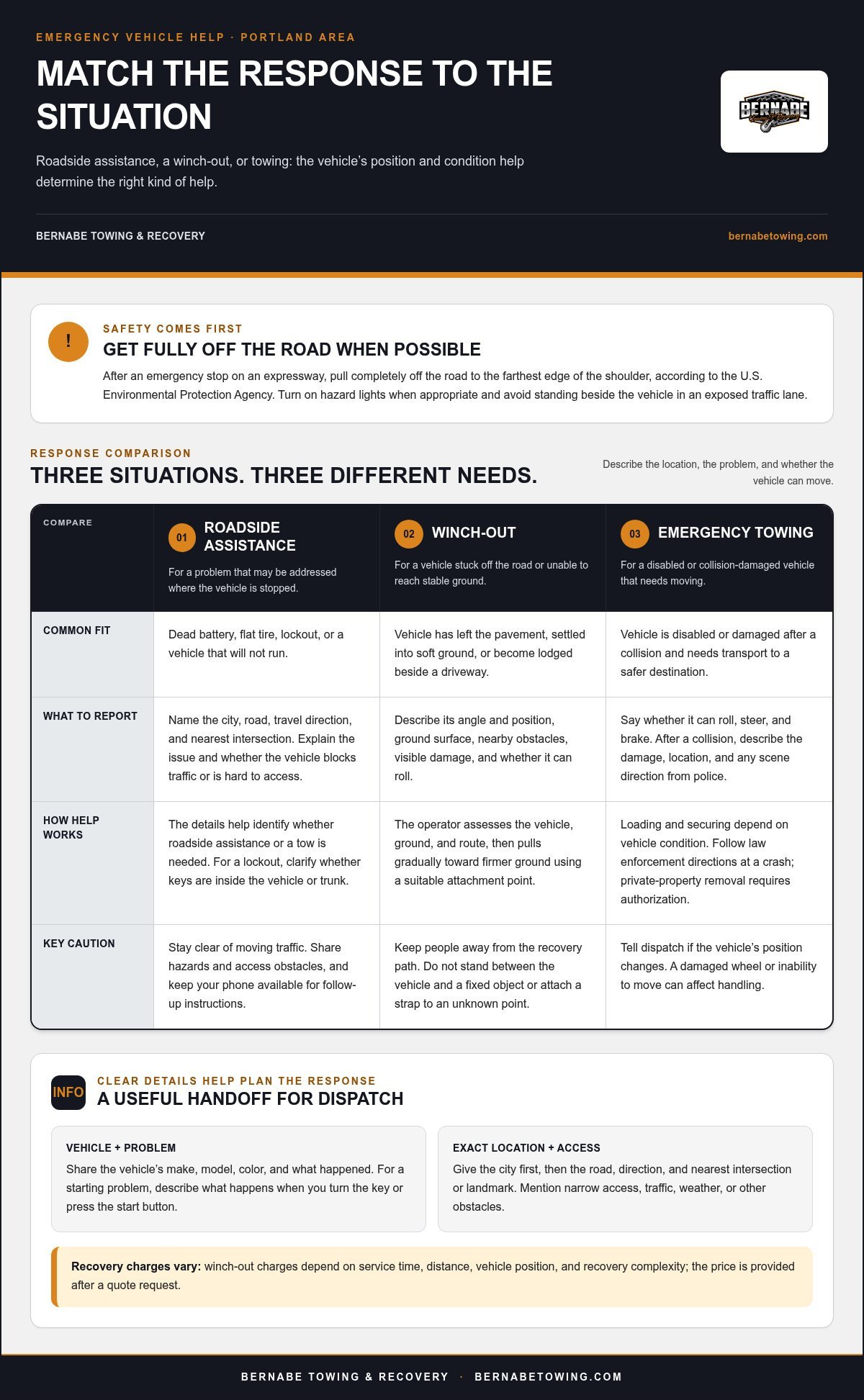
While waiting after a breakdown or collision, prioritize a safe position and stay clear of moving traffic. After an emergency stop on an expressway, pull completely off the road to the farthest edge of the shoulder, according to the U.S. Environmental Protection Agency. Turn on hazard lights when appropriate, and avoid standing beside the vehicle in an exposed traffic lane. If the vehicle is in a dangerous position, describe its location and the immediate hazard. Keep your phone available for follow-up instructions, and note a nearby sign or intersection.
The right roadside response depends on the problem. For a lockout in Sherwood, explain whether the keys are inside the vehicle or trunk. For a flat tire near Wilsonville, say whether the car is on level ground or a narrow shoulder. If the engine won’t start in Hillsboro, describe what happens when you turn the key or press the start button. These details help identify whether roadside assistance in Tualatin, Oregon or a tow is needed. After a collision, describe visible damage and the vehicle’s position.
When evaluating a towing company, compare its legal business name with available business records and review its insurance documentation. Read customer feedback for specific patterns involving communication, arrival updates, and vehicle handling.
Before help arrives, prepare a concise handoff. Note the vehicle’s make, model, color, location, and problem. On a divided road, specify your direction and the nearest entrance or cross street. In Portland or Lake Oswego, a recognizable landmark can clarify a location that a phone map places imprecisely. Keep personal belongings accessible, and tell dispatch if the vehicle’s position changes. Clear details help match the response to the situation.
Winch-outs and ditch pull-outs
A vehicle can slide off a road around Tigard without being ready for a conventional tow. A winch-out uses a recovery line to pull a stuck vehicle toward stable ground. A pull-out may be needed when a car leaves the pavement, settles into soft ground, or gets lodged beside a driveway. The right approach depends on the vehicle’s position, the ground, and the route back to a safe surface.
Tell dispatch where the vehicle is and how it sits. A car angled down a roadside ditch near Sherwood needs a different recovery plan from one stuck in mud beside a Portland driveway. Share whether the wheels are buried, the vehicle is leaning, or nearby trees, fences, or parked cars restrict access. Mention visible damage and whether the vehicle can roll. These details help determine the equipment and access needed.
While waiting, keep people away from the vehicle’s path and recovery area. Don’t stand between a vehicle and a fixed object, and don’t attach a rope or strap to an unknown point. Avoid spinning the tires in mud or gravel, as that can dig the vehicle in deeper. If it’s safe, gather loose belongings and note nearby obstacles. Leave the recovery line and connection points to the operator.
Recovery usually begins with an assessment of the vehicle, ground, and route out. The operator identifies a suitable attachment point, positions the recovery vehicle, and pulls gradually toward firmer ground. The direction matters: pulling straight uphill may be unsuitable if a fence, tree, or unstable shoulder blocks the route. For example, a car’s front end in a shallow ditch near Wilsonville may need a controlled pull aligned with the road rather than a sideways drag.
- Describe the position: Say whether the vehicle is nose-down, sideways, or resting on its wheels.
- Identify the surface: Report mud, gravel, grass, snow, or a paved shoulder.
- Point out obstacles: Mention fences, trees, narrow access, or traffic nearby.
- Explain the vehicle condition: Share whether it rolls and note damage that could affect movement.
Charges depend on factors such as service time, distance, vehicle position, and recovery complexity; the price is provided after a quote request. A winch-out may recover a vehicle to stable ground, while damage or an unsafe route can make towing more suitable. In Beaverton or Lake Oswego, describe the vehicle’s exact location and access when requesting a winch-out. Clear details help the operator plan the pull and determine whether the vehicle can move safely afterward.
Emergency towing
Emergency towing moves a disabled or collision-damaged vehicle from its current location to a safer destination. If you’re in Newberg or Dundee, explain whether the vehicle can roll, steer, and brake. These details help determine how it should be loaded and secured. A car with a damaged wheel, for example, may need different handling from one that starts but stalls repeatedly.
In Oregon, accident-scene towing and private-property towing involve different circumstances: scene direction and vehicle control after a crash, or authorization and access on private land. Follow law enforcement’s instructions at a crash, and establish who can authorize removal from private property.
After a collision, tell dispatch whether police are directing traffic or managing the scene. Share the road name, direction of travel, and nearest intersection or landmark. Describe the vehicle’s position, visible damage, and any obstruction to traffic. If responders are present, follow their instructions before arranging removal. Don’t move a vehicle if doing so could create another hazard or interfere with directions at the scene.
For a breakdown, describe the problem and location clearly. A vehicle stopped in a travel lane presents a different situation from one parked in a lot near downtown Newberg. Tell dispatch if the car is on a slope, has a locked wheel, or can’t shift into neutral. Report low clearance, a narrow entrance, or other access constraints. These details help determine the appropriate truck and loading approach.
Decide where the vehicle should go before it’s loaded. A nearby repair facility, residence, or other destination may suit the situation. If you’re unsure, explain what happened and what matters most, such as keeping the vehicle near Dundee or moving it away from a busy road. Remove essential belongings only when it’s safe. Keep registration or other vehicle information accessible if the operator needs identifying details.
- Give an exact location: Name the road, direction, nearest cross street, and a visible landmark.
- Describe the condition: Explain whether the vehicle rolls, steers, starts, or has collision damage.
- Explain scene control: Say whether police or other responders are directing activity.
- State the destination: Identify where you want the vehicle taken, if known.
Before loading, confirm that the vehicle and destination details are understood. For accident recovery, mention detached parts or damage that could affect movement. For a breakdown, describe warning lights or repeated stalling without attempting roadside repairs in traffic. Clear information helps match the tow to the vehicle’s condition and the scene. Once the vehicle is secured, keep personal items and necessary keys with you, and confirm the destination before departure.
Light-, medium-, and heavy-duty towing
Towing categories describe the size and type of vehicle involved. A compact car stopped near downtown Newberg differs from a delivery truck with a disabled axle. Vehicle weight, wheel condition, ground clearance, and access all influence equipment selection. Tell dispatch the vehicle’s make, model, and type before a truck is assigned. Include modifications such as a roof rack or lowered suspension, since they can affect loading.
Light-duty towing commonly applies to passenger vehicles and light-duty trucks. A sedan with a dead engine, for example, may need a standard tow. A collision-damaged vehicle may require careful loading to avoid putting pressure on a damaged wheel. Share whether it rolls, steers, and shifts into neutral. Those details help determine the safest loading method.
Medium-duty towing generally concerns larger work vehicles, such as certain delivery or utility trucks. The exact category depends on the vehicle and the operator’s equipment, not its appearance alone. Give the truck’s approximate type, cargo status, and location. A loaded delivery vehicle on a narrow Dundee street presents different access needs from an empty van in a parking lot. Don’t unload cargo in a traffic area.
Heavy-duty towing is intended for larger commercial vehicles, including buses and semi-trucks. It requires equipment suited to the vehicle’s size and recovery conditions. Heavy-duty semi-truck towing is a distinct service, not an extension of ordinary passenger-car towing. A disabled commercial vehicle may need specialized recovery planning, especially if it blocks a roadway or carries cargo. Describe the vehicle accurately so the right service category can be identified.
Which Newberg-area companies offer flatbed towing, roadside assistance, and accident recovery? These are separate capabilities: roadside assistance and accident recovery describe services, while flatbed towing describes a transport method. Compare the exact service descriptions with the help you need, and don’t assume every tow truck offers each option.
- Identify the vehicle: Give its make, model, and whether it’s a car, pickup, van, or commercial truck.
- Describe the problem: Mention collision damage, a locked wheel, or a vehicle that won’t shift.
- Explain the setting: Share whether it’s on a narrow street, in a lot, or blocking traffic.
- State the requested help: Distinguish a roadside issue from a tow or accident recovery.
For a passenger car or light-duty truck in Newberg or Dundee, accurate vehicle details help match the situation to appropriate towing support. For larger vehicles, state their commercial use and any cargo or access constraints. A flatbed may suit some transport situations, but the vehicle’s condition and loading needs determine the method. Clear information helps prevent a mismatch between the vehicle and the equipment sent.
Service area in Yamhill County
Across our service area including Tigard, Beaverton, and surrounding communities, the location you provide helps direct roadside help to the right place. Each neighborhood has distinct locations, so name your town first. Then give the road or street, travel direction, and nearest intersection or visible landmark. A map pin can help, but a nearby sign or business name can clarify your position if the pin lands on the wrong side of a road.
Emergency towing services in our Portland metro coverage zone can include towing, winch-outs, jump starts, tire changes, and lockout assistance. The right response depends on whether the vehicle can move, where it’s stopped, and what has failed. A car with a dead battery may need a jump start, while one stuck off the road may need a winch-out. A vehicle that can’t be driven may need towing.
Access varies by location throughout the Portland metro area. A vehicle in a parking lot presents different access needs from one on a narrow shoulder or behind a gate. When requesting help, explain whether the operator can reach the vehicle directly. Mention obstacles such as a locked entrance, steep driveway, soft ground, or nearby traffic. Don’t move a vehicle into an unsafe position just to make it easier to describe.
Share details that distinguish your location from nearby roads and properties. If you’re outside a town center, name the closest city and a recognizable landmark. For a vehicle stopped along a road, provide the direction of travel and whether it’s on the shoulder or in a lot. If you’re in Sherwood but a navigation app places you near Tualatin, say where you’re physically stopped. Accurate details help reduce confusion during dispatch.
- Tigard & Beaverton: Give the street or road, direction, and closest visible landmark.
- Tualatin & Sherwood: State your exact city, then describe the vehicle’s precise position.
- County and Metro Roads: Identify the nearest intersection, sign, or accessible entrance.
- Private Access: Explain gate, driveway, or surface conditions that could affect arrival.
Before requesting help, gather the vehicle’s make, model, color, and the problem. A red sedan with a flat tire is easier to identify than “a car near the road.” If the situation changes, such as the vehicle becoming stuck while waiting, update dispatch with its new position. Clear updates help connect the needed service with the vehicle’s location in our approved service cities.
For a vehicle that can’t continue safely, request emergency towing with the location and vehicle details ready from Bernabe Towing & Recovery.
Bernabe Towing & Recovery: Emergency Towing
Bernabe Towing & Recovery helps Newberg and Dundee drivers facing a disabled vehicle, collision, lockout, or dead battery. Turn to its emergency towing when a vehicle can’t continue safely, or its accident recovery after a collision. Lockout assistance can help when keys are inaccessible, while jump start service addresses a vehicle that won’t start because of a weak battery.
When requesting help, share your exact location, vehicle make and model, and what happened. Explain whether the vehicle can roll and whether it’s blocking traffic. A car with collision damage, for example, needs a different response from one that simply won’t start. Clear details help match the situation with the appropriate assistance.
Contact Bernabe Towing & Recovery to discuss the roadside or towing help you need.
Be Ready for the Next Step
A roadside emergency can make simple decisions harder. Keep your vehicle details and preferred destination easy to find, so you can share them calmly if a problem occurs. If you need an emergency towing service in Newberg or Dundee, Oregon, choose assistance based on the immediate situation and explain it clearly when you reach out.
Bernabe Towing & Recovery provides emergency towing for vehicles that can’t continue, accident recovery after a collision, and lockout assistance when keys are inaccessible. Matching your request to the problem gives the conversation a clear starting point, whether you’re dealing with a disabled vehicle or need help after an accident.
Contact Bernabe Towing & Recovery today to discuss the assistance you need. A clear next step can make a difficult roadside moment easier to manage.
Frequently Asked Questions
Which towing companies serve Newberg-Dundee 24/7, and what are their phone numbers?
Bernabe Towing & Recovery provides emergency towing and roadside assistance in the Portland metropolitan area, including Tigard, Beaverton, Tualatin, and Sherwood. Its listed services include accident recovery and help with vehicle lockouts. No phone number or 24/7 schedule is included here, so don’t rely on an unverified number or assume round-the-clock availability. Use the company’s official website to find its current contact information.
Do emergency tow services in Newberg and Dundee cover nearby highways and rural roads?
Bernabe Towing & Recovery’s stated service locations include Tigard, Beaverton, Tualatin, Sherwood, Hillsboro, Wilsonville, King City, Lake Oswego, and Portland. Highway and rural-road coverage isn’t identified by route in that location list. If your vehicle is stopped on a road outside those cities, provide the road name, direction, nearest intersection, and a visible landmark when describing your location.
What Oregon rules apply to towing from an accident scene or private property?
At an accident scene, follow law enforcement’s instructions. On private property, establish who can authorize removal and explain access conditions.
Do local towing companies charge extra for after-hours, weekends, mileage, or winching?
Winch-out charges depend on service time, distance, vehicle position, and recovery complexity, and a price is provided after a quote request. The material does not establish specific extra charges for after-hours service, weekends, or mileage.
Which local towing companies offer flatbed towing, roadside assistance, and accident recovery?
Bernabe Towing & Recovery offers emergency towing, roadside assistance, and accident recovery for cars and light-duty trucks.