Bernabe Towing & Recovery
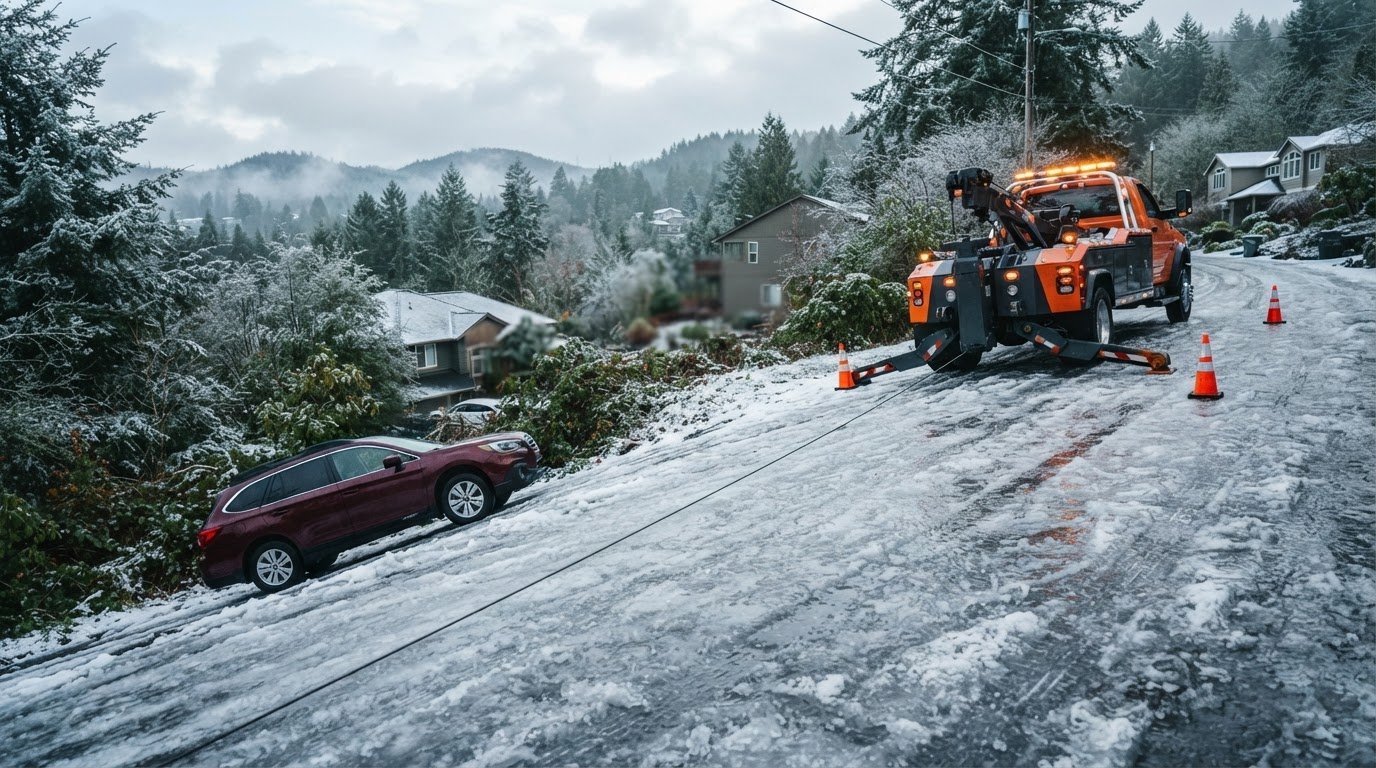
Your tires spin, the vehicle edges toward the bottom of the icy driveway, and every attempt to move it feels riskier than the last. If you’re searching for “winch out from steep icy driveway Sherwood,” stop trying to drive out if the vehicle is sliding or losing traction. Keep people clear of its possible path and focus on safety first.
Spinning tires or attempting a DIY pull can make an unstable situation harder to manage. This guide explains when professional winch-out recovery may be a safer option, what details to share when requesting help, and how to keep people away from immediate hazards. Bernabe Towing & Recovery provides winch-out service for cars and light-duty trucks in Sherwood and the Portland metropolitan area. When requesting help, describe the driveway’s slope and surface, the vehicle’s position, access conditions, and nearby obstacles.
Key Takeaways
- A professional winch-out plan accounts for the vehicle’s position, driveway conditions, access, and surroundings.
- Wheelspin, sideways movement, or a worsening position are signs to stop trying to drive out.
- For a winch out from steep icy driveway Sherwood, be ready to share the vehicle’s location, type, position, and nearby obstacles.
- Keep passengers and bystanders clear of the vehicle’s possible path and recovery area.
- Bernabe Towing & Recovery provides local winch-out service in Sherwood for cars and light-duty trucks.
Stuck on a Steep, Icy Sherwood Driveway? Start With Safety
An icy incline can make a stuck vehicle unpredictable. Tires may lose grip, and the vehicle could shift or slide. If you need a winch out from steep icy driveway Sherwood, first move passengers away from the vehicle and out of its possible path, if they can do so safely. Don’t keep accelerating, rock the vehicle back and forth, or improvise a pull. Those actions can make the situation more difficult to control.
This section covers immediate safety and professional winch-out help for cars and light-duty trucks. A winch uses a cable or line to pull a load, as described in What is a Winch? A professional recovery plan considers the vehicle and its surroundings instead of relying on more throttle or an improvised setup.
What makes an icy driveway recovery different?
A slope can allow a vehicle to move downhill, while ice reduces tire grip. Together, these conditions make it harder to predict how a vehicle will respond to driving or pulling. Its position and angle matter, as do the driveway’s width, access, and nearby hazards such as parked cars, walls, or landscaping.
Every driveway is different. A recovery professional assesses the scene before deciding how to move the vehicle. A description is useful, but it can’t establish how much traction is available or predict the outcome.
What should you do first if the vehicle may slide?
Get people clear before focusing on the vehicle. Avoid standing downhill, behind it, or near a recovery line if one is under tension. Keep children and other bystanders away, and don’t approach the vehicle if doing so would put you in its possible path.
If there is immediate danger, prioritize personal safety and emergency assistance over vehicle recovery. Don’t attach a line, push the vehicle, or direct someone else to pull it. Wait for professional help and follow the recovery operator’s instructions.
While help is being arranged, share clear information from a safe location. Useful details include:
- The vehicle’s position and angle on the driveway.
- Whether it has slipped, is close to moving, or is near an obstacle.
- Visible ice, the driveway’s slope, and its width.
- Access conditions that could affect reaching the vehicle.
Don’t put yourself at risk to inspect the tires, measure the slope, or get a closer view. A clear description helps recovery professionals understand what they may encounter and plan an assessment. Until then, leave the vehicle where it is and keep people out of its path.
How Professional Winch-Out Recovery Handles a Steep, Icy Driveway
A winch-out is controlled assistance to move a stuck vehicle from its current position. On an icy driveway, the goal is to assess the scene and plan a measured recovery rather than rely on repeated acceleration or an improvised pull. For a winch out from steep icy driveway Sherwood, the vehicle, incline, surface, access, and nearby hazards all inform the recovery plan.
The vehicle’s type and position matter, along with the driveway layout and available working space. A car angled across a narrow slope beside a wall presents different considerations from a vehicle facing straight down a wide driveway. No single approach suits every scene, so recovery decisions depend on an on-site assessment.
What does a winch-out assessment consider?
A recovery professional considers which way the vehicle is pointed, how it is positioned, and whether it is obstructed or close to an edge. The driveway’s grade, icy surface, width, and access also affect the plan. Nearby people, parked vehicles, buildings, and landscaping matter because they can limit the safe working area.
These factors need to be considered together. Details shared when requesting help are useful, but they can’t replace an assessment of the actual scene.
Recovery isn’t simply a matter of applying force. The vehicle’s position and the available access help inform how it can be moved while accounting for nearby people and property. If anything changes before help arrives, share the update rather than moving closer to inspect it. For broader winter driving preparation and safety guidance, the NHTSA Winter Driving Safety resource offers advice for cold-weather conditions.
How is a winch-out different from towing?
A winch-out extracts a vehicle from where it is stuck. Towing transports it to another location and may be needed after recovery. A vehicle that has been freed isn’t automatically being transported; extraction and transportation are separate parts of the situation.
A winch-out extracts a stuck vehicle; towing transports it after recovery when needed. Bernabe Towing & Recovery provides professional winch-out service for cars and light-duty trucks in Sherwood and the Portland metropolitan area, including Tigard, Beaverton, Tualatin, Sherwood, Hillsboro, Wilsonville, King City, Lake Oswego, and Portland. If your vehicle is stuck, you can request winch-out assistance. Share its position, the driveway’s slope and surface, access conditions, and nearby obstacles so the recovery team knows what to assess.
Winch-Out or Drive It Out? Choose the Safer Option on an Icy Slope
On a steep, icy driveway, the key question isn’t simply whether the vehicle can move. It’s whether it can move predictably without putting people or property at risk. If the tires spin without gaining ground, the vehicle shifts sideways, or it edges closer to an obstacle, stop trying to drive it out. A professional assessment can help determine whether a controlled winch-out is a safer option than continuing to apply throttle.
Professional assessment: A recovery professional considers the vehicle’s position, slope, surface, access, and nearby hazards before deciding how to proceed. The approach depends on the actual scene.
Continued driving attempts: Repeated acceleration on ice may not move the vehicle safely. Wheelspin or a change in position can signal that control is uncertain, especially near a wall, parked vehicle, or edge.
When should you stop trying to move the vehicle?
Stop if the wheels spin without progress, the vehicle moves sideways, its position worsens, or you lose control. If a brief, cautious attempt hasn’t moved it safely, don’t keep adding throttle or rocking it back and forth. Even a small shift on a slope can bring the vehicle closer to an obstacle. Step away from its possible path and arrange professional recovery.
All-wheel drive and traction control can help a vehicle manage some driving conditions, but they can’t guarantee safe movement on an icy incline. They don’t remove the ice or ensure the tires will grip enough to climb or hold the vehicle in place. Chains or traction mats may also be unsuitable for a particular position or surface, and using them doesn’t make a recovery attempt risk-free.
Why can DIY pulling create additional risks?
An improvised pull can move a vehicle suddenly or in an unintended direction, putting people nearby at risk. Don’t attach a strap or cable to an unknown point on the vehicle, and don’t use another vehicle to pull it just because one is available. A safe approach depends on the vehicle, attachment points, slope, and surrounding space. If any of those factors are uncertain, leave the extraction to a recovery professional.
For drivers seeking a winch out from steep icy driveway Sherwood, choosing controlled recovery over another uncertain attempt can help keep the situation manageable. Share what you’ve observed, including whether the vehicle has moved, which way it is pointed, and how close it is to obstacles. Bernabe Towing & Recovery provides winch-out service for cars and light-duty trucks in Sherwood. A clear description helps the recovery team understand the conditions before assessing the scene.
What to Do While Waiting for Winch-Out Help in Sherwood
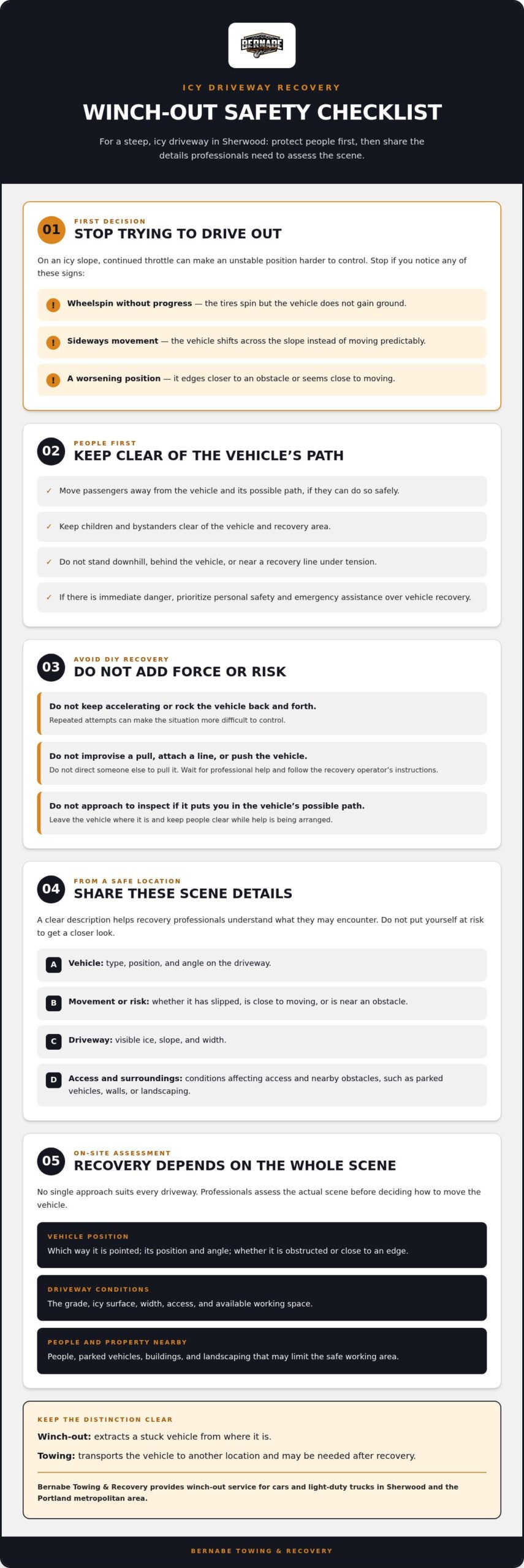
Once professional help is arranged, focus on communication and keeping people away from the vehicle’s path. Don’t attempt another pull or approach the vehicle to inspect it if the slope or ice makes that unsafe. A calm, specific update can help the recovery professional understand the driveway before assessing it.
What details should you share when requesting recovery?
Give the precise Sherwood location and explain that the vehicle is on a steep, icy driveway. Share what you can observe safely: the vehicle type, which direction it faces, where it sits on the slope, whether it has moved, and any nearby obstacles. Mention narrow access or anything else that could restrict reaching the vehicle. Stick to visible facts rather than guessing about damage or mechanical causes.
- Move people to a safer spot. If passengers can leave safely, keep them away from the vehicle and its possible path. If anyone remains inside, report that when requesting help and follow the recovery professional’s instructions.
- Share the location and scene details. Describe the driveway’s slope, visible ice, vehicle type and position, nearby obstacles, and access restrictions. Note whether the vehicle is still, sliding, or has shifted since you first called.
- Keep the area clear. Keep bystanders and pets away from the vehicle and the space where recovery may take place. Don’t approach recovery equipment or stand near a cable or line under tension.
- Pass along important changes. If the vehicle moves, someone’s situation changes, or access becomes blocked, communicate the update. Once help is on scene, follow the recovery professional’s directions and stay clear of the work area.
How can you keep people clear of the recovery area?
Choose a waiting spot well away from the vehicle’s possible path, not downhill from it or behind it. Keep pets and visitors with you rather than letting them watch nearby. Don’t walk over to recovery equipment or cross a line that may be under tension. Once the operator arrives, follow their directions about where to stand and when the area is clear.
These steps help you prepare without taking unnecessary risks. If you’re arranging a winch out from steep icy driveway Sherwood, clear details about the vehicle and driveway help explain the situation. Request winch-out assistance in Sherwood from Bernabe Towing & Recovery, serving cars and light-duty trucks in the Portland metropolitan area.
Request Bernabe Towing’s Winch-Out Help in Sherwood
Bernabe Towing & Recovery provides winch-out assistance in Sherwood for cars and light-duty trucks across the Portland metropolitan area. A clear request helps explain the driveway conditions and vehicle position so the recovery team can understand the scene and assess next steps. Share only what you can observe safely. Don’t move closer to a vehicle that may slide just to gather more details.
What to include in your recovery request
Give the Sherwood address or precise location, then describe the driveway and the vehicle’s position. If the entrance could be difficult to identify, mention a visible landmark or the safest way to find it. Keep details factual: report what you see rather than guessing about damage or why the vehicle became stuck.
- Location: Provide the address or precise location and a clear identifier for the driveway entrance.
- Vehicle: Name the vehicle type and describe which way it faces and where it sits on the slope.
- Conditions: Explain that the driveway is steep and icy, and describe any visible movement.
- Hazards: Mention nearby walls, parked vehicles, landscaping, edges, or other property to account for during recovery.
- Access: Note narrow entrances, gates, blocked approaches, or other limits to reaching the vehicle.
- Condition: Report visible damage and whether anyone remains inside the vehicle.
What happens after you request winch-out assistance?
The information you provide helps the recovery team understand the situation and assess the actual scene. It doesn’t replace an on-site evaluation, because the vehicle’s position, driveway surface, access, and surrounding hazards all matter. If the vehicle shifts or the situation changes after you request help, share the update instead of approaching to investigate.
While assistance is being arranged, stay in a safe place and keep passengers, pets, and bystanders away from the vehicle’s possible path. Keep the driveway approach accessible if you can do so without entering the hazard area. Don’t try to clear ice beside the vehicle, reposition it, or attach a strap or cable yourself. Once the recovery professional is on scene, follow their directions and leave the work area clear.
If you need a winch out from steep icy driveway Sherwood, have the location, vehicle type, slope, ice, position, access limits, and nearby obstacles ready to describe. Bernabe Towing & Recovery provides winch-out help in Sherwood for cars and light-duty trucks.
Request winch-out help in Sherwood
Take the Next Step Toward a Safer Recovery
An icy driveway can make it tempting to act quickly just to get the vehicle moving. Pause instead. Choosing a controlled next step over another uncertain attempt can help keep a difficult situation from becoming more hazardous. If the vehicle’s position or the conditions make movement uncertain, professional recovery is a practical way forward.
If you need a winch out from steep icy driveway Sherwood, Bernabe Towing & Recovery can help recover your vehicle. Share the details you can observe safely, then stay clear of its path while help is arranged. A clear request explains the recovery situation without requiring you to take risks to inspect it.
Contact Bernabe Towing & Recovery for winch-out help and take the next step toward recovery. Keep people clear and follow the recovery team’s directions.
Frequently Asked Questions
Can a car be winched out of a steep, icy driveway?
Yes, a car may be recoverable with a winch-out, but the right approach depends on its position and the conditions at the scene. A recovery professional can assess whether it can be moved safely from where it is stuck. If the car has visible damage or is resting against something, mention that before recovery begins so those details can be considered.
Is it safe to keep trying to drive a car up an icy driveway?
Not if the tires spin, the car slides, or it fails to move forward safely. Repeated throttle can leave the vehicle in a less stable position or bring it closer to a hazard. Don’t treat all-wheel drive or traction control as a guarantee of grip. If you’re unsure whether the car can move predictably, avoid another attempt and request recovery help.
What should I do if my car starts sliding on a steep driveway?
Prioritize people’s safety. Don’t approach the moving vehicle or try to stop it by hand. If you can move away without entering its path, do so and keep others clear. Don’t attempt a recovery while the car is shifting unpredictably. If anyone faces immediate danger, focus on getting to safety and contacting emergency services before arranging vehicle recovery.
How does a professional winch-out work on ice?
A recovery professional assesses the vehicle and icy driveway before deciding how to move it. The plan accounts for the car’s position, available access, and nearby hazards rather than assuming one method suits every slope. The goal is to extract the vehicle from where it is stuck in a controlled way. The approach depends on what the on-site assessment finds.
Can all-wheel drive get a car unstuck from an icy driveway?
Not necessarily. All-wheel drive can send power to more than one wheel, but it can’t create grip where tires meet slick ice. Traction control also can’t guarantee that the car will climb, turn, or remain in place on a steep surface. If the wheels spin or the vehicle shifts instead of making safe progress, stop trying to drive and consider professional winch-out help.
What information should I provide when requesting a winch-out in Sherwood?
Share the precise location, vehicle type, driveway slope, visible ice, and the vehicle’s position. Mention whether it has moved, any visible damage, and nearby obstacles or access restrictions. If your search is for a “winch out from steep icy driveway Sherwood,” these details help explain the situation clearly. Include a safe way to identify the driveway, such as a nearby landmark or entrance description.
Can a winch-out damage a vehicle or driveway?
Damage is possible during recovery, so don’t assume any pull is risk-free. The vehicle’s condition, position, and surroundings affect the assessment. Point out concerns such as a damaged bumper, low clearance, a narrow paved area, or nearby landscaping before recovery begins. A professional can consider those details when planning the move, but no recovery method can guarantee that damage won’t occur.