Bernabe Towing & Recovery
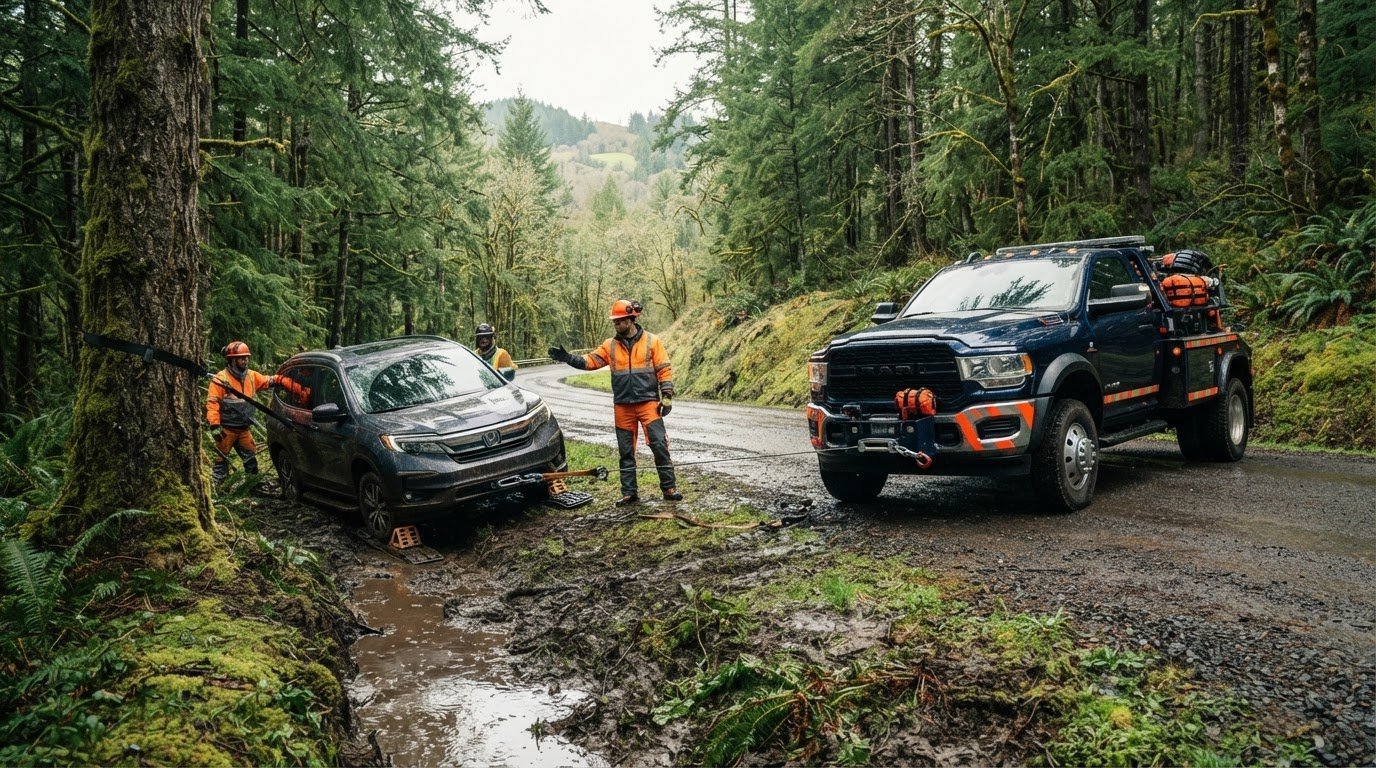
What makes an off road winch out safe is not simply the strength of the pull. It’s a plan based on where the vehicle is stuck and what’s around it. If your car, SUV, or light-duty truck is off the road, an improvised recovery attempt could create more risk or damage. A winch-out moves a stuck vehicle to accessible ground; towing transports it elsewhere. The right approach depends on the vehicle’s position, the ground, access, and nearby hazards.
This guide explains what to expect from a professional winch-out, what information helps an operator assess the scene, and how to stay safe while help is on the way. You’ll learn why recovery plans vary, what to share about your vehicle and surroundings, and when a winch-out may be followed by a tow. Bernabe Towing & Recovery provides winch-out service for cars, SUVs, and light-duty trucks across the Portland metropolitan area, including Portland, Beaverton, Tigard, and nearby communities.
Key Takeaways
- A professional off road winch out is planned around the vehicle’s position, terrain, access, and nearby hazards.
- Sharing your vehicle type, exact location, ground conditions, and visible risks helps the recovery operator assess the scene.
- Winching, traction assistance, and towing address different situations. The right option depends on whether the vehicle is stuck, needs added grip, or must be transported.
- While waiting, prioritize your safety and stay clear of unstable ground and recovery equipment.
- Learn what to expect from local winch-out and recovery help for cars, SUVs, and light-duty trucks across the Portland area.
What Is an Off-Road Winch Out, and When Is It Needed?
An off road winch out is a controlled recovery that moves a stuck vehicle from a difficult or inaccessible position to ground where it can be reached safely. A winch uses a pulling line to move the vehicle toward a suitable recovery point. The basic operation of a winch is straightforward, but vehicle recovery requires a plan suited to the scene, not simply a stronger pull.
A vehicle may need extraction after sliding off a driveway, becoming stuck on a trail, or sinking into a soft shoulder. Mud, loose ground, or a ditch can leave the tires unable to regain traction. The vehicle’s position may also prevent a tow truck from reaching it directly. These conditions can indicate a recovery challenge, but no single symptom determines the safest method.
Which situations may call for an off-road winch-out?
Conditions around the vehicle matter as much as the fact that it’s stuck. The depth and angle of a ditch, how soft or uneven the ground is, and whether recovery equipment can reach the vehicle all affect the approach. Visible damage, an unstable position, or proximity to traffic or another hazard can also change the plan. Wheel spin alone doesn’t tell you which method is safest. The vehicle’s position and its surroundings need to be considered together.
If the vehicle is in a hazardous position, keep yourself and passengers clear of traffic and unstable ground if it’s safe to move. Don’t attach improvised gear or start a pull. A professional operator can assess whether extraction is suitable and how to move the vehicle while managing the risks at the scene.
How is a winch-out different from a tow?
A winch-out extracts a vehicle from a ditch, mud, or another difficult position and brings it to accessible ground. Towing transports a vehicle from one location to another. The two services can be part of the same recovery, but they solve different problems.
Once the vehicle reaches an accessible point, it may be able to continue under its own power. If it can’t, towing may be the next step. An assessment helps determine whether extraction is appropriate on its own or whether the vehicle needs transport afterward. Bernabe Towing & Recovery provides winch-out and vehicle recovery services for cars, SUVs, and light-duty trucks across the Portland metropolitan area.
How a Professional Off-Road Winch-Out Is Assessed and Carried Out
A safe off-road winch out starts before any recovery equipment is used. The operator gathers information about the vehicle and its location, assesses the scene, chooses an approach, and carries out the recovery. After the vehicle reaches accessible ground, its position and visible condition can be reassessed. These steps help determine whether extraction is suitable or whether conditions call for a different plan.
What information helps assess the recovery?
Clear details help the operator understand what to expect and plan access to the vehicle. Share:
- Your location: Give an accurate address, trail access point, or nearby landmark in the Portland metro area.
- Vehicle details: Describe whether it’s a car, SUV, or light-duty truck, and which way it’s facing or was traveling.
- How it became stuck: Explain what happened and whether the vehicle moved, slid, or lost traction.
- What you can see: Mention nearby traffic, a slope, water, visible damage, or any other hazard.
Don’t put yourself at risk to get a better look. If you can’t safely see or describe something, say so. The operator can use the information available and assess the scene directly. For drivers planning trips on public lands, the U.S. Forest Service’s Off-highway Vehicle Touring guidance also emphasizes preparation and safety before heading out.
Why does the recovery plan change from scene to scene?
Ground that looks firm from the road may be soft near the vehicle. A slope, limited working space, or the direction the vehicle is facing can affect which recovery options are practical. The operator considers these conditions along with visible hazards and the vehicle’s position. A direct extraction may not be the safest choice; repositioning or another recovery method may be more appropriate.
During the recovery, stay clear of the work area and follow the operator’s directions. Don’t attach improvised gear or make adjustments yourself. Once the vehicle is out, the operator can reassess its position and visible condition to help determine whether it can continue or should be transported. For more detail, see Bernabe Towing & Recovery’s professional winch-out recovery process.
Winch-Out, Traction Help, or Tow: Which Recovery Approach Fits?
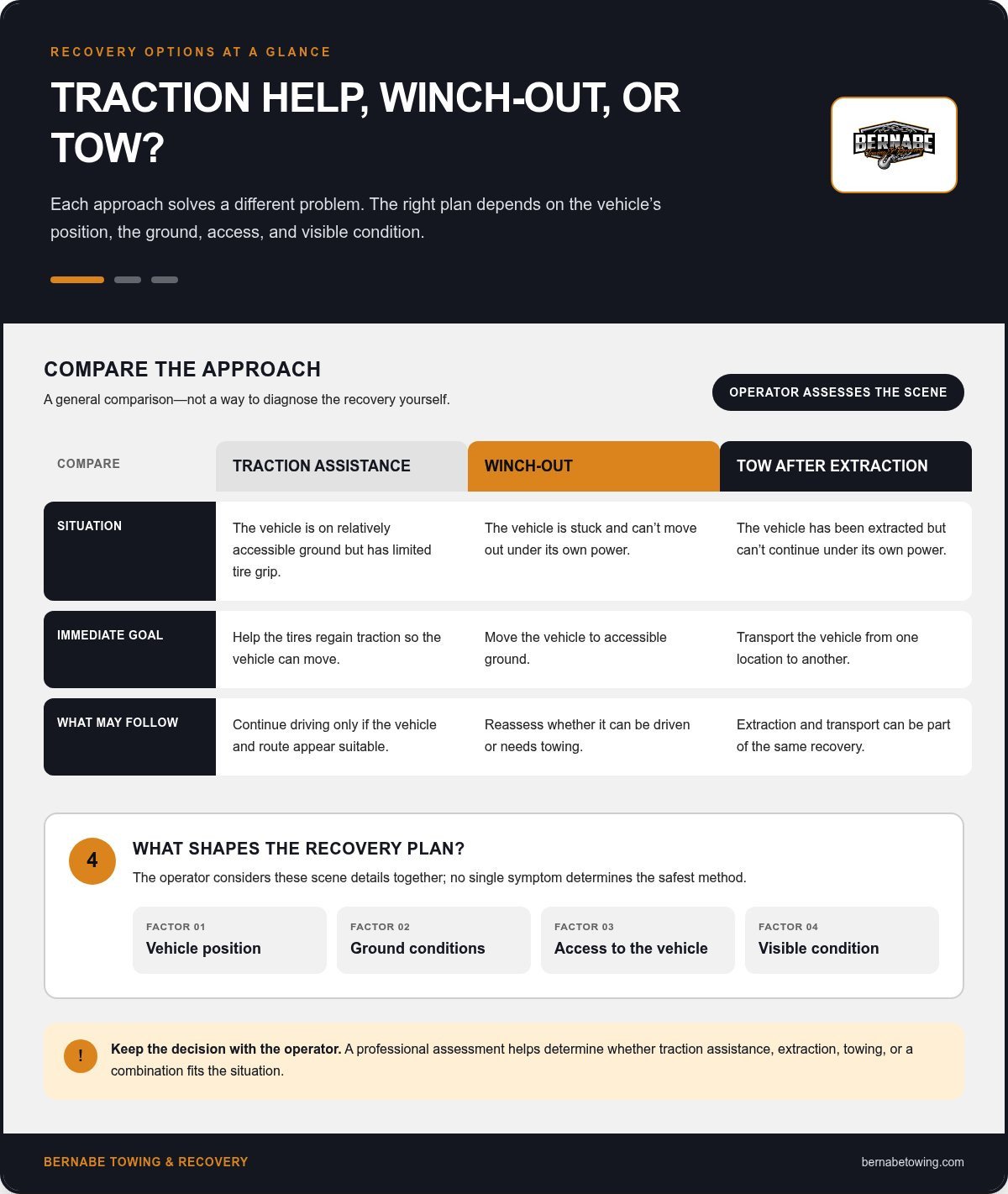
A stuck vehicle doesn’t always need the same response. An operator assesses its position, the ground, access, and visible condition before deciding whether traction assistance, extraction, towing, or a combination makes sense. The table offers a general comparison, not a way to diagnose the recovery yourself.
| Approach | Situation it addresses | Immediate goal | Likely next step |
|---|---|---|---|
| Traction assistance | The vehicle is on relatively accessible ground but has limited tire grip. | Help the tires regain traction so the vehicle can move. | Continue driving only if the vehicle and route appear suitable. |
| Winch-out | The vehicle is stuck in a position or on ground where it can’t move out under its own power. | Extract it to accessible ground. | Reassess whether it can be driven or needs towing. |
| Towing after extraction | The vehicle has been brought to an accessible point but may not be safe or able to drive. | Transport the vehicle from the recovery location. | Arrange suitable towing to the next destination. |
These approaches aren’t interchangeable in every situation, and no method can guarantee that a vehicle won’t be damaged. Existing damage, vehicle condition, and terrain all matter. Professional four-wheel-drive training is one area covered by the International 4-Wheel Drive Trainers’ Association.
When might traction assistance be enough?
Traction assistance may be considered when the vehicle is only mildly stuck and the tires can regain grip without pulling it from a difficult position. The operator determines whether conditions suit that approach. Repeated acceleration can spin the tires, disturb soft ground, and leave the vehicle more deeply stuck. Avoid improvised recovery attempts. Let the operator assess the scene and choose the method.
When might extraction be followed by towing?
Reaching accessible ground doesn’t automatically mean the vehicle is safe to drive. Visible damage, a warning sign of a mechanical problem, or uncertainty about how the vehicle is handling calls for reassessment before continuing. If it can’t be driven safely, towing may follow the extraction. If the vehicle became stuck after a collision, accident recovery may also be relevant to the next step.
What to Do While Waiting for an Off-Road Winch-Out in Oregon
While waiting for an off road winch out, focus first on people, not the vehicle. A safe place to wait depends on the vehicle’s position, nearby traffic, visibility, weather, and ground stability. Don’t move across a road or onto a slope, muddy shoulder, or area near water unless you can do so safely. If you’re unsure, stay where you are and follow the recovery operator’s directions.
How can you stay safe beside a stuck vehicle?
Keep passengers together and clear of the recovery area. Don’t stand beside the vehicle to watch, and never approach recovery equipment while it’s in use. Conditions can change if the vehicle shifts or the ground gives way. In the Portland area, as elsewhere in Oregon, traffic exposure and wet or uneven terrain may affect where it’s safest to wait. Follow the operator’s instructions about where to stand and when to move.
If the situation changes before help arrives, update the recovery operator. Report a change in your location, new hazards, shifting ground, or visible changes to the vehicle. Be specific, but don’t put yourself in danger to inspect the scene or get a better view.
What should you avoid before recovery begins?
Stop trying to drive out if the tires keep spinning and the vehicle is sinking or sliding further. Repeated acceleration can disturb soft ground and make the position harder to manage. Don’t attach straps or ropes, choose anchor points, or attempt a pull with improvised or unsuitable gear. The recovery method needs to fit the scene, and an unplanned pull can create additional risk.
For a vehicle stuck in mud, use the safe steps for a car stuck in mud as a guide to what to avoid while waiting. Keep clear of the vehicle if it appears unstable, and don’t walk onto soft edges or slopes to inspect it. Your observations can help the operator, but personal safety comes first.
When the operator arrives, give them space to assess the vehicle and surroundings. Let them direct where you and any passengers should wait, and don’t approach the equipment unless instructed. These steps help keep the recovery area clear while the operator determines what to do next. Bernabe Towing & Recovery provides off-road recovery assistance for cars, SUVs, and light-duty trucks in the Portland metro area. Request winch-out help.
Off-Road Winch-Out Help from Bernabe Towing & Recovery
Bernabe Towing & Recovery provides winch-out and vehicle recovery services for cars, SUVs, and light-duty trucks across the Portland metropolitan area. The recovery approach depends on the vehicle’s position, the ground, access, and hazards at the scene. Sharing clear information helps the operator understand the situation and assess the next step.
Service areas include Portland, Tigard, Beaverton, and Tualatin, as well as Sherwood, Hillsboro, Wilsonville, King City, and Lake Oswego. Whether your vehicle is off a driveway, on soft ground, or in a ditch, describe what you can see rather than guessing which recovery method is needed.
What details should you share when requesting recovery?
Start with your exact location or a nearby landmark. If the vehicle is away from a road, describe the safest access route you know. Then share the details that help explain the scene:
- Vehicle: Give the type, such as a car, SUV, or light-duty truck.
- Position: Explain where it’s stuck and which direction it’s facing.
- Condition: Mention any visible damage or signs that it may not be safe to drive.
- Hazards: Describe nearby traffic, a slope, water, unstable ground, or other concerns.
- Occupants and changes: Say whether everyone is in a safe place and report any change in conditions or vehicle position.
Don’t approach traffic, unstable ground, or the vehicle to gather details if doing so would put you at risk. If you’re unsure about something, explain what you can observe from a safe location.
How does local recovery support help drivers?
Local recovery support serves drivers in Portland, Tigard, Beaverton, Tualatin, and nearby communities. The operator still needs to evaluate the specific scene: a vehicle on firm ground with open access presents a different situation from one on a slope or in soft terrain. No single recovery approach fits every vehicle or location.
If you need an off road winch out, share your location, vehicle type, position, visible damage, and any immediate hazards so the recovery team can understand what’s happening. Request off-road winch-out assistance from Bernabe Towing & Recovery.
Take the Next Step Toward a Safe Recovery
A professional off road winch out is a controlled extraction, not simply a stronger pull. The right approach depends on the vehicle’s position, ground conditions, access, and visible hazards. Once the vehicle reaches accessible ground, it may need towing if it can’t continue safely. Sharing clear details about your location, vehicle, and surroundings helps the recovery operator understand the situation.
While help is on the way, prioritize people over the vehicle. Stay clear of traffic, unstable ground, and recovery equipment, and follow the operator’s directions. Avoid repeated attempts to drive out if the tires are sinking or sliding further.
Bernabe Towing & Recovery provides local towing and recovery across the Portland metropolitan area, including winch-out service for cars, SUVs, and light-duty trucks. If you need recovery, request off-road winch-out assistance and share your location and situation.
Frequently Asked Questions
What is an off-road winch out?
An off road winch out is a controlled recovery that moves a stuck vehicle to accessible ground. A professional operator considers the vehicle’s position, ground conditions, access, and visible hazards before choosing an approach. It may be used when a car, SUV, or light-duty truck can’t regain movement on mud, soft ground, a shoulder, or in a ditch. It’s an extraction, not a guarantee the vehicle can drive afterward, so its condition should be reassessed once it’s out.
Can a tow truck pull a car out of mud or a ditch?
Yes, a tow truck may be able to recover a car from mud or a ditch, depending on access and scene conditions. The operator assesses the vehicle’s position, the ground, nearby hazards, and the vehicle’s condition to decide on a suitable approach. A winch-out may bring the car back to accessible ground. If it can’t be driven safely afterward, towing may be needed to transport it.
Is a winch-out the same as towing?
No. A winch-out focuses on extracting a vehicle from a difficult position and moving it to accessible ground. Towing transports a vehicle from one location to another. The services can be part of the same recovery: a vehicle may first need extraction from mud or a ditch, then towing if it can’t continue safely. The operator assesses the scene and vehicle to determine the appropriate next step.
What should I do while waiting for an off-road recovery?
Prioritize personal safety and follow the recovery operator’s directions. Move away from traffic or unstable ground only if you can do so safely, and keep passengers clear of recovery equipment and the work area. Don’t approach the vehicle if it’s unstable, attach improvised gear, or stand near equipment during recovery. Let the operator know if your location, the hazards, or the vehicle’s condition changes while you wait.
Can I winch my own vehicle out of mud?
A DIY winch recovery can create risks if the equipment, attachment points, or ground conditions aren’t suitable. Don’t improvise a pull or stand near recovery equipment. If the tires keep spinning and the vehicle is sinking or sliding further, stop trying to drive out and seek professional recovery. An operator can assess the vehicle’s position, visible damage, ground, and access before determining an appropriate recovery approach.
What information should I provide when requesting a winch-out near Portland?
Provide your exact location or a nearby landmark, plus a description of the safest access route you know. Identify the vehicle type and explain where it’s stuck, which way it’s facing, and how it became stuck. Mention visible damage, traffic, slopes, water, or other hazards, and whether occupants are safe. Bernabe Towing & Recovery serves Portland, Tigard, Beaverton, Tualatin, Sherwood, Hillsboro, Wilsonville, King City, and Lake Oswego.