Bernabe Towing & Recovery
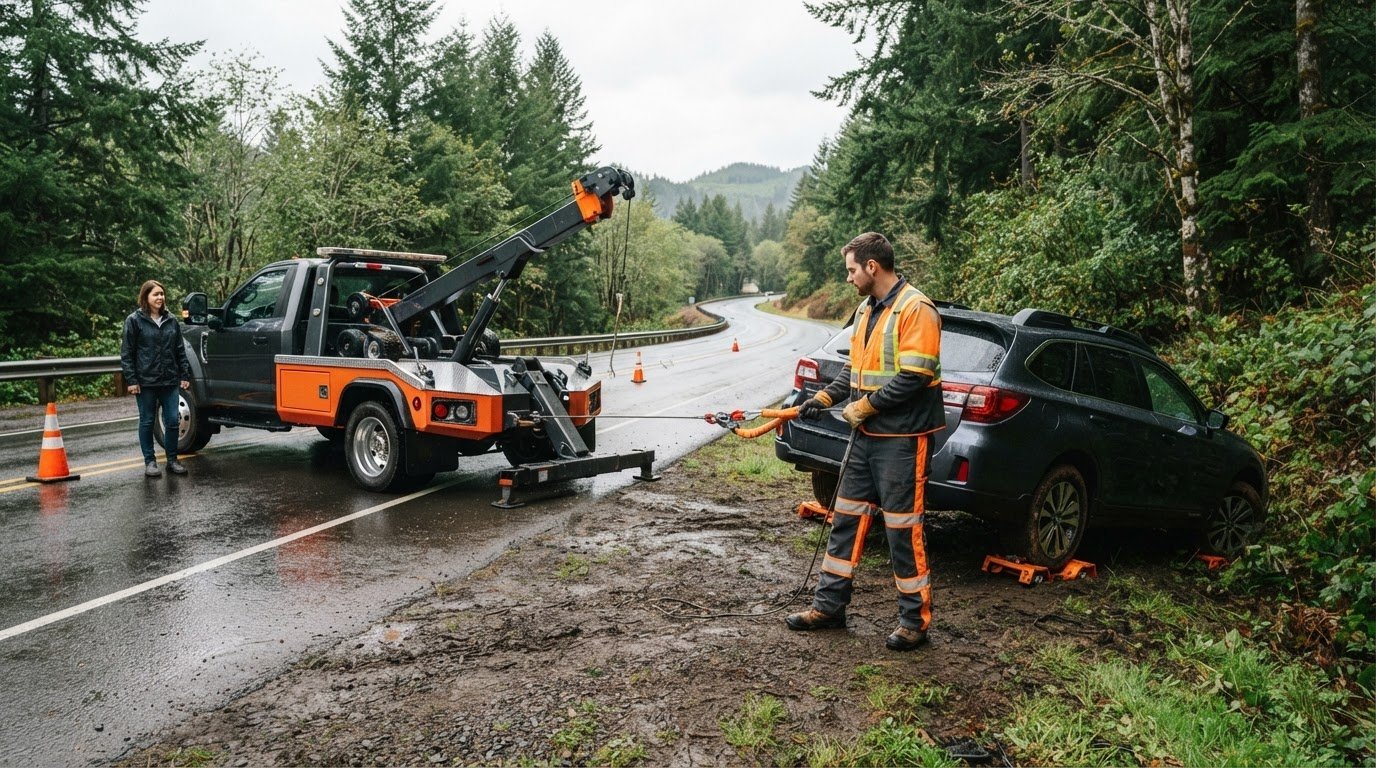
A standard tow hook can easily cause more structural damage to your car than the ditch it slid into. When your vehicle leaves the pavement or ends up disabled after an impact, the immediate instinct is to call the first generic roadside service you find. You’re already dealing with the stress of potential drivetrain issues, bent suspension components, and frustratingly long wait times from national motor club call centers. However, treating an off-road extraction like a simple transport job is a costly mistake. Knowing when you need specialized local towing and recovery ensures the right rigging touches your vehicle before tension hits the line.
In this guide, you’ll discover the critical differences between standard towing and complex vehicle recovery so you can protect your vehicle during roadside emergencies. We break down the mechanical realities of proper winching, expose common recovery myths, and show you how to verify a qualified local provider who can safely extract and transport your car without secondary frame damage.
Key Takeaways
- Differentiate standard rolling transport from complex extraction to prevent severe frame stress and suspension damage.
- Avoid costly DIY pull-out mistakes that transfer violent kinetic shock loads to unrated passenger vehicle points.
- Cut roadside response delays by bypassing third-party call centers in favor of direct local towing and recovery dispatch.
- Use a practical verification checklist to confirm an operator brings the proper light-duty rigging gear before touching your vehicle.
- Learn how precision winching techniques protect daily drivers, lowered cars, and light trucks throughout roadside emergencies.
Demystifying Local Towing and Recovery: What Sets Specialized Recovery Apart
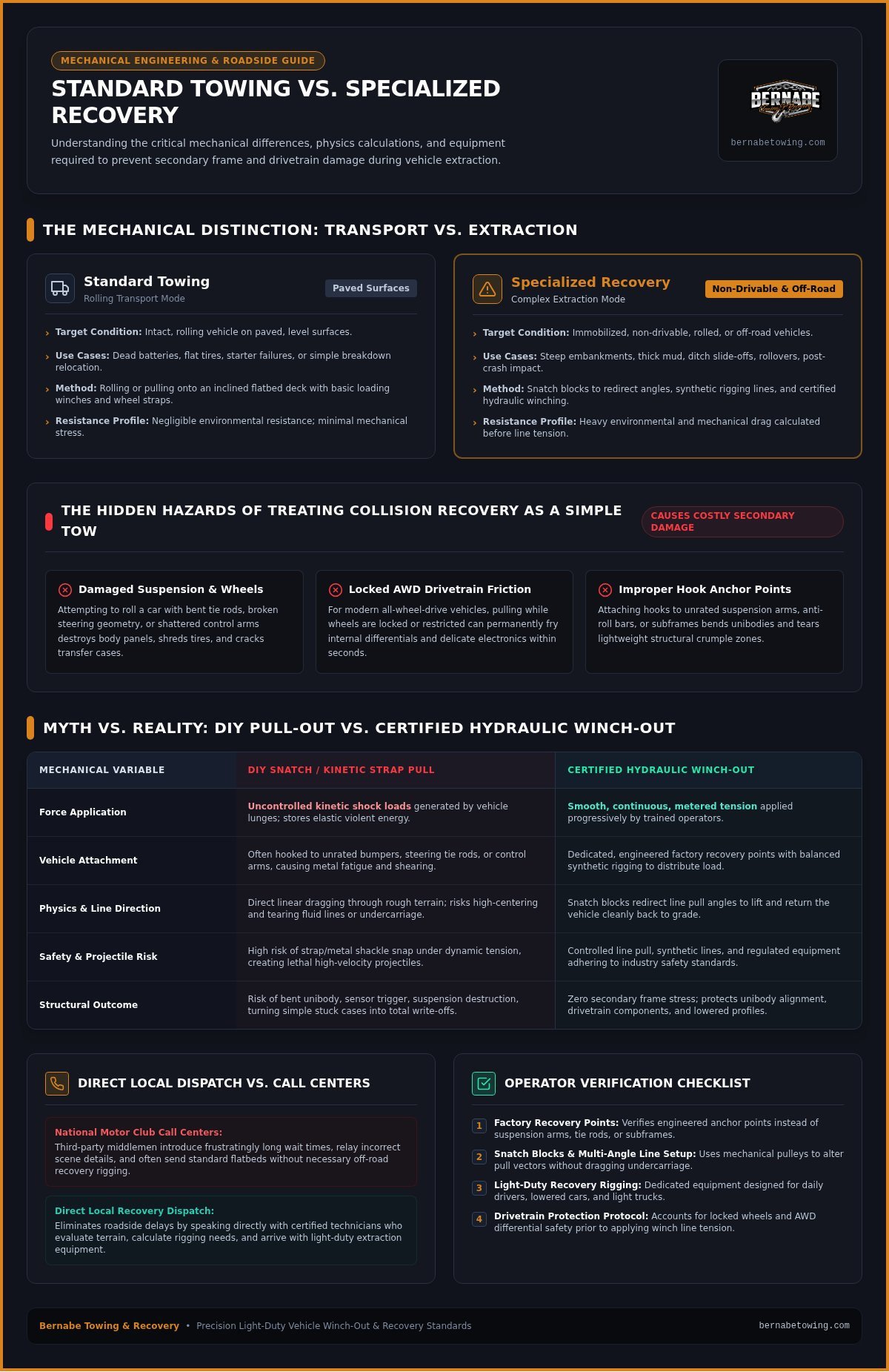
Most motorists use the words interchangeably, but towing and recovery are fundamentally different operations. Standard towing involves moving an intact, rolling vehicle from point A to point B over paved surfaces. Vehicle recovery, by contrast, focuses on safely extracting an immobilized automobile from a compromised, non-drivable location. When your car slides off the road, gets high-centered on an obstacle, or suffers heavy impact, a standard hook is rarely the right solution. Professional local towing and recovery relies on precise physics calculations, including line angles and resistance variables, to ensure that the extraction does not twist the structural unibody or tear suspension mounts.
The Mechanical Distinction Between Transport and Vehicle Extraction
Standard transport typically utilizes a flatbed carrier. The operator rolls or pulls a functional vehicle onto an inclined deck using a basic loading winch, securing it with wheel straps for transit across level pavement. This setup works well for mechanical breakdowns like dead batteries, flat tires, or starter issues.
Recovery situations introduce severe environmental resistance and uneven mechanical resistance. When a vehicle slides down a steep embankment, settles into thick mud, or rolls onto its side, standard loading methods fail. Modern vehicle recovery methods require specialized winch-out equipment, snatch blocks to redirect pulling angles, and synthetic rigging lines. These dedicated tools divide the tension evenly across engineered pickup points, bringing the vehicle back to grade without dragging its undercarriage through terrain that could rip lines loose.
The Hidden Hazards of Treating Collision Recovery as a Simple Tow
Treating a post-crash extraction like everyday transport often produces expensive secondary damage. Attempting to roll a vehicle with bent tie rods, compromised steering geometry, or shattered control arms will quickly destroy body panels, shred tires, and crack transfer cases. For modern vehicles with all-wheel drive, pulling a car while its wheels are locked can fry internal differentials and delicate electronics within seconds.
Qualified local specialists utilize dedicated light-duty recovery gear designed specifically for passenger cars, lowered vehicles, and light pickup trucks. They identify factory recovery points rather than hooking onto control arms, anti-roll bars, or subframes. To learn how collision scenes are handled safely from impact to drop-off, review our towing after accident overview. Choosing a vetted local towing and recovery operator guarantees that the extraction process protects your car’s drivetrain and frame integrity throughout the entire process.
Myth vs. Reality: Why DIY Pull-Outs Cause Costly Secondary Damage
A passing pickup truck with a tow strap looks like an immediate lifeline when you are stuck. However, accepting an amateur yank often turns a minor recovery scenario into a mechanical write-off. Unlike older trucks built with rigid perimeter frames and exposed tow loops, modern passenger vehicles feature lightweight unibody structures with thin crumple zones. Connecting an unrated tow strap to a suspension arm, bumper support, or steering tie rod creates violent shock loads that shear steel, bend unibodies, and compromise factory safety systems. Relying on professional local towing and recovery ensures your car is removed using controlled tension that adheres to verified towing industry standards.
Myth: A Basic Tow Strap Can Safely Dislodge Any Trapped Car
Kinetic tow straps operate by storing elastic energy, which amplifies pulling force when the recovery vehicle lunges forward. This sudden, violent jolt routinely tears through suspension components and can even trigger airbag sensors. Worse, cheap tow straps often snap under dynamic tension. When a strap or metal shackle breaks, it becomes a high-velocity projectile capable of shattering windshields and inflicting catastrophic injury. Certified hydraulic winches eliminate this hazard by applying progressive, steady line pull monitored by a trained technician.
| Feature | DIY Snatch Strap Pull | Certified Hydraulic Winch-Out |
|---|---|---|
| Force Application | Uncontrolled, dynamic shock loads | Smooth, continuous, metered tension |
| Attachment Points | Often hooked to weak cosmetic or suspension parts | Engineered factory frame slots and bridle points |
| Line Failure Risk | High risk of snap-back and flying projectiles | Damped synthetic lines and rated safety cables |
| Structural Outcome | Frequent subframe twist and alignment loss | Zero secondary frame or body damage |
Unseen Drivetrain and Unibody Frame Strain from Improper Recovery
Drivetrain damage represents another hidden risk of backyard extractions. Pulling an electronic all-wheel-drive sedan or crossover sideways while in park severely binds the transfer case and strips differential gears. Similarly, securing lines to bumper beams twists the unibody, throwing off door alignment and breaking expensive radar sensors mounted in modern bumpers.
Protecting your vehicle requires methodical rigging that accounts for rolling resistance, mud suction, and line angles. For step-by-step insight into safe extraction protocols, explore our car recovery after accident guide. If you find your car off the roadway, booking a specialized local towing and recovery service is the safest way to extract your vehicle without adding thousands of dollars in mechanical repairs.
Local Recovery Operators vs. National Dispatch Networks: The Response Reality
When an unexpected breakdown leaves you stranded on the shoulder, calling a national roadside club feels like the default move. You assume their massive network ensures fast support. In reality, national auto clubs act as brokers rather than direct service providers. They route your call through out-of-state call centers, log basic details into an automated queue, and broadcast the job across lowest-bidder networks. This multi-tiered system introduces severe communication bottlenecks. Choosing a direct provider for local towing and recovery cuts out the middleman, putting you in direct contact with the dispatcher sending the truck.
Myth: National Membership Motor Clubs Always Arrive Fastest
Motor club algorithms prioritize cost optimization over speed. National dispatch networks often take 60 to 90 minutes or longer just to confirm an available contractor, especially during peak commute hours. In contrast, local towing companies in the Portland metro area typically maintain response times of 20 to 40 minutes. Calling a local fleet directly eliminates queue delays and ensures the person on the phone actually knows the area.
- National Motor Clubs: Remote call intake, automated contractor bidding, inaccurate physical location notes, and prolonged wait times.
- Direct Local Dispatch: Immediate assessment with experienced local staff, real-time driver ETA updates, and prompt equipment matching.
Mastering Pacific Northwest Road Realities and Local Bottlenecks
Regional road geometry requires hands-on familiarity that automated dispatch algorithms cannot process. A national call taker in another time zone does not grasp how evening gridlock backs up Highway 217 near Beaverton, or how narrow, winding roads around Lake Oswego complicate flatbed positioning. Local operators know alternate access points across Interstate 5 corridors and understand how wet Pacific Northwest clay demands specific winching angles. That institutional knowledge ensures drivers reach your exact coordinates quickly and clear the scene without creating hazardous traffic backups.
Matching Rigging Capabilities to Light-Duty Vehicle Profiles
Centralized broker scripts frequently fail to convey vehicle specifications, leading to mismatched machinery on scene. An automated portal might send a standard wheel-lift truck for a lowered sports sedan, an all-wheel-drive crossover, or a vehicle stuck down an embankment. Just as consumer safety agencies emphasize the dangers of DIY car maintenance when equipment is mismatched, using the wrong recovery apparatus invites catastrophic bodywork and mechanical damage.
Dedicated local operators deploy specialized light-duty flatbeds and soft-strap rigging suited for passenger cars, light trucks, and electric vehicles. For a detailed breakdown of field-tested extraction methods, explore our car recovery service guide. Direct communication guarantees that your local towing and recovery team arrives equipped with the exact rigging gear required for your vehicle’s specific clearance and drivetrain layout.
How to Evaluate a Local Towing and Recovery Provider Before You Call
Taking sixty seconds to vet an operator over the phone prevents mechanical blunders and costly damage claims. Drivers often settle for whoever promises the fastest arrival, only to realize too late that the responding truck lacks suitable equipment for their vehicle type. Choosing an established partner for local towing and recovery requires looking past generic marketing and asking direct questions about rigging gear, insurance, and procedural safety.
Verifying Recovery Equipment and Operator Safety Standards
Modern passenger cars demand precise extraction methods. Before authorizing service, ask the provider these essential operational questions:
- Rigging hardware: Do you deploy hydraulic winches with synthetic lines to prevent abrasive damage to paint and undercarriage parts?
- Attachment protocol: Will your technician utilize factory-engineered recovery eyelets and bridle slots rather than hooking onto suspension arms?
- Insurance protection: Does your company carry comprehensive on-hook cargo and liability coverage that protects my vehicle throughout extraction and transit?
- Vehicle configuration: Do you operate specialized light-duty equipment configured specifically for passenger sedans, lowered vehicles, SUVs, and light trucks?
Assessing Direct Dispatch Transparency and Scene Coordination
Clear communication during a roadside emergency lowers stress and eliminates guesswork. Professional local dispatchers ask detailed questions about your vehicle’s physical position, steering condition, and immediate surroundings before rolling a truck. They know neighborhood intersections, alternate side routes, and local bottlenecks, which keeps response times realistic and predictable.
When an accident leaves a vehicle stranded in traffic or disabled off the pavement, proper incident coordination is mandatory. Reliable operators coordinate directly with municipal police and emergency crews to secure the perimeter and clear lanes safely without causing secondary damage. To see how structured extraction methods work under real-world conditions, explore our accident recovery Tigard Oregon case study. If your vehicle is immobilized and requires expert light-duty handling, contact Bernabe Towing & Recovery to speak directly with our local dispatch team.
Reliable Vehicle Recovery Solutions Across the Greater Portland Metro Area
Facing an unexpected breakdown on a crowded corridor demands rapid action from operators who understand the ground beneath your tires. Whether your sedan slipped down a muddy shoulder or your crossover suffered steering failure in traffic, dependable local towing and recovery bridges the gap between roadside danger and complete peace of mind. Focusing exclusively on passenger vehicles, light trucks, and low-clearance cars, dedicated light-duty operators provide the exact balance of power and gentle handling necessary to extract and transport your car intact.
Rapid Incident Response from Tigard and Beaverton to Surrounding Communities
Roadside emergencies along Highway 217, Interstate 5, and Oregon Route 99W require immediate, localized response. Having trucks stationed locally means assistance reaches you quickly across Tigard, Beaverton, Hillsboro, Sherwood, and Tualatin. Local teams handle daily driver needs with tailored roadside and transport capabilities:
- Precision winch-out service: Controlled extractions from ditches, muddy fields, and steep embankments without frame stress.
- Emergency towing service: Safe flatbed transit for passenger cars, lowered sedans, SUVs, and light pickups.
- Accident recovery: Methodical extraction and scene clearance following collisions, protecting salvageable drivetrains.
- Roadside assistance: On-scene tire change service, jump start service, and fast lockout assistance to get you moving again.
Information to Have Ready for Your Emergency Recovery Dispatcher
Direct communication begins the moment you call. Relaying precise situational data allows the dispatcher to send the right equipment on the very first run. If you are stopped on the shoulder or off the roadway, stay inside your vehicle with your seatbelt fastened whenever traffic is moving nearby. Keep hazard lights active to warn approaching traffic, especially during low-visibility Pacific Northwest rain.
When you contact dispatch, provide these specific incident details:
- Location markers: Share exact highway mileposts, exit numbers, nearby businesses, or intersecting cross streets.
- Vehicle position: Explain whether the car sits on level shoulder pavement, down an incline, or high-centered on a curb.
- Mechanical state: Note whether wheels roll freely, if the transmission shifts out of park, or if there is visible fluid leakage.
- Vehicle specs: State the exact make, model, and drive configuration (front-wheel, rear-wheel, or all-wheel drive).
Clear details ensure the responding truck arrives ready to execute a safe, damage-free recovery on arrival. When you need rapid, professional assistance anywhere in the metro area, contact Bernabe Towing & Recovery for dependable vehicle recovery from trusted neighborhood professionals.
Make the Safe Choice for Your Vehicle’s Recovery
Roadside emergencies leave no margin for improvised pull-outs or guesswork. Understanding the mechanical differences between simple transport and complex extraction protects your vehicle from catastrophic unibody twisting and drivetrain damage. Bypassing third-party national call centers in favor of direct communication ensures that the right equipment arrives at your location without frustrating delays.
When unexpected trouble strikes, you need an agile partner focused on preserving your vehicle. Bernabe Towing & Recovery provides direct local dispatch throughout Tigard, Beaverton, and the greater Portland metropolitan area. Our team deploys specialized light-duty rigging engineered to safeguard daily sedans, lowered cars, SUVs, and light trucks. Whether you need controlled winch-outs, collision transport, or rapid roadside assistance like jump starts and lockout services, we are ready to assist. Request dependable local towing and recovery from Bernabe Towing & Recovery to get off the shoulder safely and keep your vehicle completely protected.
Frequently Asked Questions
What is the primary difference between vehicle towing and accident recovery?
Standard vehicle towing moves a rolling car across paved surfaces, whereas accident recovery extracts an immobilized or compromised vehicle from a crash site, ditch, or hazardous position. Recovery demands specialized rigging, load calculations, and winch-outs to protect the chassis before transport begins. Calling a specialized local towing and recovery team ensures damaged steering, axles, or drivetrains are safely stabilized before the car ever rolls onto a flatbed.
Can using a regular tow strap to pull my stuck car cause permanent damage?
Yes, pulling a stuck car with a basic kinetic tow strap often causes severe frame and suspension damage. Amateur yanks deliver sudden, uncontrolled shock loads that can tear aluminum control arms, bend tie rods, crack unibody subframes, or accidentally set off airbag sensors. Snapped recovery straps also turn into dangerous airborne hazards. Controlled hydraulic winching applies steady tension to factory-rated anchor points, preventing catastrophic structural failure.
Why should I contact a local towing company directly instead of my motor club app?
Calling a local provider connects you straight to regional dispatchers who know local traffic corridors across Beaverton, Tigard, and Portland. Motor club apps route requests through national call centers and automated bidding portals, routinely producing 60 to 90 minute delays. Direct local towing and recovery dispatch cuts out third-party brokers, verifies your vehicle’s mechanical condition immediately, and sends the properly equipped truck on the initial run.
Can all-wheel-drive vehicles be safely towed with standard front-wheel lift trucks?
No, all-wheel-drive vehicles should never be towed with two wheels rolling on the pavement. Rolling an AWD or 4WD vehicle with its opposite axle lifted causes severe friction in the central differential, burning out transfer cases and destroying electronic drivetrain modules within miles. AWD cars, crossovers, and electric vehicles require complete four-wheel transport on a flatbed or the use of auxiliary wheel dollies to prevent expensive mechanical failure.
What details should I provide when calling for an off-road winch-out service?
Give the dispatcher your exact location, nearby cross streets or highway mileposts, and the vehicle’s physical position. Explain how far the tires sit off the road, whether the car rests on an incline, and the terrain type, like wet Pacific Northwest clay or gravel. Mention if the vehicle shifts into neutral, if steering functions, and whether any wheels are jammed or high-centered against curbs or obstacles.
Is professional recovery equipment safe for lowered passenger cars and electric vehicles?
Yes, professional light-duty operators use low-profile loading angles and soft-strap wheel webbing engineered specifically for delicate vehicles. Lowered sports cars, modified suspensions, and electric vehicles lack heavy steel tie-downs and sit dangerously close to the road. Dedicated flatbed beds slide back horizontally to reduce incline, while nylon bridles attach securely without scratching ground-effects body kits, scraping aluminum subframes, or puncturing high-voltage underbody battery enclosures.
Will professional accident recovery damage my car’s unibody frame further?
Qualified recovery technicians follow precise extraction protocols that isolate collision damage and prevent secondary frame distortion. Technicians analyze pulling vectors and connect synthetic lines solely to reinforced unibody slots or structural subframe points designed by the automaker. Using metered hydraulic tension rather than dynamic pulling protects the passenger cabin, preserves salvageable drivetrain parts, and ensures your vehicle arrives at the repair facility in its post-impact state.