Bernabe Towing & Recovery
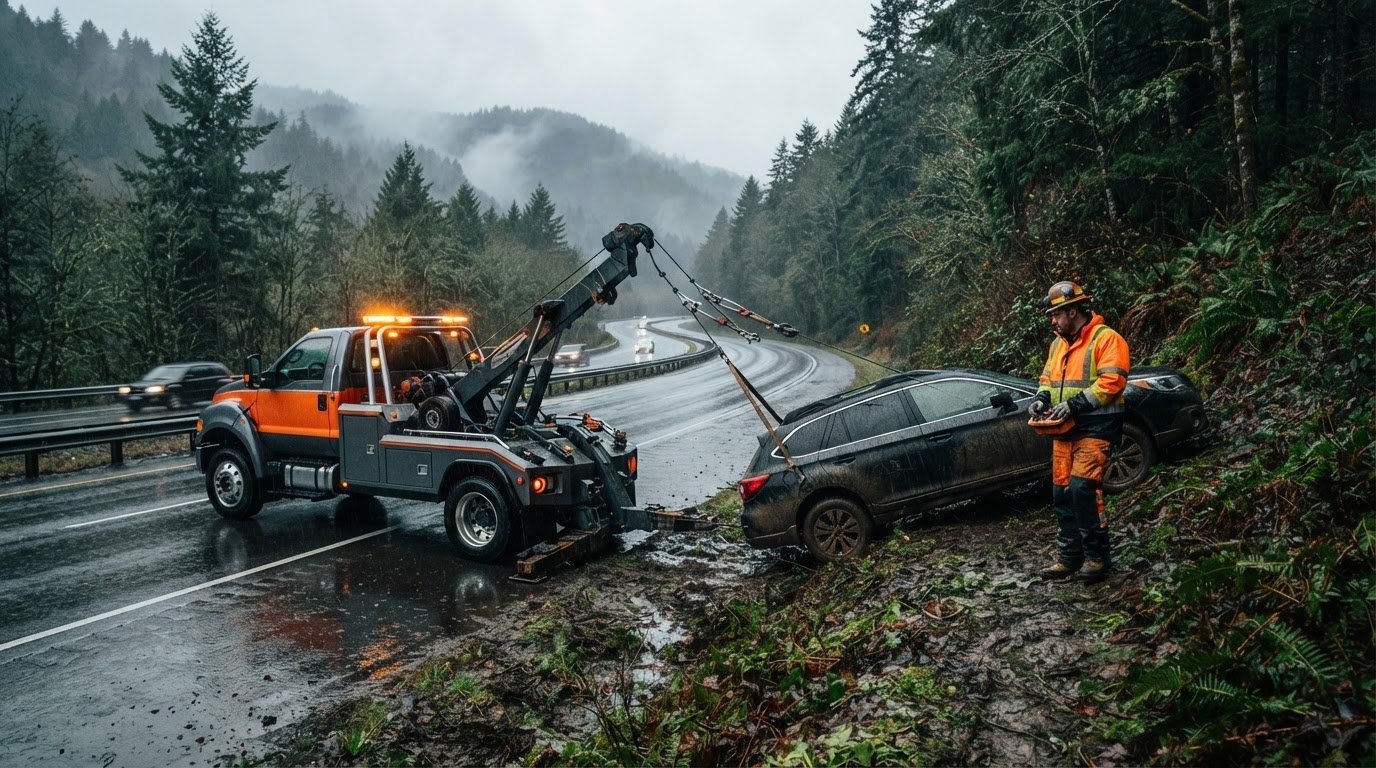
Calling a standard tow truck might be the most expensive mistake you make when your vehicle is stuck down a steep embankment or flipped in a ditch. While many drivers think any hook and chain will do, technical extraction is a specialized rigging operation that requires far more than just a simple lift. You’re likely feeling the weight of the situation, especially if you’re stranded on a dangerous highway shoulder like OR-217 or I-5 during a Portland rainstorm. The fear of causing further frame damage or facing confusing costs only adds to the pressure of the moment.
Our professional guide to car recovery service explains exactly how to handle these high-stress extractions safely and efficiently. You will learn the vital differences between basic towing and technical recovery to ensure your vehicle returns to the pavement without structural compromise. We’ll preview the specialized winch-out equipment used in the Tigard and Beaverton area, clarify how recovery labor is calculated, and show you what to expect from a dependable local expert when you need them most. Understanding these technical requirements helps you stay calm and ensures your car is handled with the precision it deserves.
Key Takeaways
- Understand the vital difference between basic towing and technical vehicle recovery to ensure you request the correct equipment for your specific situation.
- Learn how specialized rigging and hydraulic winches prevent frame damage by calculating resistance and using controlled pulling power.
- Discover the specific safety steps you must take when stranded on Oregon highways to remain visible and protected from passing traffic.
- Identify the essential details to share with dispatchers to receive a quick response and an accurate estimate for a professional car recovery service.
- Gain insights into how local experts navigate the unique challenges of Portland’s West Hills and wet clay soils during off-road extractions.
Understanding Car Recovery Service vs. Standard Towing
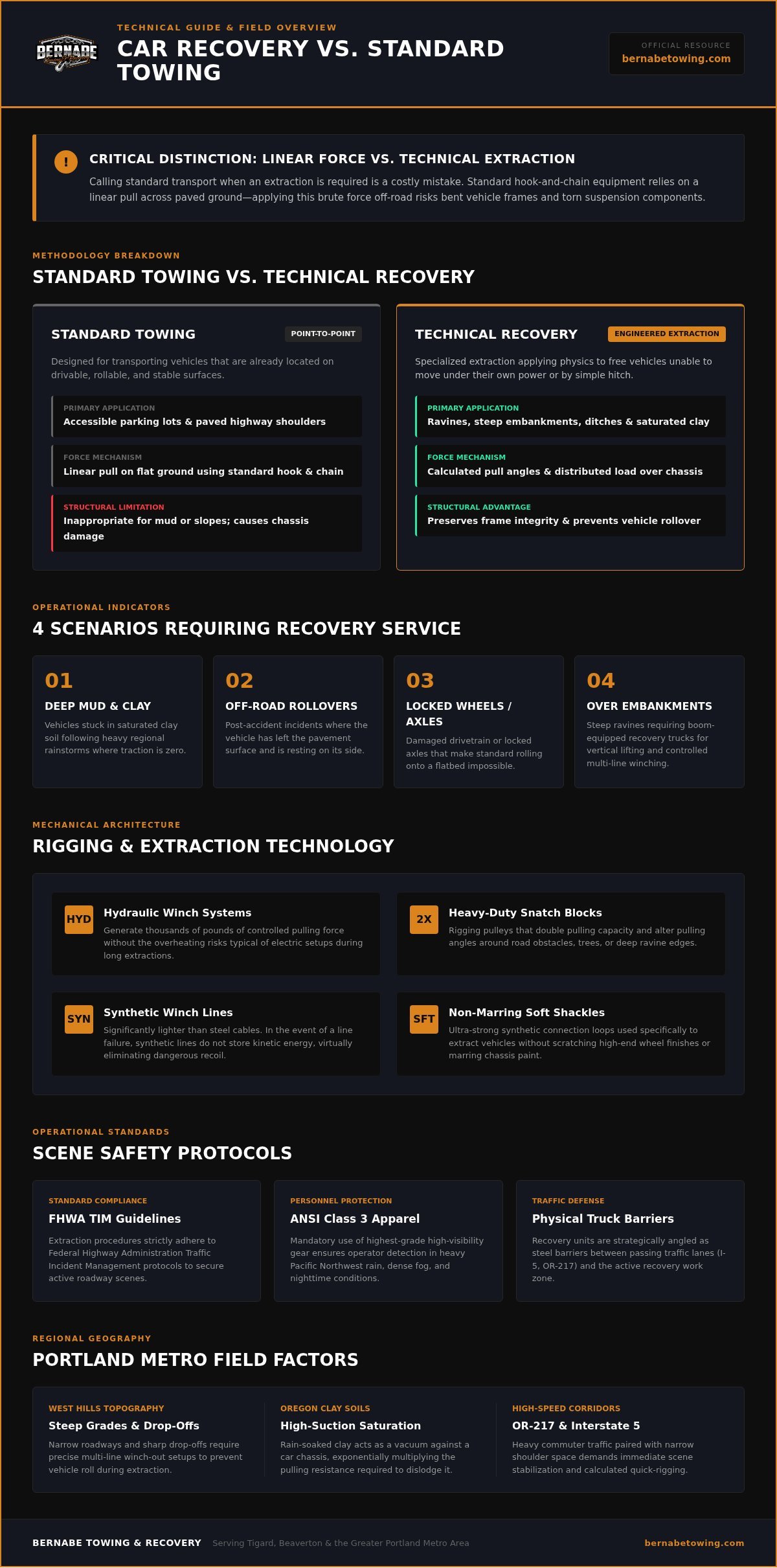
Many drivers assume that any tow truck can handle a vehicle that has slid off the road. This misconception often leads to avoidable frame or suspension damage. Standard towing is fundamentally different from recovery. A standard tow involves transporting a vehicle that is already on a drivable, rollable surface. It’s a point-to-point transport service for cars that have experienced a mechanical failure but remain accessible. If your car is in a parking lot or sitting on the shoulder of Highway 217 with a dead battery, you need a tow. If your car is at the bottom of a ditch in the West Hills, you need a specialized car recovery service.
The distinction matters because of how force is applied to your vehicle. A standard hook-and-chain approach is designed for a linear pull on a flat surface. When this method is used to yank a car out of mud or up a steep embankment, it can easily bend the frame or tear through suspension components. Professional recovery requires an understanding of resistance and load distribution. It’s a technical operation that prioritizes the structural integrity of your vehicle over brute force. Before calling any roadside service, it’s worth understanding the common myths surrounding local towing and recovery that can lead drivers to make costly decisions in an emergency.
The Definition of Technical Recovery
Car recovery is the specialized extraction of a vehicle from a position where it cannot be moved under its own power or by a simple tow hitch. This process relies heavily on the principles of physics to ensure a safe transition back to the roadway. Operators must calculate specific pull angles to minimize resistance and prevent the car from rolling or flipping during the move. By utilizing various vehicle recovery and extraction methods, experts can distribute the weight of the vehicle across multiple points. This technical rigging ensures that the winch does the work without putting undue stress on a single part of the car’s chassis.
When Do You Specifically Need a Recovery Service?
You’ll need a car recovery service whenever your vehicle’s wheels are no longer on a stable, paved surface. This includes several common scenarios in the Tigard and Beaverton area:
- Vehicles stuck in deep mud or saturated clay after a heavy Oregon rainstorm.
- Post-accident situations where the vehicle has left the roadway or is resting on its side.
- Scenarios where the wheels are locked or the axle is damaged, making a standard roll-up impossible.
- Over-the-embankment incidents that require specialized boom equipment to lift the vehicle vertically.
Attempting to “gun it” or having a friend pull you out with a strap often makes the situation worse. Professional recovery teams use hydraulic winches and snatch blocks to provide a controlled, steady pull that protects your investment.
The Technical Process: Specialized Equipment and Rigging
Professional recovery isn’t just about pulling; it’s about the application of controlled force. A car recovery service relies on hydraulic winches that generate thousands of pounds of tension. These systems offer consistent power without the risk of overheating during long, difficult extractions. Operators categorize these tasks into levels based on complexity. A basic winch-out might involve a single line pull, but a complex recovery often requires multiple trucks and coordinated rigging to stabilize a vehicle on a steep slope.
To manage this immense power, experts use snatch blocks. These heavy-duty pulleys double the pulling capacity while allowing the operator to change the angle of the pull. This is essential when a car is stuck behind an obstacle or deep in a ravine. Scene management is just as important as the rigging itself. Operators follow Federal Highway Administration TIM guidelines to ensure the safety of both the crew and passing motorists. This includes wearing ANSI Class 3 high-visibility apparel and using the recovery truck as a physical barrier against traffic flow.
Winch-Out Equipment and Capabilities
Modern recovery often utilizes synthetic winch lines instead of traditional steel cables. Synthetic lines are significantly lighter and safer for the operator. If a line snaps, it doesn’t store the same kinetic energy as steel, which practically eliminates catastrophic recoil. To keep the recovery truck stationary on soft Oregon soil, operators use specialized anchor points. For luxury vehicles or those with high-end wheel finishes, we use soft shackles. These synthetic loops provide immense strength without scratching or marring the rims during the extraction process.
Flatbed Recovery for Damaged Vehicles
After the initial extraction, choosing the right transport method is critical. Flatbed trucks are the safest option for accident recovery, especially for All-Wheel Drive (AWD) and 4WD vehicles. Towing these with wheels on the ground can destroy the drivetrain. If a vehicle has a seized transmission or wheels that won’t turn, we use skates or dollies to slide the car onto the bed. It’s a game of precision. The operator must tilt and slide the bed with accuracy to avoid undercarriage damage. If you’re facing a complex extraction in the Portland area, contacting a professional recovery specialist ensures the job is done right the first time.
Common Recovery Scenarios in the Portland Metro Area
Portland’s geography presents unique challenges that require more than a basic tow. Saturated soil and steep inclines mean a car recovery service must account for environmental variables that change by the hour. On corridors like Highway 217 or I-5, the combination of high speed traffic and narrow shoulders creates a high pressure environment where speed and safety are equally critical. Our team focuses on resolving these incidents quickly to restore traffic flow while protecting your vehicle’s undercarriage from the abrasive Pacific Northwest terrain.
Lowered vehicles and sports cars with minimal ground clearance require even more specialized care. Standard recovery methods can easily crack a front air dam or scrape a low-hanging oil pan. We utilize low-profile ramps, specialized wood blocking, and soft rigging to ensure these vehicles are extracted without a single scratch. Whether your car is high-centered on a curb in Beaverton or buried in a soft shoulder near Tigard, we adapt our approach to the specific clearance and weight distribution of your vehicle.
Off-Road and Ditch Extractions
The “Oregon Mud” factor is a significant hurdle during off-road extractions. Saturated clay-heavy soil creates a suction effect around tires that can triple the effective weight of your vehicle. Spinning your tires in an attempt to escape only deepens the mire and increases this suction. A technician first assesses the slope and soil stability before setting any rigging. We calculate the necessary pull force to break this suction without snapping components. For a detailed look at the extraction process, read our Car Recovery After Accident: A Step-by-Step Guide to Vehicle Extraction.
Accident Scene Management
Effective recovery involves more than just moving a car; it requires total scene management. We coordinate closely with local law enforcement in Tigard and Beaverton to secure the area before beginning the car recovery service. Following FHWA Traffic Incident Management guidelines, we prioritize clear communication and visible safety barriers. This process includes clearing crash debris like glass and plastic from the roadway to prevent secondary accidents for other commuters. You can learn more about the logistics of post-crash care in our Accident Recovery Guide: What Happens to Your Vehicle After a Crash. Our goal is to move the vehicle safely and leave the roadway in a condition that is safe for the community.
Logistics and Safety: Managing the Scene and Insurance
Safety starts the second your vehicle comes to a halt. If you’re stranded on a high speed corridor like I-5 or OR-217, your first priority is visibility. Switch on your hazard lights immediately and, if it’s safe to do so, deploy road flares or reflective triangles behind your vehicle. Oregon’s “Move Over” law (ORS 811.147) is designed to protect you; it requires approaching drivers to move to a non-adjacent lane or reduce their speed by at least 5 mph below the limit. Don’t stay in the vehicle if it’s positioned in a live travel lane. Move to a safe distance behind a guardrail or up an embankment while you wait for your car recovery service to arrive.
While waiting, use your phone to document the scene. Take photos of the vehicle’s position, the terrain, and any visible damage from multiple angles. These images are vital for insurance claims, as they provide proof of the “recovery” conditions that justify higher labor rates compared to a standard tow. Most auto policies include “Towing and Storage” coverage, but the technical nature of an extraction often falls under the collision portion of your policy. Clear documentation ensures your adjuster understands why specialized rigging was necessary.
What to Tell Your Recovery Dispatcher
Precision in communication leads to precision in extraction. When you call for help, provide specific location details using landmarks like the Washington Square Mall or specific mile markers. You must also describe the vehicle’s condition in detail. Tell the dispatcher if the wheels are straight, if the vehicle is stuck in gear, or if you notice any fluids leaking. Accessibility is the final piece of the puzzle. A vehicle stuck in a tight parking garage in downtown Beaverton requires different equipment than one flipped in a wide-open field. Providing these details helps us arrive with the right tools for a quick and safe recovery.
Insurance and Documentation
It’s important to understand the difference between roadside assistance clubs and private recovery specialists. Most clubs are designed for basic services like jump starts or flat tires and may not cover the full cost of a complex winch-out. When you hire a private car recovery service, you’re paying for technical expertise and specialized equipment. Always request an itemized receipt that breaks down “recovery labor” separately from the “towing” fee. This transparency helps with insurance subrogation and ensures you aren’t left paying out of pocket for necessary safety steps. For a real-world look at how we handle these logistics, see our Accident Recovery Tigard Oregon: Professional Vehicle Extraction Case Study.
Bernabe Towing & Recovery: Professional Extraction in Oregon
Bernabe Towing & Recovery operates as the dependable local expert for the Portland Westside. We specialize in light-duty cars, pickup trucks, and SUVs, ensuring every extraction is handled with professional precision. When you require a car recovery service, you aren’t just hiring a truck; you’re securing a seasoned professional who understands the structural vulnerabilities of modern vehicles. Our commitment to damage-free recovery means we utilize soft shackles and mathematically calculated pull points to protect your frame and suspension integrity. We focus on light-duty needs to ensure our equipment is perfectly suited for the task at hand.
Serving the Portland Westside
Our primary service footprint spans across Multnomah, Washington, and Clackamas Counties. We maintain a consistent presence in Tigard, Beaverton, Tualatin, and King City to ensure rapid response times. This proximity allows for efficient dispatch protocols, especially during peak commute hours on the Sunset Highway, OR-217, or I-5. Our technicians possess deep familiarity with local geography, ranging from the winding corridors of the West Hills to the rural stretches of Sherwood and Wilsonville. We navigate these areas with the specific equipment needed for the terrain, whether it is saturated clay or a steep ravine.
We understand the unique challenges of the Pacific Northwest environment and provide a range of specialized solutions:
- Accident recovery on high-speed metro corridors.
- Off-road winch-outs in saturated clay and mud.
- Emergency towing for disabled light-duty vehicles.
- Tire changes and lockout assistance in emergency situations.
Call Bernabe for Immediate Recovery
Emergency situations don’t follow a schedule, so our team remains on standby 24/7. We bring a sense of professional composure to every scene, helping to lower your stress levels while we secure your vehicle. Our “ready-to-act” attitude ensures that we prioritize your safety and the integrity of your car above all else. We don’t attempt to be bold innovators or casual friends; we position ourselves as high-utility partners dedicated to the well-being of our community. This grounded approach suggests a consistent and trustworthy fixture within the neighborhoods we serve.
Every technician is trained to handle complex extractions with a no-nonsense approach. We arrive fully equipped to manage the scene, coordinate with local law enforcement if necessary, and execute the recovery without causing secondary damage. If you’re stranded or involved in a crash, you need a partner who is efficient, reliable, and deeply committed to local service. Contact Bernabe Towing & Recovery for professional car recovery service today for immediate assistance.
Restore Your Peace of Mind with Professional Extraction
Navigating a vehicle extraction requires more than just a heavy truck; it demands technical proficiency and a deep understanding of mechanical resistance. As you’ve learned, the distinction between a standard tow and a car recovery service is vital for protecting your vehicle’s frame and ensuring the safety of everyone on the road. By prioritizing specialized rigging and following strict scene management protocols, you can avoid the costly mistakes associated with improper extraction methods.
Bernabe Towing & Recovery is locally owned and operated in Tigard, providing the Portland Westside with a dependable expert presence. We utilize specialized equipment designed specifically for light-duty vehicle recovery, ensuring that your car or SUV is handled with the care it deserves. Our team remains on standby with 24/7 emergency dispatch to respond whenever a crisis occurs on our local highways. You don’t have to face a dangerous roadside situation alone. Get Professional Car Recovery Service Now and let our seasoned technicians handle the heavy lifting. We are ready to help you get back on track safely and efficiently.
Frequently Asked Questions
How much does a car recovery service typically cost?
Pricing for vehicle extraction is determined by the complexity of the rigging, the distance the vehicle is from a paved surface, and the total time required on-scene. Unlike a standard tow, recovery involves technical labor and specialized equipment like snatch blocks or hydraulic winches. Factors such as vehicle weight, soil saturation, and the angle of the slope will influence the final rate. It’s best to consult your insurance provider to see if these professional fees are covered.
Is vehicle recovery covered by my standard car insurance?
Most collision or comprehensive insurance policies cover the costs of a car recovery service if the vehicle is disabled due to an accident or environmental hazard. This coverage is often separate from basic roadside assistance memberships, which typically have low limits for winching operations. You should check your policy’s “collision” or “towing and storage” sections to confirm that technical extractions from ditches or embankments are included in your benefits.
Can a recovery service get my car out of a parking garage?
Yes, we utilize specialized low-clearance wheel-lift trucks and dollies designed for tight urban structures like parking garages in downtown Beaverton or Portland. Standard flatbeds are often too tall to navigate these facilities, so we deploy equipment that can operate under low ceilings. This allows us to safely extract your vehicle from a stall without the risk of roof damage or scraping against concrete support pillars or low-hanging pipes.
What is the difference between a winch-out and a recovery?
A winch-out is a straightforward procedure where a vehicle is pulled a short distance from a minor obstruction, such as a soft shoulder or shallow mud, back onto the pavement. A recovery is a technical rigging operation for vehicles that are overturned, submerged, or significantly off the roadway. Recoveries require advanced physics calculations and specialized equipment to safely return the car to a drivable surface without causing structural or chassis compromise. Many stranded drivers are surprised to learn how much separates these two services, and reviewing the myths vs. reality of local towing and recovery can help clarify which service your situation actually requires.
Will my car be damaged during the recovery process?
Professional operators prioritize damage-free extraction by utilizing soft shackles and identifying specific anchor points on the vehicle’s chassis. We avoid hooking onto suspension components or body panels that could bend under the immense tension of a hydraulic winch. By calculating the correct pull angles and using snatch blocks to distribute force, we ensure your car’s frame remains straight. Selecting a car recovery service with specialized light-duty experience is the best way to prevent secondary damage.
How long does it take for a recovery truck to arrive in Tigard or Beaverton?
We maintain rapid response protocols for the Portland Westside, reaching most callers in the Tigard and Beaverton areas within 30 to 45 minutes. Our central location near major corridors like Highway 217 and I-5 allows us to bypass heavy congestion more efficiently than long-distance providers. We provide real-time updates during the dispatch process so you know exactly when our technicians will arrive to secure your vehicle and manage the scene safety.
Do I need to be with the vehicle during the recovery?
It’s generally safer and more efficient if you are present to provide keys and sign necessary documentation, but we can accommodate situations where you must leave. If you are transported for medical reasons or safety, you can coordinate with our dispatcher to leave the keys in a secure location. We document the condition of the vehicle before and after the extraction to ensure total transparency throughout the process for you and your insurance adjuster.
What happens if my car cannot be driven after it is recovered?
If your vehicle is undrivable due to collision damage or mechanical failure, we will transition directly from recovery to a standard towing service. We can transport the car to a local repair shop, your home, or a secure storage facility in the Tualatin or Sherwood area. Our flatbed trucks utilize skates and dollies to safely load non-rolling vehicles, ensuring they are moved without causing further drivetrain wear or tire damage during the transport.