Bernabe Towing & Recovery
Most drivers assume that any tow truck can handle a post-crash scene, but professional car recovery after accident is actually a technical extraction process designed to prevent secondary damage. The moments following a collision are overwhelming, especially when you’re pressured to clear the road quickly. You likely feel the stress of making split-second decisions while worrying about where your vehicle will end up. It’s a common fear that a rushed tow might cause more harm than the accident itself.
This guide provides the essential steps to manage your vehicle’s physical recovery safely, ensuring your car is handled with professional composure from the initial winch-out to its final destination. We’ll walk through how to navigate police-ordered tows in areas like Tigard and Beaverton, how to choose a recovery specialist who understands light-duty vehicle extractions, and the specific actions you can take to protect your car’s condition during transport. By the end of this article, you’ll have a clear plan to regain control of the situation and move your vehicle toward resolution.
Key Takeaways
- Prioritize safety and learn how to stabilize your vehicle to prevent mechanical damage before the recovery team arrives.
- Understand the technical difference between standard towing and specialized car recovery after accident, including how winch-out services handle complex extractions.
- Discover how to choose the right destination for your vehicle, whether it’s an insurance-approved shop or your own residence.
- Learn the best methods for documenting the scene and vehicle position to ensure a smooth insurance claim and prevent disputes over recovery damage.
- See why local expertise in the Portland metro area, including Tigard and Beaverton, is critical for a rapid and professional response.
Immediate Steps for Safety and Vehicle Protection
The moments following a collision are chaotic. Your priority must remain on personal and passenger safety before you even consider the state of your vehicle. Professional car recovery after accident begins with establishing a controlled environment. Once everyone is safe, focus on stabilizing the situation to prevent further mechanical or structural harm to your car or SUV.
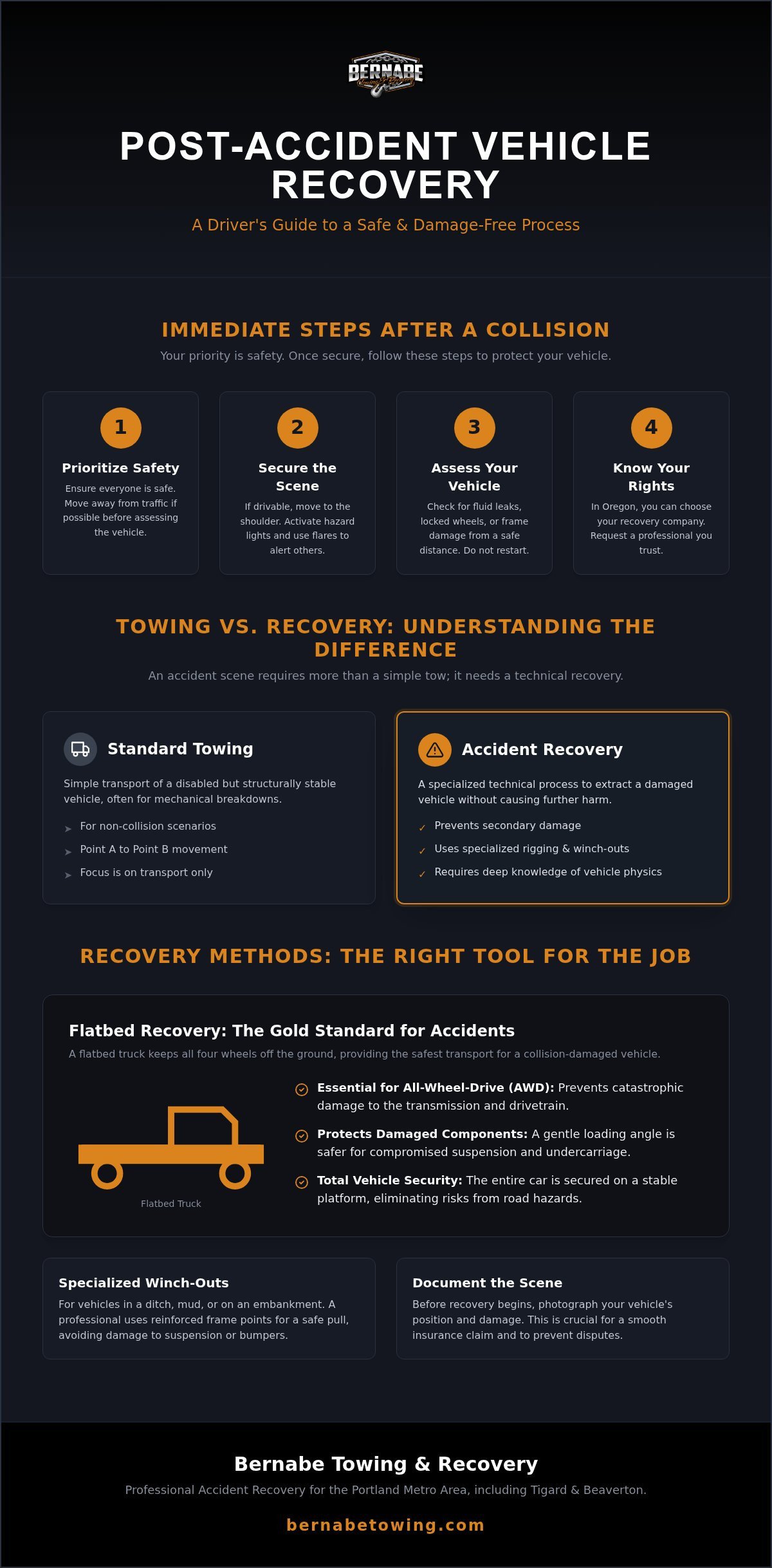
When emergency responders arrive, communicate your recovery preference clearly. Many drivers don’t realize that in Oregon, you have the legal right to choose your own recovery partner. You aren’t required to use a specific provider unless the police determine the vehicle is a “hazard tow” that must be cleared immediately by the next truck on the rotation. Requesting a dependable local expert ensures the extraction is handled with the proper equipment for your specific vehicle type, especially if you are in Tigard or Beaverton where traffic moves fast.
Securing the Accident Scene
If the car is drivable and it’s safe to do so, move it to the shoulder immediately to clear the travel lanes. Activate your hazard lights and use flares or reflective triangles to alert oncoming traffic, especially during low visibility or rain in the Portland metro area. Remaining inside the vehicle with your seatbelt fastened is often the safest choice on busy highways because the car’s frame provides a protective barrier against secondary collisions while you wait for professional assistance.
Initial Vehicle Assessment
Before the recovery team arrives, perform a quick visual check from a safe distance. Look for the following indicators of vehicle distress:
- Fluid leaks: Check for oil, coolant, or fuel pooling under the car; these pose significant fire risks and environmental hazards.
- Mechanical blockages: Identify if any wheels are locked or if the vehicle frame is dragging on the pavement.
- Structural damage: Note if the bumpers or body panels are pinned against the tires.
You should avoid attempting to restart a vehicle with visible engine compartment damage, as this can cause permanent electrical or mechanical failure. Providing these details to your car recovery after accident specialist allows them to arrive prepared with the right tools, such as dollies or specific winch-out gear, for a damage-free extraction. This proactive communication helps the recovery team work efficiently to clear the scene and protect your investment.
Understanding the Technical Car Recovery Process
While a standard tow involves moving a functional vehicle from one parking spot to another, car recovery after accident is a complex technical operation. It requires specialized rigging and a deep understanding of vehicle physics to move a damaged car without causing further structural issues. The process focuses on extraction and stabilization rather than just transport. When a vehicle is compromised by a collision, its structural integrity is no longer guaranteed, making the method of movement critical to preventing total loss. Understanding the full scope of what a professional car recovery service involves can help you make better decisions at the scene.
Professional recovery teams prioritize the preservation of the vehicle’s remaining mechanical systems. This involves calculating the proper angles for a pull and selecting the right equipment for the specific damage profile. Whether the car is sitting on its frame or has a wheel sheared off, the technical approach must be methodical to ensure a successful resolution. Many drivers are surprised to learn how much misinformation exists about this process, and reviewing the common local towing and recovery myths vs. reality can help you avoid costly assumptions before the recovery team arrives.
Winch-Out and Extraction Techniques
A winch-out service becomes necessary when a vehicle has left the roadway and is stuck in a ditch, mud, or on an embankment. These scenarios require more than a simple hook and chain. Recovery specialists locate specific reinforced recovery points on the vehicle frame to ensure a safe pull. Attaching cables to a suspension component or a bumper can lead to catastrophic failure and expensive secondary damage. For lowered or modified cars, the team uses specialized ramps and wooden blocks to adjust the approach angle, ensuring the undercarriage clears the terrain during the extraction. If your vehicle is in a precarious position, choosing a recovery specialist with winch-out expertise ensures the extraction process doesn’t add to your repair bill.
Flatbed vs. Wheel-Lift Recovery
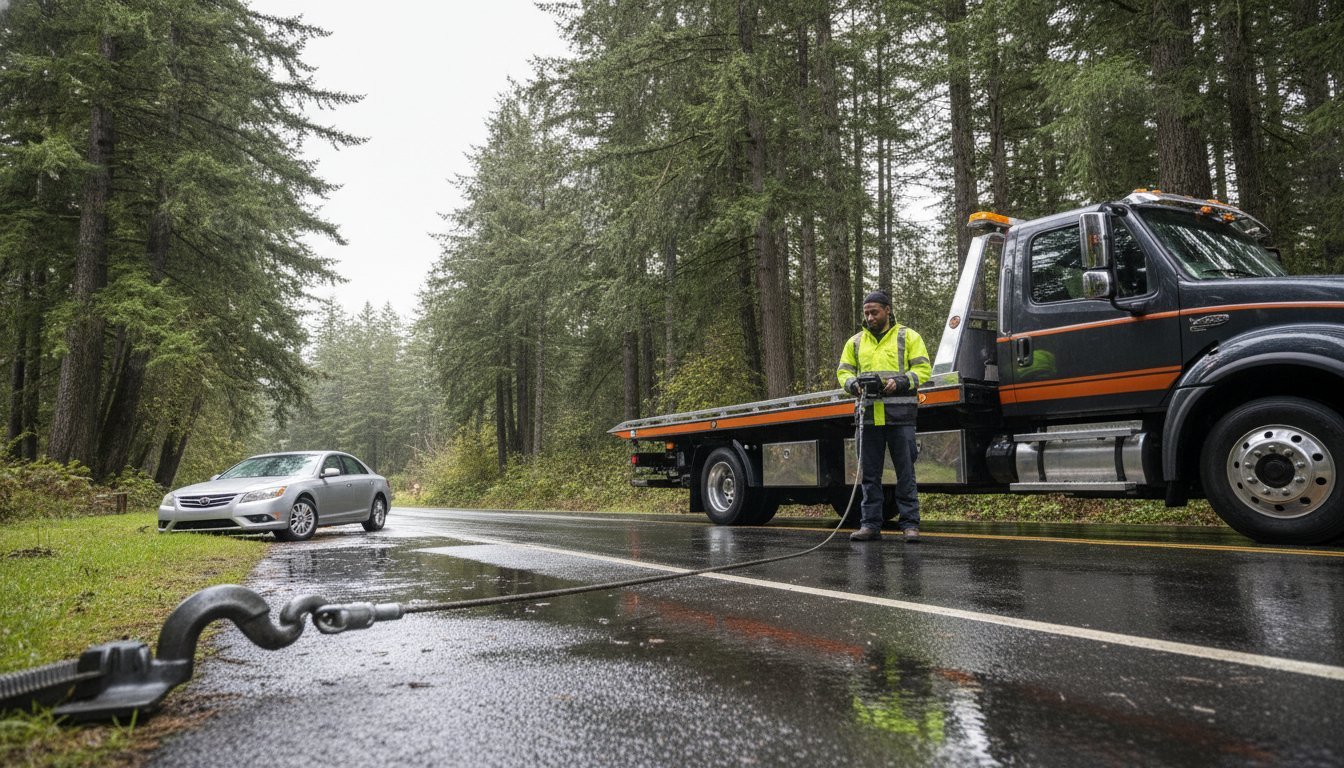
Flatbed trucks are the industry standard for post-accident transport because they keep all four wheels off the ground. This is vital for all-wheel-drive (AWD) systems. Dragging even two wheels of an AWD vehicle can destroy the center differential and transmission. A flatbed’s hydraulic tilt tray allows the vehicle to be pulled up at a gentle angle, which is much safer for the suspension than a traditional wheel-lift tow.
When dealing with car recovery after accident involving deployed airbags or locked brakes, flatbeds provide the necessary stability. If the wheels cannot roll, the recovery team uses “skates” or “dollies” to slide the vehicle onto the flatbed deck without grinding the tires or drivetrain components. Once the car is on the deck, it’s secured using soft tire straps instead of metal chains. This method prevents further alignment issues and protects the wheels from cosmetic damage during transit to a repair facility in Tigard or Beaverton.
Managing Vehicle Logistics: Where Does the Car Go?
Deciding where to send your vehicle is a critical step in the car recovery after accident process. You generally have three choices: a certified repair shop, an insurance-designated salvage yard, or your own residence. If the vehicle is a total loss, the insurance company will likely move it to a salvage yard for processing. However, if the car is repairable, taking it directly to a collision center in the Portland metro area is the most logical step to begin the restoration process.
Police-ordered tows operate under different rules than private requests. If your car is blocking a major thoroughfare in Tigard or Beaverton, the police may call the next available truck on their rotation to clear the scene immediately. In these cases, the vehicle is usually taken to the towing company’s secure storage lot. You still retain the right to move the vehicle to your preferred shop later, but you will be responsible for the initial tow and any storage fees that accrue. Understanding these destination rules helps you stay in control of your vehicle’s journey.
Storage Lots and Daily Accruals
Secure storage facilities provide a safe place for your vehicle when repair shops are closed. These lots charge daily fees that start the moment the car enters the gate. To keep costs low, contact your insurance company immediately to schedule an inspection. You will need to sign release forms, which are formal authorizations that allow a secondary tow service to move the car from the storage lot to its final destination. Providing these forms quickly prevents unnecessary daily charges from piling up.
Direct Transport to Repair Facilities
Choosing to tow directly to a collision center saves time and money. This approach avoids the “double-towing” scenario where you pay for two separate transport services. Before the truck leaves the scene, verify that your chosen shop can accept the vehicle, especially during late-night hours. Many reputable shops in Beaverton and Tigard have designated drop-off zones for car recovery after accident specialists. This coordination often allows for direct-billing to your insurance provider, reducing your immediate financial burden and moving you closer to a resolution.
Documenting the Scene for Insurance and Recovery
Documentation is your best defense against insurance complications and disputes over vehicle damage. Before the car recovery after accident moves into the extraction phase, you must record the scene as it exists. This ensures that any damage caused by the collision is clearly separated from damage that could occur during an improper tow. Insurance adjusters rely on this evidence to determine the sequence of events and the extent of the liability.
You should also record the recovery company’s name, the truck number, and the operator’s name. Professional teams in Tigard and Beaverton will provide this information readily. Keeping a detailed log of all roadside assistance and recovery expenses is equally important. Most insurance policies cover these costs, but you’ll need precise records to ensure full reimbursement for the specialized extraction services required.
Photographic Evidence Checklist
Visual proof is the most reliable way to communicate the state of the scene to your insurance provider. Use your phone to capture the following images before the recovery specialist begins their work:
- Wide shots: Capture the road conditions, traffic signs, and the vehicle’s position relative to the lane markings.
- Four-corner close-ups: Take photos of all four corners of the car to document existing body damage and tire condition.
- Undercarriage shots: If the vehicle is being winched out of a ditch, photograph the underside to show the suspension and frame before any tension is applied.
These images provide a baseline for the vehicle’s condition. If you notice new scratches or mechanical issues after the transport, these photos serve as your primary evidence for a secondary claim.
The Recovery Receipt and Paperwork
The “bill of lading” is a legal document that reflects the car’s condition at the time of pickup. You must review this document carefully to ensure it accurately describes the damage you observed during your initial assessment. You should never sign a blank authorization form at the scene. Signing an incomplete form can leave you vulnerable to unauthorized charges or destination changes that you didn’t approve.
Managing the paperwork correctly is just the beginning of the claims process. For a deeper look at the long-term steps, read our Accident Recovery Guide to learn what happens to your vehicle in the days following a crash. If you need immediate assistance with a professional extraction, contact Bernabe Towing & Recovery for a reliable, no-nonsense response to your scene. Our team focuses on accurate documentation and damage-free transport to help you move toward a resolution as quickly as possible.
Professional Accident Recovery in the Portland Metro Area
When you require car recovery after accident, every minute spent waiting on the shoulder increases the risk of a secondary collision. National roadside providers often lack the local situational awareness needed to navigate the unique traffic patterns of the Portland metro area. Choosing a local expert ensures that the recovery team understands the fastest routes to reach you, regardless of the time or traffic conditions on I-5 or Highway 217. This immediate reliability is essential for clearing the scene and reducing the stress of an emergency situation.
Our service area extends across the region, providing specialized support to drivers in Portland, Tualatin, and Hillsboro. We focus exclusively on light-duty vehicles like cars, SUVs, and light trucks. This specialization allows us to maintain the precise equipment needed for delicate extractions without the bulk of heavy-duty wreckers that can’t maneuver easily in tight residential or congested urban spaces. We prioritize a steady, professional presence to lower your stress and resolve the situation with technical proficiency. Drivers who want to understand the full scope of what professional car recovery service techniques and vehicle extraction safety entail will find that specialized local knowledge makes a significant difference in outcomes.
Rapid Response for Tigard and Beaverton
Local expertise is the foundation of a successful recovery process. Our team knows the highway bypasses and side streets in Tigard and Beaverton, allowing us to circumvent gridlock and reach accident scenes faster than out-of-area providers. We maintain professional relationships with local law enforcement to ensure seamless scene clearance. This coordination helps minimize road closures and ensures your vehicle is moved to a safe location as quickly as possible. For a look at our process in action, you can review our case study on Accident Recovery Tigard Oregon.
Bernabe Towing: Your Dependable Local Expert
At Bernabe Towing & Recovery, we approach every scene with a ready-to-act attitude. We’re committed to damage-free car recovery after accident for all light-duty vehicles. This means we never take shortcuts during the loading or securing process. We offer transparent pricing and maintain direct communication with you throughout the extraction, so you’re never left wondering about the status of your car or its final destination. While we don’t offer mechanical repairs, we excel at the technical extraction and transport needed to get your car to a repair facility safely.
If you’re currently dealing with a collision, you need a partner who can manage the physical recovery with composure. It’s vital to have a specialist on standby who can respond when every minute counts. You can Contact Bernabe Towing & Recovery for immediate accident support. We’ll handle the logistics and the heavy lifting, allowing you to focus on your own well-being and the next steps of your insurance claim.
Take Control of Your Vehicle’s Recovery
Managing a post-collision scene requires a methodical approach that prioritizes safety and technical precision. By stabilizing the area, documenting the damage, and choosing a specialist with specialized accident recovery equipment, you protect your vehicle from secondary harm. You now understand how critical it is to select the right destination for your car and how to navigate the logistics of insurance and storage fees. Professional car recovery after accident is more than a simple tow; it’s a controlled extraction that preserves the structural integrity of your light-duty vehicle.
Bernabe Towing & Recovery is your dependable local expert, standing by with a 24/7 emergency response for drivers in Portland, Tigard, and Beaverton. We handle the technical details of winch-outs and flatbed transport so you don’t have to manage the stress alone. Our team is ready to act with the professional composure you need during a crisis. Get Professional Accident Recovery Now and move forward with the confidence that your vehicle is in expert hands.
Frequently Asked Questions
Can I choose which towing company recovers my car after an accident?
You generally have the legal right to choose your preferred recovery partner in Oregon. However, if your vehicle is blocking a major highway in Portland or Tigard and creating an immediate safety hazard, law enforcement may call the next available truck on their rotation to clear the road. If the situation isn’t an emergency, you can request a specific local expert to manage the scene. This ensures your vehicle is handled by a team you trust.
What is the difference between towing and accident recovery?
Standard towing involves transporting a functional or broken-down vehicle from one point to another. Accident recovery is a more technical process that involves extracting a damaged vehicle from a crash site, often using winches or specialized rigging. Professional car recovery after accident focuses on preserving the vehicle’s structural integrity when it’s in a precarious position or has sustained significant mechanical damage. It requires specific expertise to move the car without causing secondary issues.
Will my insurance cover the cost of car recovery after an accident?
Most insurance policies with collision coverage or roadside assistance will reimburse you for recovery costs. You’ll need to provide a detailed bill of lading or receipt from the recovery team to file your claim. It’s a good idea to contact your insurance adjuster as soon as possible to confirm their specific billing procedures. Many local providers in the Portland metro area can coordinate with insurance companies to streamline the reimbursement process for you.
What happens if my car is towed to a police impound lot?
If your vehicle is taken to a police-ordered storage lot in Beaverton or Hillsboro, it will accrue daily storage fees until it’s released. You’ll need to visit the local police department to obtain a vehicle release form before the lot will let you move the car. Once you have the paperwork, you can arrange for a private recovery service to transport the vehicle to your home or a certified collision repair shop.
Do I need a winch-out service if my car is just off the shoulder?
You likely need a winch-out service if your wheels have lost traction in mud, grass, or on an embankment. Even if the car is just inches off the shoulder, trying to drive it back onto the pavement can cause frame damage or transmission strain. A professional recovery team uses a motorized winch and cable to pull the vehicle back onto the road surface at a controlled angle. This prevents the undercarriage from dragging and protects your tires.
How can I prevent further damage to my car during the recovery process?
Requesting a flatbed tow truck is the most effective way to prevent secondary damage to your car or SUV. Flatbeds ensure that all four wheels remain off the ground, which is critical for protecting all-wheel-drive systems and transmissions. You should also ensure the recovery specialist uses designated frame points for any winching. Avoid using companies that attempt to pull a vehicle by its bumper or suspension components, as these parts aren’t designed to handle extraction tension.
What information should I give the recovery team when I call?
Provide your exact location, the make and model of your vehicle, and a brief description of the damage. Tell the operator if the wheels are locked, if the airbags deployed, or if the car is in a ditch. Mentioning specific landmarks or highway mile markers in areas like Tualatin or Sherwood helps the team reach you faster. This information allows the specialist to bring the correct equipment, such as dollies or specific winch-out gear, for your car recovery after accident.
Is 24/7 accident recovery available in Beaverton and Tigard?
Yes, professional recovery specialists provide emergency support throughout Beaverton, Tigard, and the surrounding Portland metro cities at any hour. Accidents don’t happen on a schedule, so local experts remain on standby to respond to late-night collisions or early-morning emergencies. This constant availability ensures that you’re never left stranded on a dangerous shoulder. Rapid response times are a priority for local teams who understand the traffic risks on Highway 217 and I-5 during off-hours.